
Recruiting is changing tremendously in the way it is being conducted nowadays. Organizations had been relying on human recruiters to handle all the recruitment processes, such as sourcing, screening CVs, and scheduling interviews.
It was a very manual process that was also time-consuming. However, today, when artificial intelligence has been introduced into the recruitment procedure, this picture has begun to change.
AI in HR is gaining relevance within contemporary HR departments, particularly in the GCC, where firms need to work within highly competitive and fast-paced business environments.
According to many HR leaders, the conventional recruitment procedures can no longer keep up with the pace and magnitude that is demanded in the world today.
They demand smarter tools that help them in the optimization of their workflows without losing the personal touch that aids in successful hiring.
AI recruitment agents assist in the provision of the very thing. They are smart digital assistants that help recruiters do their daily work and free them to concentrate on the things that matter, which are Human connection, Candidate experience and Strategic decision making.
The article assists you in making a serious examination of what AI recruitment agents are doing to the job of recruiters and why companies should consider these new approaches to recruitment technology.
Table of contents
- The Increasing Demand for Intelligent Recruitment Solutions in the GCC
- What Do AI Recruitment Agents Actually Do?
- How Do AI Recruitment Agents Elevate the Recruiter’s Role?
- Practical implications of AI in the recruitment process
- Top AI Recruitment Agents in GCC
- How Ensaan Technologies Helps Organizations with AI-Driven Recruitment?
- What is the Best Way to adopt AI Recruitment Agents?
- Recruitment Future in the GCC
- Conclusion
- Frequently Asked Questions
The Increasing Demand for Intelligent Recruitment Solutions in the GCC
The labour market in the Gulf Cooperation Council (GCC) countries has changed drastically over the last decade.
New industries such as financial technology, advanced manufacturing, renewable energy and digital services are not only being established but are also growing very fast.
Moreover, localization policies for the labor market, as well as the evolution of employee needs, have resulted in a shift in the business focus.
Consequently, HR departments nowadays are facing a huge number of employment applications from candidates who have a wide range of skills and at the same time, they are under pressure to make quick decisions to hire the right person.
Recruiters have never been under such an obligation to deal with huge candidate numbers and paperwork simultaneously.
They must go through hundreds of resumes just to fill one vacancy, and the situation can even be so out of control that the time allotted for other beneficial activities gets cut down.
As a result, many companies now find themselves challenging the old notion that hiring is only a personnel skill, while it is the use of advanced technology that makes the process efficient.
AI recruiting agents are the perfect solution in challenging times like these. On one side, they help to reduce the monotonous work of humans, and on the other, they can go through candidates’ information in a matter of seconds and thus assist human recruiters in making the best choice.
In the case of companies in the GCC, where the most important factors are speed, compliance and high performance, the introduction of AI is going to revolutionize the recruitment process by not only changing its appearance but also making it a more efficient one.
What Do AI Recruitment Agents Actually Do?
There is a common misconception that AI recruitment agents are designed to replace HR professionals. But in reality, they are created to increase their productivity and abilities.
Instead of spending hours on tasks like CV screening, scheduling interviews, or shortlisting applicants, recruiters can let AI agents complete these tasks quickly and accurately.
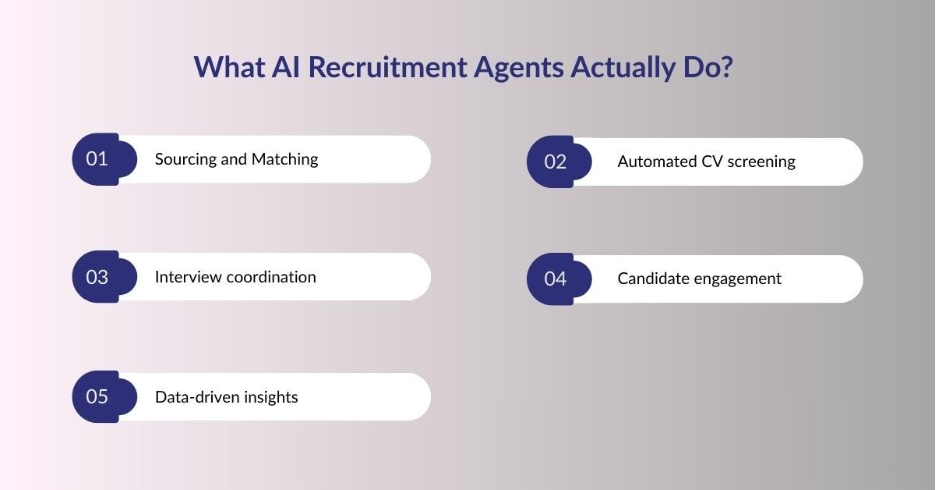
Here are some of the key functions these systems can perform:
1. Sourcing and matching
AI recruitment agents can scan multiple talent pools in a matter of seconds.
They can evaluate candidate profiles and identify the best matches based on skills, experience, certifications, and role requirements. This eliminates the time recruiters spend manually searching through job boards or databases.
2. Automated CV screening
One of the most time-consuming stages of recruitment is screening CVs. AI agents can scan and analyze hundreds of CVs instantly with a high level of accuracy.
They can highlight the most relevant candidates and filter out those who do not meet the criteria.
3. Interview coordination
Scheduling interviews usually involves multiple messages and confirmations.
AI systems can automate this entire process by coordinating times between candidates and hiring managers, reducing delays and helping them stay organized.
4. Candidate engagement
AI recruitment agents also communicate with candidates through chat or email to answer basic queries, provide updates, and share next steps.
This improves the candidate experience and keeps them engaged throughout the process.
5. Data-driven insights
Besides automation, AI solutions can generate valuable insights about hiring patterns, candidate quality, sourcing channels, and potential shortages in talent supply.
Recruiters can use this information and knowledge to plan better and support business goals more effectively.
These features significantly help to reduce the manual workload and assist recruiters in focusing on the parts of their job that require creativity, empathy, and human judgment.
How Do AI Recruitment Agents Elevate the Recruiter’s Role?
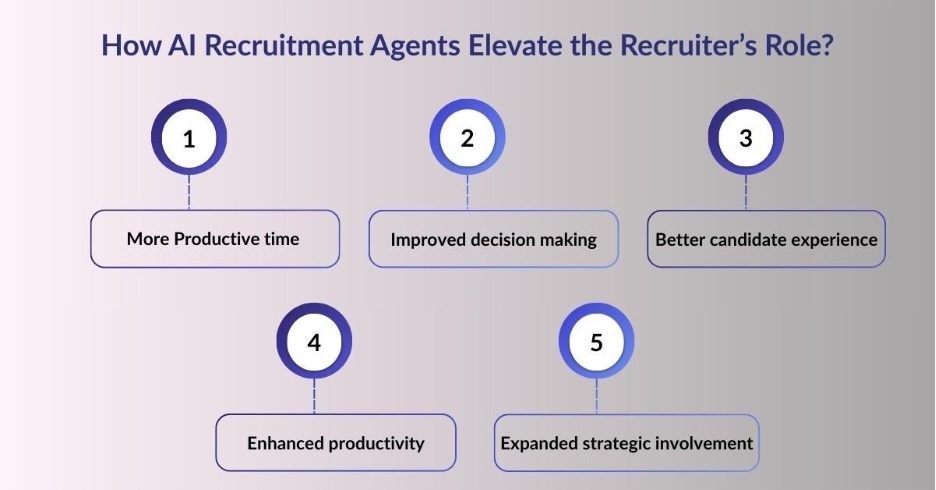
Recruiters often worry that AI might replace their positions. Yet the opposite is true. AI enhances their roles, transforms how they work, and increases their strategic value inside the organization.
1. More time for relationship building
The best recruiters know that strong relationships with candidates and hiring managers lead to better hiring outcomes.
When AI agents take over operational tasks, recruiters get more time to conduct meaningful conversations, understand personal motivations, and guide candidates through the journey.
2. Improved decision making
With AI-generated insights, recruiters can make more informed decisions. Instead of relying on instinct alone, they gain access to trend analysis, skill forecasting, and data-based recommendations. This creates stronger alignment with organizational goals.
3. Better candidate experience
AI helps maintain consistent communication with candidates. Recruiters can then focus on creating personalized interactions instead of repetitive administrative updates.
This leads to higher satisfaction and stronger employer branding.
4. Enhanced productivity
AI recruitment agents reduce workload and operational stress. Recruiters can manage more positions efficiently without feeling overwhelmed. This helps HR teams meet targets more consistently.
5. Expanded strategic involvement
As automation takes over repetitive tasks, recruiters gain the opportunity to engage in strategic initiatives such as workforce planning, employer branding, and talent development.
Their role becomes more influential and future focused.
The shift is clear. AI does not remove the importance of human recruiters. It redefines their responsibilities and empowers them to contribute more meaningfully to organizational success.
Practical implications of AI in the recruitment process
Even within the GCC, the positive outcomes of implementing AI in the recruitment process are already being observed in numerous medium and large sized organizations.
They have reduced time to hire, better shortlisting and enhanced candidate satisfaction.
These are particularly useful in highly competitive industries for specialized talent.
As an illustration, AI recruitment agents can save companies that hire large numbers of people, such as hospitality, retail, or customer service and time.
In the meantime, technical organizations like engineering or technology enjoy the advantage of a more exact match of skills, and thus, they can get good candidates more quickly.
The fairness of recruitment is also enhanced by AI. It makes decisions on candidates using the criteria and information and not subjects. This brings about a more open procedure, which is necessary in the modern multi-cultural workforce.
Top AI Recruitment Agents in GCC
1. Kore AI
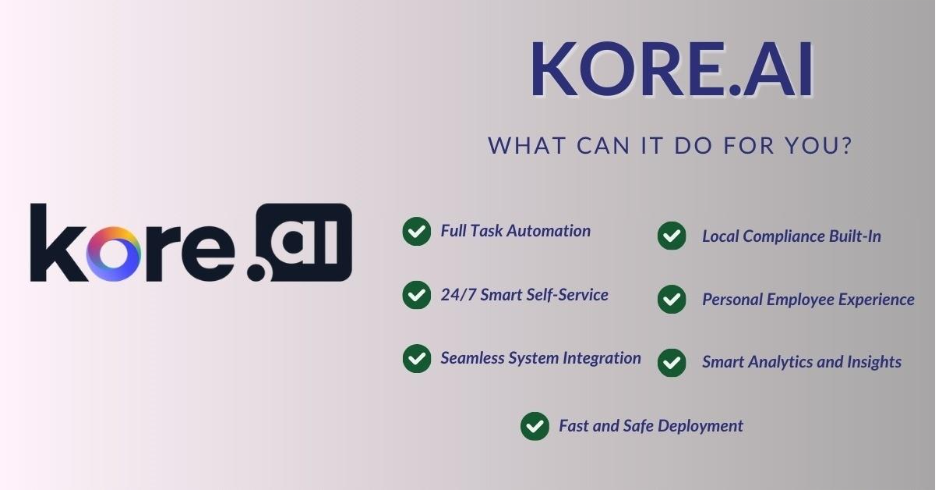
Recruitment AI is becoming a necessity in teams with a large number of applicants or teams functioning at various locations.
The Kore AI provided by Ensaan Technologies can assist in this change as it can assist organizations with making repetitive aspects of the hiring process more effective.
It is able to filter the profiles, rank candidates according to the needs of the job, and assist recruiters in connecting with the applicants on time, even during busy times of the year.
Pros
- Improved response times
Candidates are also able to communicate faster, and this reduces drop-off in competitive markets.
- Better shortlisting quality
Through analysis of the role criteria, behavioural cues, or skill patterns, the system aids in eliminating fatigue from manual review.
- Enhanced recruiter focus
Recruiters have additional time in interviews, alignment with stakeholders, and experience with the candidates.
Cons
- Requires thoughtful setup
The model works best when role requirements, selection criteria, and keywords are clearly defined.
- Human judgement still necessary
AI can highlight strong applicants but are not able to fully understand organizational culture or team chemistry.
How Ensaan Technologies Helps Organizations with AI-Driven Recruitment?
Ensaan Technologies has been involved in HR innovation in the GCC for a long period. We collaborate with world leaders in the field of technology to implement developed HR solutions to organizations in the regions.
Our goal is simple. To enable businesses to modernize their HR practices and build smarter, more effective, and more humanized recruiting practices.
Our recruitment solutions are based on AI and feature predictive analytics, intelligent candidate matching, automated CV screening, and conversational engagement tools.
These tools are compatible with the current HR settings and mirror the GCC talent market reality.
Ensaan Technologies has a unique offer in the form of an end-to-end approach. We do not just sell software. We assist organizations in terms of consultation, implementation, training, and continuous optimization.
We assist HR departments in knowing how to incorporate AI applications with human skills so that the recruitment process can be enhanced not only on an operational level but also at the strategic level.
Our solutions can design measurable improvements, whether an organization is in need of scaling its hiring, minimizing efforts on its time to hire, or enhancing the quality of its candidates.
What is the Best Way to adopt AI Recruitment Agents?
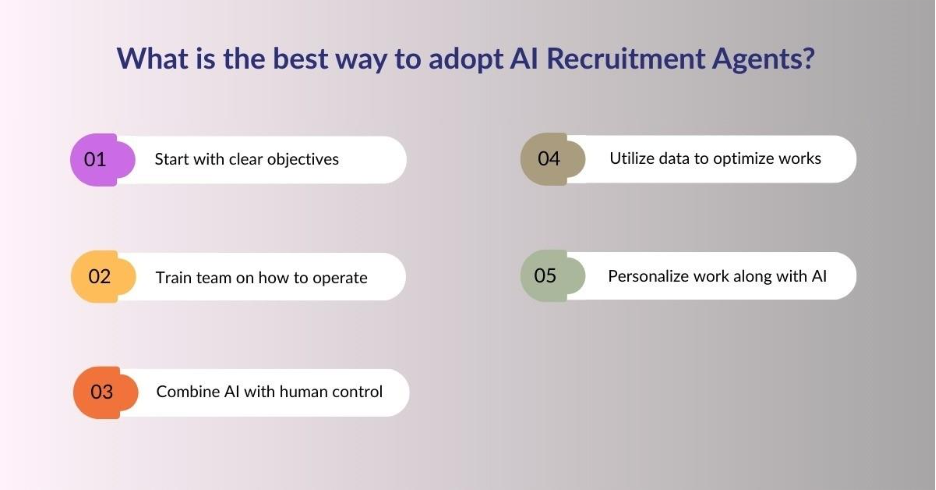
The implementation of AI in recruitment must be planned. Those companies that handle this transition attentively can have a more seamless adoption process and have improved outcomes.
The following are some of the best practices that have been suggested to businesses in the GCC.
- Start with clear objectives. Know what areas of recruitment should be improved.
- Train recruiters on how to operate comfortably with AI tools.
- Combine AI automation and human control to have a balance.
- Utilize data to optimize job descriptions, sourcing, and hiring plans.
- Focus on enhancing the candidate’s experience through both technology and personalized communication.
- With the right approach, AI becomes a powerful enabler rather than a complicated system.
Recruitment Future in the GCC
GCC is still spending heavily on digital transformation. One of the areas of transformation that can provide immediate value is recruitment.
AI recruitment agents will find their way into the arsenal of HR in every organization in the coming years.
Recruitment of talents will be more expedited, strategic, and business-oriented.
Recruiters will become talent advisors applying data, insights, and technology to make organizations successful.
Human recruiters will not be pushed out of their jobs as AI will go on replacing monotonous tasks with it, yet human recruiters will stay at the heart of hiring decisions.
This moderate solution is what will make recruitment in the region in the future.
Conclusion
Recruitment agents that are AI-based are changing the functions of recruiters in the GCC.
It improves the capability, lessens the workload and reinforces the entire recruitment process instead of substituting human expertise.
Early AI adoption provides organizations with a competitive advantage by enabling them to hire more quickly, engage their candidates in a more meaningful way and streamline their processes in a more efficient way.
Ensaan Technologies will help in this evolution. The AI-powered recruitment solutions enable HR teams to work smarter, ease the burden of operations, and provide hiring results that perfectly fit the business requirements.
The collaboration between recruiters and AI will be necessary as organizations keep expanding and changing.
It is not merely an upgradation of technology but a change of strategy towards a smarter and more human approach to recruitment.
Frequently Asked Questions
Yes. The current AI-based recruiting systems may handle applications in various languages that are popular in the area. English and Arabic are typically most supported.
No. AI assists recruiters in eliminating repetitive screening activities. Human judgment is still necessary.
With proper training, AI can identify keywords and experience about the local market. Recruiters must check cultural fit and regulatory compliance by hand.
AI tools rank candidates at a higher rate, handle communication and decrease the load during periods of intense hiring, like pre-Ramadan or pre-tourist season.
Costs vary based on scale. The adoption of AI by many GCC companies, such as SMEs and mid-sized companies, is in stages, which allows them to pay only for the features required.
Yes. AI-supported applications help track documents, reminders of document verification, and structured onboarding. This makes it easier to align with country-related labour laws.