
The recent changes in the Saudi Labor Law that formally became effective on February 19, 2025, represent the largest regulatory overhaul in the Kingdom’s employment sector in more than a decade.
As we move into 2026, these reforms have transitioned from “new rules” to the standard operating procedure for all businesses.
These changes are not merely administrative; they are a direct reflection of Saudi Vision 2030, which focuses on transforming the local economy into a global talent and investment force.
For companies, these updates signal a move toward a more flexible, open, and digital working environment.
To HR professionals and business owners, understanding these reforms is no longer optional.
As the Ministry of Human Resources and Social Development (MHRSD) shifts to real-time digital control, compliance is a non-negotiable precondition for operating.
The 2026 legislation is highly responsive to the modern labor market, establishing flexible work patterns, enhancing anti-discrimination protections, and streamlining the legal relationship between employer and employee.
By aligning with these updates, Saudi businesses can boost their market competitiveness and foster a culture of fairness and professional stability.
Table of contents
- Key Objectives Behind the 2025 Saudi Labor Law Reforms
- Changes in Employment Contracts and Modern Work Models
- Updates to Working Hours, Leave Policies, and Employee Rights
- Wage Protection System (WPS) and Payroll Compliance Updates
- Rules on Termination, Resignation, and End-of-Service Benefits
- Saudization (Nitaqat) Updates and Workforce Localization
- Employer Compliance Responsibilities in 2026
- Role of Digital HR and Payroll Systems in Legal Compliance
- Common Labor Law Compliance Mistakes to Avoid
- Conclusion
- FAQs
Key Objectives Behind the 2025 Saudi Labor Law Reforms
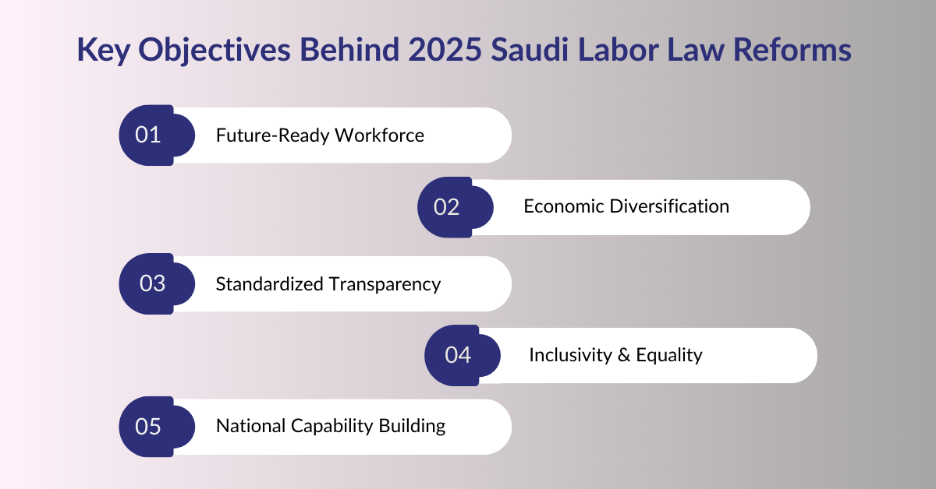
- Future-Ready Workforce: Designing an open labor environment that is both responsive to business needs and ensures high standards of worker safety.
- Economic Diversification: Change in regulations to attract international talent and keep high-growth sectors growing in the Kingdom.
- Standardized Transparency: Minimizing litigation by making probation, resignation, and contract renewals digitally defined and designed first.
- Inclusivity & Equality: Reinforce equal pay requirements and maternity leaves to considerably improve the rate of female representation in the labor market.
- National Capability Building: This is a requirement to put Saudi nationals through structured training to move the local workforce to a stage of high-skill and leadership roles.
Changes in Employment Contracts and Modern Work Models
The 2026 legal framework provides structural clarity to employment relationships, standardizing contract types and identifying modern work models.
- Fixed-Term Mandate for Expatriates: All non-Saudi contracts must be in written, fixed-term format. If no specific period is given, the contract is legally deemed a one-year fixed term from the start date, renewing automatically if work continues.
- 180-Day Probation Window: Employers now have the liberty to establish a probation period of up to 180 days (6 months). To be legally binding, this must be explicitly stated in the Qiwa electronic contract.
- Innovative Overtime Solutions: Companies can now offer paid compensatory leave instead of cash payments for overtime. This is calculated at 1.5 hours of leave for every 1 hour of overtime, subject to written employee agreement.
- Recognition of Flexible Work: The law formally safeguards remote, part-time, and seasonal work. These models enjoy the same fundamental rights and wage protections as conventional full-time positions.
Updates to Working Hours, Leave Policies, and Employee Rights
The 2026 labor environment prioritizes employee welfare, aligning Saudi Arabia with international best practices.
- Improved Maternity and Paternity Leave: Maternity leave is now 12 weeks on full pay (6 weeks of which are mandatory after delivery). Additionally, fathers are entitled to 3 days of paid paternity leave, to be taken within the first week of childbirth.
- Compassionate Leave Extensions: Funeral leave is extended to 3 days for the death of a sibling, recognizing a broader definition of family support. Marriage leave is standardized at 5 days.
- Housing and Transportation: Employers must either provide suitable accommodation and transport or offer a monetary allowance as part of the total remuneration package.
- Anti-Discrimination Protections: An explicit ban exists on all forms of discrimination regarding hiring, wages, or promotions based on gender, age, disability, or marital status.
Wage Protection System (WPS) and Payroll Compliance Updates
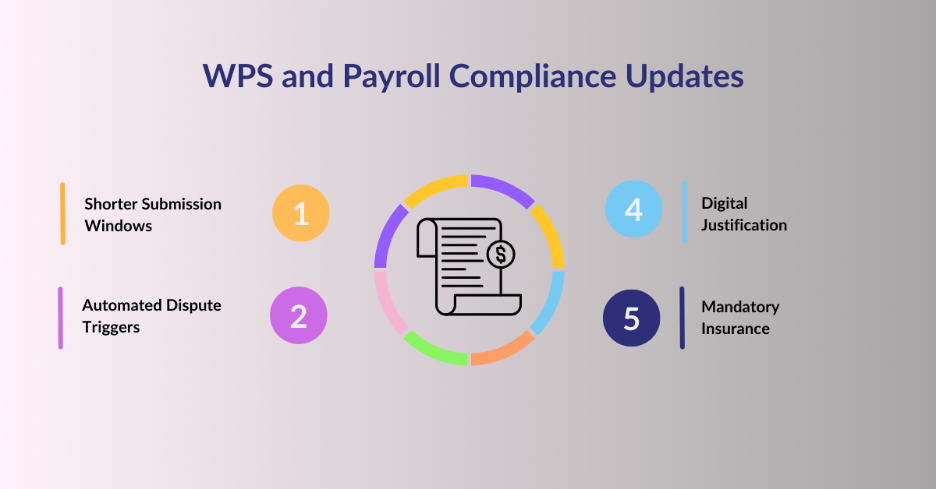
In 2026, the Wage Protection System (WPS) is no longer just a monitor; it is a real-time compliance engine integrated through the Mudad platform.
- Shorter Submission Windows: Employers must submit their Salary Information File (SIF) no later than 30 days after the salary payment date. Missing this window triggers an immediate red flag on government portals.
- Automated Dispute Triggers: If two consecutive monthly salary payments are missed, the system suspends the employer’s right to renew work permits or issue new visas. After three months of non-payment, employees can transfer to another employer without authorization.
- Digital Justification: Any deduction (e.g., unpaid leave) requires a digital justification via Mudad, which must be reviewed and accepted by the employee for complete transparency.
- Mandatory Insurance: Payroll compliance now strictly enforces compulsory health insurance and GOSI (Social Insurance) contributions simultaneously.
Rules on Termination, Resignation, and End-of-Service Benefits
The 2026 amendments provide a structured process for ending employment, finally formalizing the legal concept of “resignation.”
- Structured Resignation Process: Resignation is officially recognized as a voluntary written desire to end a contract. Employees submit their request through the Qiwa portal.
- Employer Response: Employers have 30 days to respond. If ignored, the resignation is automatically accepted.
- Withdrawal: Employees can withdraw a resignation within 7 days, provided it hasn’t been formally accepted.
- Termination Grounds: Article 74 now includes bankruptcy and permanent closure of the business as lawful reasons for termination.
- Notice Periods: For indefinite contracts, the notice period is 30 days for employees and 60 days for employers.
- End-of-Service Gratuity (ESG): The calculation remains standard, but settlement timelines are strict: one week if the employer terminates and two weeks if the employee resigns.
Saudization (Nitaqat) Updates and Workforce Localization
In 2026, the Nitaqat (Saudization) program is more sophisticated, using “Nitaqat Mutawar” logic that focuses on both quantity and quality of employment.
- Logarithmic Quotas: The system removes “jumps” between categories, providing a smoother compliance path as a company grows.
- Sector-Specific Targets: High-skill sectors like accounting and engineering have higher mandatory percentages and minimum wage requirements (SAR 6,000–8,000) for a Saudi national to count toward the quota.
- The “Premium” Zones: Maintaining Platinum or High Green status is essential for instant visa issuance. Falling into the Red Zone results in an immediate freeze on recruitment and permit renewals.
- Training Mandates: Employers must document formal training policies for Saudi staff to ensure long-term upskilling for leadership roles.
Employer Compliance Responsibilities in 2026
Compliance today is a continuous digital obligation. The MHRSD conducts electronic audits by monitoring data remotely through integrated platforms.
- Electronic Contract Documentation: Employers must ensure 100% of staff have digitally authenticated contracts on Qiwa. Unrecorded agreements are legally nonexistent.
- Workplace Safety (OHS): Strict adherence to safety guidelines, including free PPE and respecting the midday work ban (12 PM – 3 PM) during summer.
- Transparent Record Keeping: Digital records of hours, overtime, and leave must be maintained for at least 5 years.
- Internal Grievance Procedures: Companies must establish a documented internal appeal process before any dispute can be escalated to the Labor Office.
Role of Digital HR and Payroll Systems in Legal Compliance
Managing HR manually in 2026 is a significant business risk. Digital HCM systems have transitioned from “convenience tools” into essential compliance shields.
- Government Integration: Modern systems like those from Ensaan Tech offer direct API integration with Qiwa, Mudad, and GOSI, ensuring data is automatically synced and eliminating “red flags.”
- Automated Rule Application: Whether it’s the 180-day probation or the 1.5x overtime leave, digital systems have these rules built into their logic to prevent accidental violations.
- Proactive Expiry Management: Automated alerts for Iqama expiries and contract renewals allow HR to act before a breach occurs.
- Audit-Ready Reporting: Generating reports for an MHRSD inspection takes seconds, ensuring you are always “inspection-ready.”
Common Labor Law Compliance Mistakes to Avoid
- Failing to Update Contracts: Many firms still rely on old templates. In 2026, all contracts must be migrated to Qiwa to be legally valid.
- Incorrect Probation Documentation: Setting a 180-day probation without documenting it in the digital Qiwa contract defaults the legal probation period to zero.
- Missing WPS Deadlines: With the window strictly at 30 days, even a 24-hour delay can suspend Ministry services.
- Miscalculating ESG: Excluding mandatory allowances (like housing) from the gratuity calculation is illegal.
- Unauthorized Deductions: Deducting pay without following the 30-day internal appeal process is a major violation.
Conclusion
The 2026 landscape of the Saudi Labor Law is a testament to the Kingdom’s unwavering commitment to a modern, global employment environment.
These reforms have moved beyond simple legal updates to become the driving force of Saudi Vision 2030, establishing an economy based on transparency, fairness, and moral development.
For Saudi businesses, the path forward is clear: success in this new era requires a proactive strategy that centers on digitization.
The days of manual HR practices and paper-based compliance are officially over; in 2026, operational continuity depends on your ability to integrate with the Kingdom’s digital infrastructure.
At Ensaan Tech, we guide you into this new horizon with future-ready solutions specifically tailored for the Saudi market.
By using hybrid HR and payroll tools to automate compliance with Qiwa, Mudad, and GOSI, you do more than just eliminate the risk of heavy fines and service suspensions.
You create a robust, high-performance culture where employees feel protected and valued.
When a company prioritizes legal adherence and employee well-being through advanced technology, it transforms into an employer of choice that the top talent in the Kingdom would love to work for.
Let Ensaan Tech be your partner in navigating these regulations to build a more efficient, compliant, and prosperous future.
FAQs
180 days, if explicitly stated in the Qiwa digital contract.
Yes. Under Article 37, they default to one year if no duration is specified.
Yes, it is 12 weeks on full pay.
Yes, at a rate of 1.5 hours of leave per hour worked, with written employee consent.
Government services (like visa issuance) will be suspended until compliance is restored on Mudad.
3 paid days within the first week of birth.
Yes, either as an actual provision or as a financial allowance.