
If you have any experience managing HR in the UAE, you already know how it feels.
It is 9 PM, you are tallying leave balances across three different spreadsheets, the formulas keep breaking, and someone has accidentally overwritten a column that took a lot of your mental energy to make it work.
Sound familiar?
Excel has been a faithful companion for HR teams across the GCC as well as the whole world for decades, and it deserves praise for that.
But in 2026, running HR on spreadsheets in a region as fast-moving as the UAE is a bit like navigating Dubai’s Sheikh Zayed Road with a printed map from 2005.
The infrastructure has developed a lot. The demands of people have changed. And the tools need to change, too.
The cloud HR software industry, in general, has been progressing, and companies in the UAE, whether a small or medium enterprise in Abu Dhabi or a large corporation with branches all over the GCC, are highly advised to adopt the latest technology.
Table of contents
- Reasons to Choose Cloud HR Software over Excel
- 1. Live Information across the Entire Organization
- 2. UAE Labour Law Compliance is Needed
- 3. End-of-Service Gratuity Calculations are made easier
- 4. Planning Workforce Needs More Than a Table
- 5. Employee Self-Service Reduces HR Tickets
- 6. Scalability Without the Spreadsheet Difficulties
- 7. Better Candidate Experience Through Integrated Recruitment
- 8. Easier Performance Management
- 9. Payroll Errors can be very Expensive
- 10. Modern Data Security
- 11. Fast Reporting Time
- 12. Integration With the Rest of Your Business
- 13. The Market has many Options, and the Pricing Has Come Down
- 5 Top Cloud HR Software Solutions in the GCC Right Now
- How does Ensaan Technologies help you?
- Conclusion
- Frequently Asked Questions (FAQs)
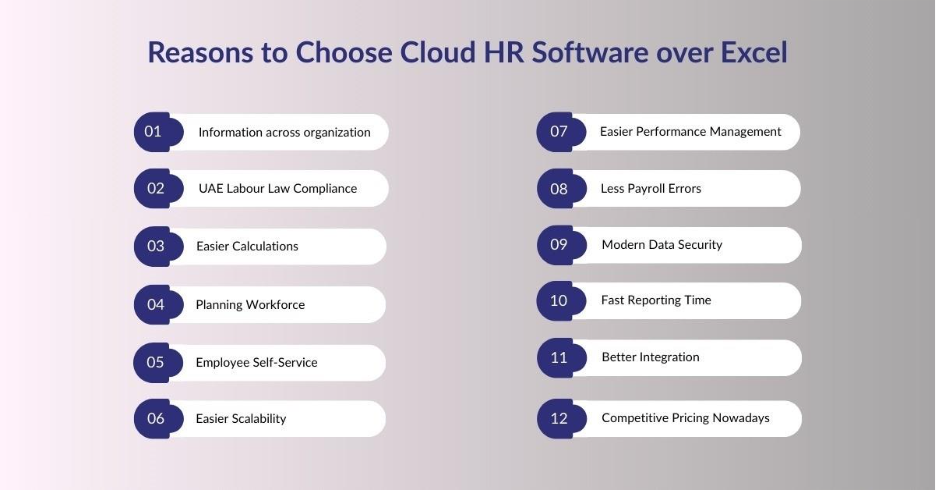
Reasons to Choose Cloud HR Software over Excel
1. Live Information across the Entire Organization
Excel files are stored in the laptop of one person or a shared drive where three individuals can access the versions.
Cloud HR software provides all people with access to one source of truth, which is constantly updated.
When an employee in Dubai updates their personal information, or a manager in Riyadh approves a leave request, that change is reflected instantly across the entire system.
2. UAE Labour Law Compliance is Needed
The UAE labor law, such as the Federal Decree-Law No. 33 of 2021 on the Regulation of the Labour Relations, brought a lot of changes in the way the contracts, working hours, leave rights, and end-of-service gratuity should be addressed.
Maintaining these requirements manually in Excel is a compliance risk.
Cloud HR systems are designed with local regulatory frameworks and can be updated to reflect the changes in legislation, which saves the load on your HR department to manually follow all changes in terms and conditions.
3. End-of-Service Gratuity Calculations are made easier
Calculating gratuity in the UAE requires careful attention to specific legal and employment details.
It depends on the employee’s years of service, the basis of termination, contract type, and the applicable law for the employee’s nationality and sector. Getting this wrong is costly.
Specialized HR software makes these calculations automatically, and the audit trail can be presented to the regulators or employees in case of a dispute.
4. Planning Workforce Needs More Than a Table
Specific solutions, such as HRForecast, which can be obtained via Ensaan Technologies, are tailored to strategic workforce planning.
They can do more than any spreadsheet can provide and will assist you in modeling future headcount requirements, determining skills requirements, and making plans to address the workforce changes after the UAE development goals of Vision 2030.
When your organization is attempting to localize its workforce or strategize a major growth, such software is a huge advantage.
5. Employee Self-Service Reduces HR Tickets
What is the duration your HR team spends answering questions that their employees can answer themselves?
Payslips, leave balances, policy documents, and letter requests.
Cloud HR systems have employee self-service portals that place this information right in the hands of employees and are frequently accessible via a mobile application.
This can release a few hours a week to the HR teams that are currently responding to these requests through WhatsApp or email.
6. Scalability Without the Spreadsheet Difficulties
An Excel-based HR system is not a graceful scale-out solution when your company is 80 people, and you need to expand to 800.
You are left with a network of interconnected files, manual consolidation, and an increasing reliance on the single individual who developed the system and has an actual understanding of it.
Cloud HR software will expand with your organization without necessarily having to re-architect your infrastructure every few years.
7. Better Candidate Experience Through Integrated Recruitment
Platforms like PeoplesHR offered through Ensaan Technologies, include applicant tracking and recruitment modules that integrate seamlessly with onboarding.
This means a candidate who accepts an offer automatically enters your onboarding workflow, without anyone manually copying data from a recruitment tracker into an employee database.
In a competitive talent market like the UAE, this type of smooth candidate experience matters.
8. Easier Performance Management
The appraisals made annually, as represented in Excel forms, are painfully hard to analyse, monitor and act.
Modern cloud HR platforms include performance management modules that allow you to set OKRs, track progress, gather 360-degree feedback, and link performance outcomes to compensation and development planning.
CoreHR, available through Ensaan Technologies, is one example of a platform that takes a more integrated approach to connecting performance data with the broader HR lifecycle.
9. Payroll Errors can be very Expensive
The Wage Protection System (WPS) in the UAE can impose severe consequences on the employee in case of late or wrongful payment of salary.
Processing payroll out of spreadsheets implies that all the calculations are a point of manual intervention as well as an error point.
Cloud HR software, and payroll, or payroll integration makes sure that calculations, deductions, and submissions are done systematically and checks are integrated and not attached.
10. Modern Data Security
Who has access to your current HR spreadsheets?
In case the truthful answer includes mutual motivations, email attachments, or files that are stored on personal laptops, that is a major data safety threat.
Cloud HR systems offer role-based access controls, in-rest and in-transit encryption, and audit logs that indicate precisely who accessed or modified what data and when.
In the case of organizations that deal with sensitive information about employees, not only is this a good practice, but regulators are becoming more demanding of it.
11. Fast Reporting Time
The frustration that is mostly presented with Excel-based HR is the time required to generate a basic headcount report or turnover analysis.
There is built-in reporting in cloud HR systems. You will be able to create standard reports on demand and create custom dashboards that will provide the leadership with the required visibility without having to spend half a day on data compilation by HR.
This is transformative to HR leaders who would like to be more strategic.
12. Integration With the Rest of Your Business
HR does not operate in isolation. Payroll helps to connect to finance. Recruitment connects to headcount budgets. Attendance connects to project management.
Cloud HR software is built to integrate with ERP systems, accounting platforms, time and attendance hardware, and other business tools.
13. The Market has many Options, and the Pricing Has Come Down
This is probably the most viable reason of all. The market of cloud HR software has grown tremendously, and now, there are options with credibility and a variety of prices.
In addition to the solutions provided by Ensaan Technologies, other organizations considering this space will also find the established players, such as SAP SuccessFactors, dominating the enterprise segment throughout the GCC.
Oracle HCM Cloud, popular with larger organizations with more complex requirements, Zoho People, accessible and affordable to SMEs in the UAE, and Darwinbox, which has been gaining popularity in the region, especially with mid-market organizations.
The presence of real competition implies that relocation to cloud HR is more available than it has ever been.
5 Top Cloud HR Software Solutions in the GCC Right Now
In case you are seriously considering your options, here is an open view of the platforms that are worth considering in 2026 for organizations that are operating in the UAE and the Gulf region in general.
1. PeoplesHR
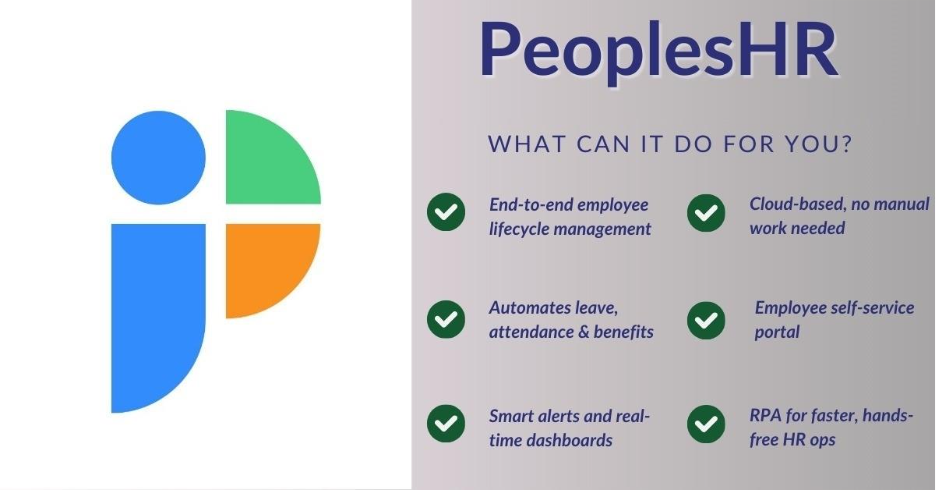
PeoplesHR has built a strong reputation across Asia and the Middle East as a comprehensive, mid-market HR platform that covers the full employee lifecycle from recruitment through to offboarding.
Its strength lies in its configurability, offering modules for core HR, payroll, leave management, performance, and analytics without the complexity overhead of an enterprise-grade system.
For UAE-based organizations that want a platform with genuine regional adaptations, including WPS compliance and Arabic language support, PeoplesHR is a strong starting point. It is available in the GCC through Ensaan Technologies.
2. HRForecast
HRForecast occupies a specific and increasingly important niche: strategic workforce planning and people analytics.
Rather than replacing your core HR system, it sits alongside it and transforms your HR data into forward-looking intelligence.
Think of skills gap analysis, headcount scenario modelling, and organizational design planning.
In a region where workforce nationalization targets and rapid business growth create complex planning demands, HRForecast is one of the few platforms built to address this level of strategic complexity. Ensaan Technologies brings this solution to the GCC market.
3. Darwinbox
Darwinbox has been one of the more interesting stories in regional HR technology over the past few years.
Built with mobile-first design at its core, it has gained traction in the GCC, particularly among mid-market organizations that want a modern user experience without the enterprise price tag.
Its strong employee experience features, including an intuitive self-service app and solid performance management tools, have made it popular with companies that put employee adoption at the centre of their HR technology decisions.
4. SAP SuccessFactors
SAP SuccessFactors is the prevalent enterprise HR service in the GCC, especially in big companies, government-affiliated institutions, and multinational corporations.
Its scope is unrivaled as it encompasses all aspects, such as core HR and payroll, learning, succession planning, and workforce analytics.
The complexity and cost trade-off is complexity and cost. The implementation is a serious task, and the overall cost of ownership may be huge.
With that said, SuccessFactors is the standard for organizations that have 1,000-plus employees and the IT infrastructure to service them.
5. Adrenalin
Adrenalin is a talent management platform that is specifically deep in recruitment, learning and development, and performance management.
It is well-suited to organizations that have the core HR basics covered and want to invest in the talent side of the equation: attracting better candidates, developing employees more systematically, and building performance cultures that go beyond the annual review.
It is a good option in organizations of various industries in the GCC because of its configurability.
How does Ensaan Technologies help you?
Ensaan Technologies has spent years working specifically in the GCC market, which means the solutions they offer and the implementation of support they provide are shaped by an understanding of the region’s specific HR challenges.
Whether that is multi-country payroll across the GCC, WPS compliance, Arabic language interfaces, or workforce localization planning, these are not afterthoughts but core considerations.
The portfolio they bring to the market spans PeoplesHR for core HR management and HRForecast for workforce planning analytics.
Conclusion
Excel is not leaving as a business application, and it most likely should not. It is great at doing what it was intended to do.
However, HR System, especially in a regulation-focused environment as specialised as the UAE, and in a labour market as dynamic as the GCC, has since exceeded it.
The issue is not necessarily whether to switch to cloud HR software.
It is the way to select the appropriate solution and how to make the transition without interfering with your operations.
By 2026, you will not only be making the lives of your team more difficult than they should be by continuing to use spreadsheets to run HR.
You are also bearing compliance risk; you are not making decisions based on data, and you are likely wasting hours each week on manual operations that can be automated using software.
That is worth thinking about.
Frequently Asked Questions (FAQs)
Yes. Most reputable platforms generate the Salary Information File (SIF) required by MOHRE automatically, which removes the manual effort entirely.
SMEs can typically go live in four to eight weeks. Larger enterprises with multi-country operations should expect three to six months, which depends on the level of complexity.
Reputable vendors let you export your data in standard formats like CSV or Excel at any time. Confirm this before you sign, and check if there are any fees attached to data extraction.
Cloud HR is hosted by the vendor and accessed via browser or app. It requires no internal IT infrastructure. Local server-based sits on your own servers.
Yes, always. Waiting just adds more data, which you need to migrate later, and more workarounds. So, you can start as soon as possible for faster integration.