

By 2026, it is not enough to be able to navigate the Qatari labor market with the help of operational expertise; it is necessary to use strict legal adherence.
With the Qatar National Vision 2030 in its final peak phase, the Ministry of Labor (MoL) has been changed to an entirely digital model of oversight.
To employers, the breaking down of the kafala system and the introduction of a nondiscriminatory minimum wage translate to the fact that now transparency is obligatory.
The Qatar Labor Law (No. 14 of 2004) is the key to protecting your business against harsh fines or penalties up to the blocking of a visa and fines up to QAR 100,000.
In addition to eliminating litigation, compliance also creates a high-performance, stable work environment.
When the market is competitive, a reputation of sound treatment is confirmed by mechanisms such as the Wage Protection System (WPS).
It’s the best attribute that an employer could have in attracting the specialized talent that would push forth innovation within the developing private sector in Qatar.
Table of contents
- Overview of Qatar Labor Law
- Qatari Employment Contracts
- Working Hours, Overtime, and Rest Days
- Wages, Salaries, and Wage Protection System (WPS)
- Leave Entitlements Under Qatar Labor Law
- Employer Obligations and Employee Rights
- Termination, Resignation, and Notice Periods
- Non-Compliance Penalties
- How Can Employers Ensure Ongoing Compliance?
- Conclusion
- FAQs
Overview of Qatar Labor Law
The Qatar Labor Law (No. 14 of 2004) is the initial legal instrument governing the employment of the individuals in the private sector depending on the balancing of employer and worker interests.
It refers to minimum safety and wage and dispute resolution standards in a move to ensure that Qatar is shifting to a contract-based labor force in line with Qatar National Vision 2030.
The law is applicable to most of those employees in the private sector, both the Qatari and expatriate employees.
It should also be noted, though, that employers must be conscious of the particular categories that fall out of this general mandate.
The law is not normally applicable to:
- Government Employees: Employees of ministries and state agencies that are subject to the Civil Human Resources Law.
- Domestic Workers: Drivers, cooks, and nannies under the Domestic Workers Law (No. 15 of 2017).
- QFC Employees: Professionals are professionals working at the Qatar Financial Centre, and they adhere to specialized employment regulations.
- Specialized Industries: Employees of firms founded by or in cooperation with Qatar Energy at work in the petroleum and petrochemical industries.
- Casual Labor: Workers called in to do some work that may not exceed four weeks.
Qatari Employment Contracts
The worker-employer relationship has a legal basis in the employment contract.
It should be registered using the Ministry of Labour (MoL) E-Contract system in order to be valid.
1. Types of Contracts
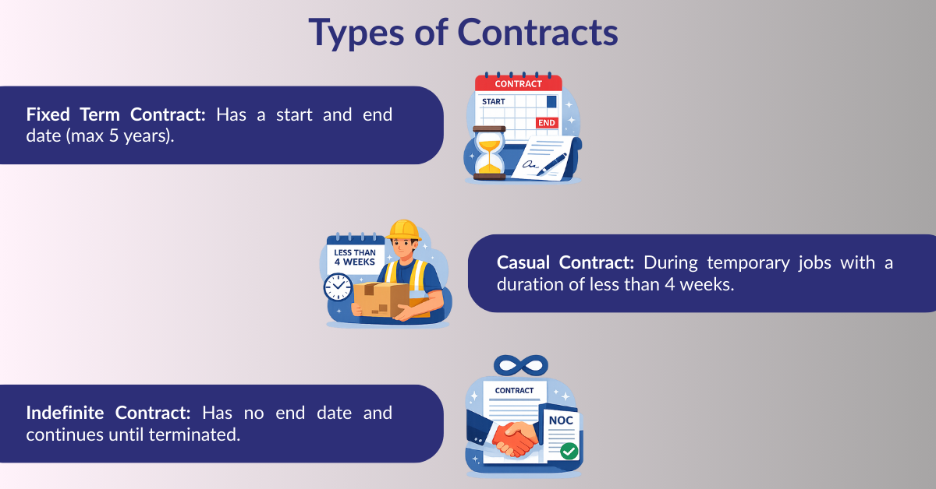
- Fixed-Term: Has a start and end date (not longer than 5 years). When work is carried on beyond expiry and not renewed, then it becomes a default indefinite contract.
- Indefinite: Has no fixed expiry date; it lasts until one party decides to end it. Employees do not need a No Objection Certificate (NOC) in order to change jobs.
- Casual: During temporary jobs with a duration of less than 4 weeks.
2. Mandatory Contract Terms and Language
Contracts should be written in Arabic in order to be legally binding.
The most important information is the job description, the basic wage, and particular housing/food allowances.
3. Probation Period Rules
The limit is 6 months’ probation. Any termination during this period must include a one-month written recall using the MoL electronic system.
Working Hours, Overtime, and Rest Days
The Labor Law (No. 14 of 2004) provides strict time limits in Qatar to observe safety and health.
1. Standard & Ramadan Hours
- Normal: Max 8 hours/day (48 hours/week).
- Ramadan 2026: This will be reduced to 6 hours/day (36 hours/week) for all those in the private sector.
- Breaks: 1-hour mandatory break after 5 successive work hours.
2. Overtime & Compensation
- Limits: The maximum time spent on work per day should not exceed 10 hours.
- Pay: Basic wage + 25% regular overtime. Maintenance work at night (between 9PM and 6AM) or rest-day work constitutes basic wage plus half.
3. Weekly and Summer Restrictions
- Friday: Standard rest day. Friday work necessitates another day off or a 150 percent overcharge.
- Summer Heat Law: The Heat Stress Ministerial Decision prohibits outdoor work between 10:00 AM and 3:30 PM between June 1 and September 15.
Wages, Salaries, and Wage Protection System (WPS)
In Qatar, wage payment is a digitized activity that focuses on transparency and financial stability.
With the Ministerial Decision No. 17 of 2020, Qatar was the first to implement a nondiscriminatory minimum wage in the region.
1. Minimum Wage Requirements
Under this, employers must address the following minimum monthly requirements:
- Basic Wage: Minimum QAR 1,000.
- Housing Allowance: Minimum QAR 500 (unless delivered by the employer).
- Food Allowance: Minimum QAR 300 (not made by employer).
- Total: At least QAR 1,800 monthly for the workers who are unemployed and do not receive food or shelter.
The Wage Protection System (WPS)
The WPS is a computer-based system for monitoring salary payments by Qatari banks.
Employers must submit a Salary Information File (SIF) monthly, reflecting contract data. Salaries must be paid within 7 days of the due date.
Non-compliance, such as underpayment or missed deadlines, may result in work permit blocks and fines up to QAR 10,000 or jail management.
Leave Entitlements Under Qatar Labor Law
The entitlement to leave is established so as to establish work-life balance but not to affect the business continuity in 2026.
These are minimums that are mandated by law; thus, employers can offer more but not less.
1. Annual Leave Article 79
Annual leave, which is paid and granted after one year of continuous employment:
- 1-5 years of service: 3 weeks (21 calendar days).
- More than 5 years of service: 28 days (4 weeks) minimum.
Rules: The leave of employees is planned according to workplace demands. Employees are allowed to take balances up to 50 percent to the next year with mutual consent.
2. Sick Leave
The public sector is entitled to paid sick leave after three months of service on the condition of submitting a medical certificate:
- First 2 weeks: 100% pay.
- Next 4 weeks: 50% pay.
- Subsequently: Unpaid (up to 6 other weeks).
3. Maternity and Special Leave
- Maternity Leave: Female employees with one year of service are given 50 days of full pay (at least 35 days following delivery). The mothers also receive a one-hour paid nursing break per day in one year.
- Hajj Leave: Muslim employees should have one pilgrimage leave of not more than 20 days without pay.
Employer Obligations and Employee Rights
As of 2026, the Qatari job market is overly interested in ethical concerns and physical protection.
Employers are also subjected to high standards that are monitored through automated government services in order to secure the rights of workers.
1. Equal Treatment and Non-Discrimination
Qatar legally forbids discrimination with the assistance of the constitutional document of 2004 in Qatar and Article 93 of the Labor Law.
- Gender Equality: Law No. 14 of 2004 clearly states that the female gender should be paid equally when performing the same work and given an equal opportunity to train and be promoted.
- Nationalization: Employers also have to deal with the Nationalization Law (No. 12 of 2024), in accordance with which Qatari nationals have priority in occupying particular jobs.
2. Health and Safety Requirements
It is the legal duty of employers to ensure the safety of their employees, according to Articles 99-106:
- Mandatory Insurance: Employers are required to offer all expatriate employees private health insurance.
- Workplace Safety: Organizations should offer free PPE and drinking water, as well as first aid boxes. Organizations that have over 100 employees are required to hire a full-time nurse.
- Heat Stress: There is a strict ban on outdoor work between 10.00 AM and 3.30 PM during the period between June 1 and the 15th of September.
3. End-of-Service Benefits (Gratuity)
Workers get a gratuity payment upon the completion of one year of service or thereafter.
- Calculation: The basic wage paid to the employee must be no less than 21 days (3 weeks) of annual working days.
- Basis: It is to be computed by using the previous basic pay, without any allowance.
Termination, Resignation, and Notice Periods
Termination of an employment relationship in Qatar in 2026 is legal, as it indicates the elimination of the need for a No Objection Certificate (NOC).
With the 2020 labor reforms, employers and employees are now able to cancel a contract without specifying the reason, provided that they are required to follow mandatory notice.
1. Period of Notice Requirements
Notice is subject to be provided through the electronic system of the Ministry of Labour:
- Less than two years of service: 1 month.
- Over 2 years of your service: 2 months’ notice.
- Under Probation: Employers who wish to dismiss an inappropriate employee should give a notice of one month.
2. Legal Termination Without Warning (Article 61)
Under Article 61, an employer has a right to terminate a worker immediately and without End-of-Service Gratuity due to gross misconduct, including
- Counterfeited papers or fake identity.
- Bringing about gross financial loss (should be reported to MoL within 24 hours).
- Continuing to break safety guidelines even with written warnings.
- Being caught in a drunken state or under the influence of drugs at work.
- Physical assault against a supervisor or unjustified absence of 7 days.
3. Final Settlement
All the dues (unpaid salary, leave withdrawal, and gratuity) should be paid in one business day in case the employer has fired him, or seven days in case the employee has resigned.
It is also the responsibility of the employers to repatriate a worker by giving a ticket within two weeks except when the worker has moved to a new company.
Non-Compliance Penalties
The Ministry of Labour (MoL) has also, in 2026, stepped up its implementation of the Qatar Labor Law by conducting strict inspections and automated online tracking.
To the employers, legal risk has ceased to be only an issue but a direct business discontinuity, since violations are usually accompanied by unilateral blocks on sponsorship of visas and government services.
1. Common Labor Law Violations
- Wage Delays: A failure to remunerate wages through the Wage Protection System (WPS) or below the minimum wage.
- Passport Confiscation: Withholding the passport of an employee, and this is highly unlawful according to the Qatari law.
- Health and Safety Violations: Breaking the summer midday work prohibition (10.00 AM – 3.30 PM) or not furnishing the mandatory health insurance.
- Failures of localization: The absence of compliance with the Law on the Privacy of Job Localization (No. 12 of 2024).
2. Financial and Legal Penalties
The sentence depends on the degree of the crime:
- Fine Monetary: Distribution of QAR 2,000-QAR 100,000. In case of localized job violations, fines may extend to QAR 1,000,000.
- Imprisonment: Gross violations, including those involving the WPS or unlawful enlistment, can attract sentences of up to one month or three years of incarceration.
- Worksite Closure: Heat stress violations may be imposed by the minister with the partial or complete closure of the worksites.
- Operational Suspension: Operational Suspension is the most widespread, and the employer is prohibited from employing new people and renewing the residency permits until the violation is addressed.
How Can Employers Ensure Ongoing Compliance?
By 2026, the compliance regarding labor in Qatar had been shifted to real-time, but in a digital format.
Proactive strategies are needed to prevent the freezing of operations because the Ministry of Labour (MoL) and Qatar Central Bank are very likely to use built-in monitoring.
1. Online automation and E-Contracts
- WPS Integration: Automate Salary Information Files (SIF) using AI-powered payroll software. This guarantees that there is 100 percent accuracy, and red flags in the Wage Protection System are avoided.
- Real-Time Updates: Enter all adjustments in salaries and changes in positions on the MoL E-Contract system at once. These records are the digital ones that are used as the main reference in terms of inspections in 2026.
2. The Trusted Employer Pathway
High-compliance companies are able to join the Trusted Employer Scheme, which is a pilot program and pays for good practices of transparency and job nationalization. Benefits include:
- Rapid Visas: Swift visa work permits.
- Less Audits: decreased alpha site visits.
- Priority Support: Direct contact with regulatory authority.
3. Regular Audits
Conduct quarterly internal audits to ensure that there is no tolerance towards holding passports and attending seminars conducted by MoL to keep updated with Qatar National Vision 2030 updates.
Conclusion
With the ongoing development of the Qatar regulatory environment towards the ultimate achievement of the National Vision 2030.
Labor compliance has emerged as a component of corporate sustainability.
The landscape in 2026 is designed to reward employers that adopt transparency and contract management digitally.
As well as the Wage Protection System (WPS) instead of the previous sponsorship model.
With a strict interpretation of the Qatar Labor Law and keeping track of the demands of the Ministry of Labor, i.e., with bans on midday work and minimum wage-related demands, businesses can avoid serious litigations and freezes of their operational activities.
Finally, it goes beyond legal safety to make sure that the best approach to worker rights is proactive.
In creating a strong, ethical brand that will survive on its own in this highly competitive and modernized economy.
FAQs
No. It is strictly illegal for employers to retain passports. Violations can result in fines up to QAR 25,000 per passport.
The minimum basic wage is QAR 1,000. If housing and food are not provided, allowances of QAR 500 and QAR 300, respectively, must be added, totaling QAR 1,800.
No. The No Objection Certificate (NOC) was abolished. Employees may change jobs after completing their notice period via the Ministry of Labour’s electronic system.
Standard overtime is paid at the basic rate plus 25%. For night work (9 PM – 6 AM) or rest days, the premium increases to 50%.
Failing to pay via WPS by the 7th of the month can lead to fines up to QAR 6,000, imprisonment, and an immediate block on company work permits.
Workers with 1+ years of service must receive at least 21 days’ basic pay for every year worked, calculated on the last basic salary.