
The selection of appropriate HR software is a very important decision for any organization.
As digital transformation continues to take shape in modern workplace places, businesses have been left with one of the biggest decisions to make: On-Premise HR software or cloud-based HR solutions.
Both alternatives have their benefits and difficulties, and you can choose the correct one depending on the size of your business, the level of security, and your future objectives.
On-Premise HR solutions refer to software installed locally on servers belonging to a company and are handled internally.
This provides organizations with complete control of data, customization, and integration with existing IT systems.
Cloud HR systems, on the other hand, are web-based and controlled by the provider and are easy to access anywhere, and they are automatically updated.
Although cloud HR software is gaining popularity due to its flexibility and reduced initial expenses, On-Premise solutions can still be used in most cases.
On-premise systems can also be the most intelligent choice when certain industries, large organizations, or businesses have the highest compliance and security standards.
This blog states that On-Premise HR software should be used, its advantages, disadvantages, and the way a company can make a wise decision that would ensure effectiveness and security in the long term.
Table of contents
What is On-Premise HR Software?
On-Premise HR software is a solution installed and executed on the servers and IT infrastructure of the company.
On-premise systems are entirely controlled by the organization, unlike the cloud-based HR solutions, which are hosted on the internet and run by a service provider.
Such software operates all fundamental HR activities, and they include:
- Employee data and records
- Payroll processing
- Time tracking and absence record keeping
- Performance management
- Recruitment and onboarding
The company is in complete control of data security, system access, and customization since the software is hosted locally.
IT teams have the responsibility to properly maintain servers, update them, and troubleshoot.
Organizations with high compliance, highly sensitive data, or complex HR processes faced with high customization often prefer on-premise HR software.
It can be integrated with other IT systems, like ERP, finance, and internal security tools.
The installation might be more expensive at first, with having to invest more in hardware, software licenses, and information technology workers, but it may prove to be less expensive in the long run when companies require a safe, stable, and fully customizable HR platform.
Major Benefits of On-Premise HR Software
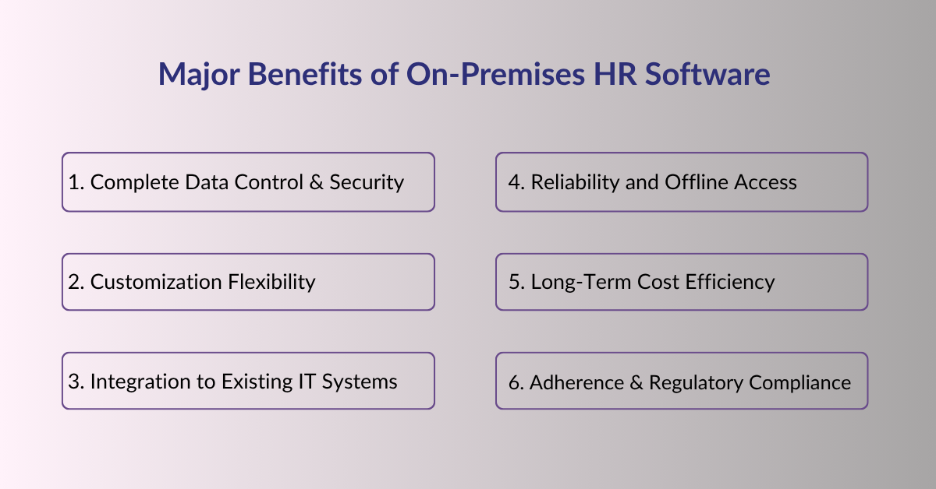
On-Premise HR software has a variety of advantages for organizations that require control, security, and customization.
Here are the main advantages:
1. Complete Data Control and Security
The software is hosted on your own servers, meaning that your company has all the control over the sensitive data of employees.
This will allow you to establish security measures, access control, and provide backups without involving third-party service providers.
It is of particular importance to industries dealing with confidential data or with a high level of compliance.
2. Customization Flexibility
On-Premise systems are customizable to reflect your special HR processes.
Examples of this would be unique workflows as well as specialized reporting.
You can customize the software to exactly match your needs, something that cannot be easily done with a typical cloud.
3. Integration to Existing IT Systems
Other internal systems are usually found in companies, such as ERP, finance, or internal security tools.
On-Premise HR software can smoothly interface with these systems and thus enables the free flow of data and minimizes errors of repeated data entry.
4. Reliability and Offline Access
The software is locally operated, which means you are not as reliant on internet access.
Your HR team can work even when the network is down. This may be essential to big companies that have many locations.
5. Long-Term Cost Efficiency
Although On-Premise systems may demand greater initial investment in infrastructure and license fees, they can prove less expensive in the long run when large organizations are involved.
You save on repetitive subscription payments and have complete control to upgrade as well as maintenance.
6. Adherence and Regulatory Compliance
On-Premise HR software enables organizations to achieve compliance with industry-specific requirements without difficulty.
Records can be kept and maintained as per local labor laws, audit standards, and company policies.
In short, On-Premise HR systems offer companies a certain degree of control, security, and customization unavailable to cloud solutions, making them a good fit in selected companies.
When Does On-Premise HR Software Make Sense?
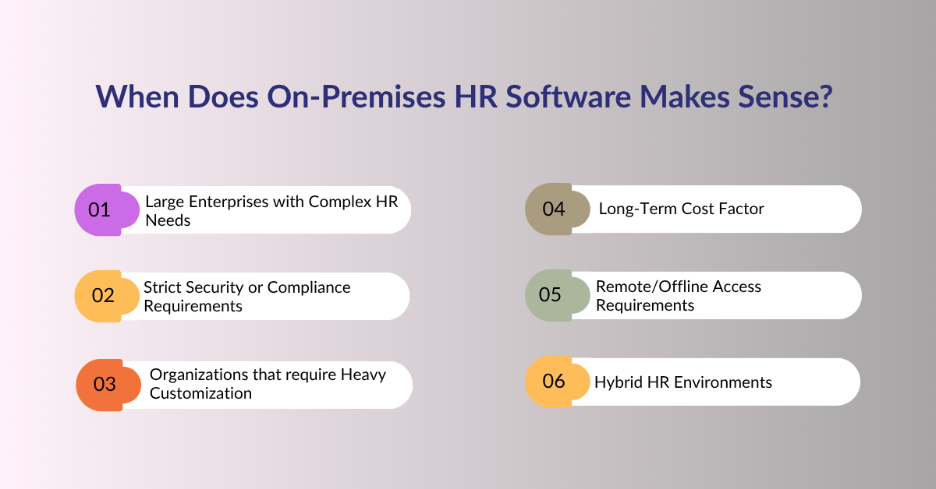
Not all organizations can use on-premise HR software.
Although cloud-based HR solutions are well-adapted due to flexibility and reduced initial expenses, an On-Premise system may be the wiser decision in some circumstances.
In the following case, it will be reasonable to consider the On-Premise HR software:
1. Large Enterprises with Complex HR Needs
Large companies are highly structured and may comprise several departments, offices, and thousands of workers.
They require HR systems that would support intricate workflow, sophisticated reporting, and connection to other enterprise software such as ERP or financial applications.
On-Premise solutions offer scalability and flexibility to large operations.
2. Strict Security or Compliance Requirements
Healthcare, finance, government, or defense industries deal with extremely sensitive data.
They can be legally or internally asked to keep data on-site and have tight security measures.
On-Premise software HR software gives an opportunity to use its own security measures, which diminishes any chances of breach or non-compliance.
3. Organizations that require Heavy Customization
Other companies have customized HR mechanisms that require full customization by traditional cloud solutions.
On-Premise software may be customized to fit specific business processes, styles of reports, and special approvals.
4. Remote/Offline Access Requirements
On-premise systems can be utilized in areas with unreliable internet connections, so that even when the facilities are not connected to the internet, the HR teams can still work.
This will guarantee continuity and reliability of HR activities.
5. Long-Term Cost Factors
In terms of overall cost effectiveness, On-Premise software can be less expensive in the long term for On-Premise software organizations over a duration of many years.
No recurring payment of subscriptions, and the companies have complete control of upgrades and maintenance schedules.
6. Hybrid HR Environments
Organizations that utilize a combination of old systems and the newly introduced digital applications might find On-Premise solutions easier to integrate.
This guarantees smooth data flow of HR, payroll, and other business systems.
To conclude, On-Premise HR software is best suited to large, security-sensitive, or highly customized companies.
It offers control, stability, and flexibility, which cloud solutions do not always provide, which is why it makes the correct choice in particular business situations.
On-Premise vs Cloud HR Solutions
Choosing between On-Premise and cloud HR software, it is crucial to compare such aspects to determine which type of software goes best with your organization.
1. Cost
- On-Premise: Greater initial expenditure in software, hardware, and personnel IT. Reduce operating expenses in the long run.
- Cloud: Reduced start-up price, subscription charges (monthly or annually).
2. Control and Security
- On-Premise: Full data and security settings. Perfect when it comes to sensitive information.
- Cloud: The security is controlled by the provider. It has great encryption, but weaker control.
3. Customization
- On-Premise: Strong customization that can be tailored to fit project-specific workflows and company policies.
- Cloud: Fewer personalization options; vendor-supplied mostly generic workflows.
4. Maintenance and Updates
- On-Premise: Will need the internal IT group to perform maintenance and hand updates.
- Cloud: The provider itself does updates and maintenance.
5. Accessibility
- On-Premise: These are typically accessed via an internal network or VPN. Offline use is possible.
- Cloud: Can be accessed anywhere online and is perfect for a remote team.
6. Scalability
- On-Premise: It can be something slower to add users or new features and also needs additional hardware.
- Cloud: Can be scaled easily; the user or modules can be added easily and quickly.
How can Ensaan Technologies help your organization to Implement On-Premise HR software?
Ensaan Technologies assists organizations in Qatar and the GCC in the implementation of the On-premise HR software in an efficient and safe way.
Their specialization helps to make sure that companies can have the advantages of On-Premise systems without the usual difficulties of installation, support, or integration.
Ensaan offers end-to-end support, which includes:
- Installation and Configuration: It is the process of installing the software on your servers and connecting it to the existing IT systems.
- Data Migration: Relocation of the records of employees and HR information on the former systems.
- Customization: Allows workflows, reports, and modules to be customized to suit the HR processes of your organization.
- Training and Support: Training HR teams on how to make effective use of the system and providing continuous technical support.
Organizations gain complete control over their data, better security, and compliance, and do not experience downtime and implementation problems.
The solutions provided by Ensaan apply to large businesses, governmental organizations, and SMEs that require dependable, scalable, and secure HR solutions.
Through the collaboration with Ensaan Technologies, firms will be able to receive all the benefits of On-Premise HR software, have a hassle-free implementation, and accomplish all the HR objectives, rather than technical issues.
Conclusion
On-Premise HR software is also a safe option for organizations when it comes to applications that require a high level of control, security, and extensive customization.
Although cloud HR systems are available where flexibility and convenience of use are concerned, there are still industries that are well served by having their HR systems managed internally.
On-Premise systems will prove to be more secure and reliable in an organization with sensitive data, complicated HR processes, and stringent compliance needs.
With initial hardware acquisition costs and licenses, IT support can pay back over the long term for increased savings and control of operations.
Ensaan Technologies assists companies with On-Premise HR software implementation that is easily performed, including configuration, customization, data migration, and support.
This provides a safe, non-compliant, and effective HR system that meets the requirements of the organization.
When making decisions about which HR software to consider, self-employees, leaders in the HR department, and decision-makers are concerned with the balance of security, control, cost, and flexibility.
The clever thing that organizations may consider building a reliable and future-proof HR infrastructure is the On-Premise HR systems, which might be enhanced with the help of experienced partners such as Ensaan Technologies.
FAQs
It is HR software installed and run on a company’s own servers, giving full control over data and customization.
Large companies, industries with strict security or compliance needs, and organizations with complex HR processes benefit most.
It has higher upfront costs for hardware and licenses but can be more cost-effective in the long term.
Yes, it can integrate with ERP, finance, payroll, and other internal systems.
Yes, Ensaan provides setup, customization, training, and ongoing support for On-Premise HR solutions.