Artificial Intelligence (AI) is no longer a concept of the future; it is changing the way we work, employ and develop.
In all types of industries, including logistics, HR, healthcare and finance, AI is no longer a tool of innovation but the key element of efficiency and decision-making.
The world is beginning to see a significant change in the workforce where the old roles are being redefined and completely new ones are being created faster than before.
The need to hire employees capable of operating intelligent systems instead of competing with them has been increasing multiple times over as organizations embrace AI throughout their operations.
Skills such as data interpretation, AI literacy and digital transformation strategies are becoming as necessary as communication and teamwork used to be.
It is not an evolution of work; it is a revolution of skill.
To the business leader and HR professional, the real question is not whether AI will disrupt their workforce, but how soon will they be able to adapt to it.
Today, the ones who begin planning by hiring, training, and developing AI-ready talent will be the ones who will be at the forefront in 2026 and beyond.
The AI transformation is now upon us, and it is high time to make preparations in your workforce.
Table of contents
- The Way AI Is Transforming Recruiting and Workplace Formation
- Coming AI-Driven Jobs to Behold in 2026
- Essential Skills That Every HR Leader Should Have in the Age of AI
- How AI Is Changing the Way HR Hires and Trains Talent?
- The Case of AI and Its Impact on How HR Hires and Trains Talent
- How Ensaan Technologies Supports the Creation of AI-Ready Teams?
- Conclusion
- FAQs
The Way AI Is Transforming Recruiting and Workplace Formation
Artificial Intelligence is changing hiring at a speed that most organizations cannot adjust to.
The previous model of recruitment that relied on manual screening, fixed job descriptions, and linear career paths is being replaced by AI-based, skills-driven models that develop as fast as changes in technology.
AI has automated recruitment in several ways, scanning thousands of resumes and predicting the success of a candidate based on data analytics.
HR leaders today are making use of AI to detect soft skills, measure cultural alignment and even customize employee onboarding.
However, even more than the hiring tools, the real change is in the job roles themselves.
The number of positions in the areas of Data Analysts, AI Engineers and Machine Learning Specialists is increasingly in demand, whereas the AI era also creates new hybrid ones, such as the positions of AI Business Strategist, Human-AI Interaction Designer, and Ethics Officer, in which technical knowledge intertwines with human judgment.
Even with conventional roles in the marketing field, human resources and operations are changing, and employees have to learn to read data clues and consult AI systems to make smarter decisions.
To the HR professionals, there will be a change of mindset in that they might not hire based on experience; it is now time to employ someone based on adaptability, digital intelligence and learning agility.
Adaptability with technology is a quality more important than years of immobility in this new landscape.
Essentially, it is not automation of work, but it is transforming the meaning of work.
Coming AI-Driven Jobs to Behold in 2026
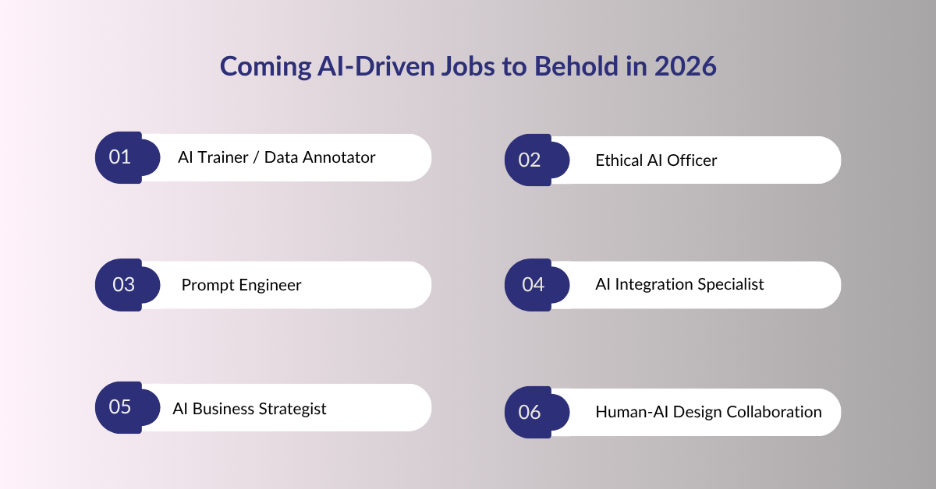
As AI keeps developing, completely new positions are created in the residential sectors that seek to work around the area of human creativity and machine learning.
The key is that HR leaders and business owners should be aware of the positions as early as possible to future-proof their staff and remain competitive in 2026 and beyond.
The following are the most demanded AI-oriented positions:
1. AI Trainer / Data Annotator
This is because these professionals instruct AI systems to process information correctly.
They tag pictures, text, and speech to enhance machine learning models.
The use of generative AI will grow exponentially, and without skilled annotators, the technology will be useless.
2. Prompt Engineer
Prompt engineers develop inputs into AI tools to produce accurate, useful outputs, one of the most innovative and imaginative jobs ever.
They facilitate the languages and logic used in marketing texts and product designs to make AI systems smarter and more reliable.
3. AI Business Strategist
These strategists focus on AI implementation and business objectives to make sure the leaders know where automation and predictive analytics can accomplish real ROI.
They play a major role in the realization of investments in AI to concrete results.
4. Ethical AI Officer
With the spread of AI, the issues of data privacy, bias, and compliance are growing.
Moral AI officers make systems transparent, accountable, and in line with organizational values and international policies.
5. AI Integration Specialist
These experts are charged with integrating the use of AI devices with the current processes and platforms and ensuring that businesses suffer minimal inconvenience and the greatest benefit in efficiency.
6. Human-AI Collaboration Designer
This job is employee-centered because it develops interfaces and procedures that facilitate the seamless interaction of people with AI tools to avoid substitution but rather supplement human potential.
These will be the roles in the coming decade of hiring.
The companies that initiate scouting, training, or reskilling towards these jobs to date will be at the forefront of the AI revolution tomorrow.
Essential Skills That Every HR Leader Should Have in the Age of AI
And in the era of Artificial Intelligence, recruiting is not only a matter of finding individuals capable of utilizing technology, but also able to be adaptable and develop.
The competencies required to succeed in an AI-based workplace are not limited to coding or analytics.
They encompass digital expertise, the ability to think critically, and emotionally intelligent skills that allow employees to procure AI but with a human touch.
The following are the key skills that the HR leaders must focus on in 2026:
1. AI Literacy and Data Fluency
The cross-functional staff must have a background on how AI works, its potential, limitations, and ethical boundaries.
The future employees will be those who can analyze the data and apply AI-enabled insights to make more accurate decisions.
2. Critical Thinking and Problem Solving
Automation will leave human employees with the task of solving strategic issues.
Critical across functions is the capability to extract insights from complex data and make good judgments.
3. Flexibility and Lifelong Learning
The world of AI is rapidly changing, so a person should learn continuously.
HR must seek those professionals willing to upskill, reskill, and keep up with technological trends.
4. Tech Collaboration Skills
The employees should understand how to interact with AI systems, be it chatbots, analytics dashboards, or enhanced workflows, without losing control and creativity.
5. Responsible and Ethical AI Understanding
As AI gains importance, there is a need to be aware of ethical judgment, privacy of data, and fairness.
The recent innovation focused on accountability will be appreciated by companies that need professionals capable of striking a balance between both.
6. Emotional Intelligence (EQ)
With work logic careers overtaken by machines, empathetic human beings, communication, and leadership will mark the organizational culture.
In summary, the workers of tomorrow most likely to be of benefit will be those who are human, empathetic, and AI competent in creating people into the real engines of intelligent transformation rather than machines themselves.
How AI Is Changing the Way HR Hires and Trains Talent?
AI is not only reshaping job roles; it’s transforming how HR leaders recruit, develop and retain talent.
Traditional hiring methods are giving way to data-driven, AI-assisted recruitment strategies that are faster, more accurate, and less biased.
For recruitment, AI-powered platforms can scan thousands of resumes, analyze candidate profiles, and predict potential success based on skill alignment, cultural fit, and past performance.
Chatbots and virtual assistants handle initial candidate interactions, freeing HR teams to focus on strategic decision-making.
This automation reduces time-to-hire and improves the quality of talent acquisition.
Training and development are also experiencing a major shift.
AI-driven Learning Management Systems (LMS) personalize learning paths for employees, recommending courses based on individual performance, interests, and career goals.
Gamification, interactive modules, and real-time feedback create engaging learning experiences that improve retention and skill acquisition.
Additionally, predictive analytics enable HR to identify skill gaps, plan workforce development initiatives, and prepare employees for emerging AI-driven roles.
This proactive approach ensures organizations remain competitive in rapidly evolving markets.
For HR leaders, embracing AI means more than efficiency; it’s about strategic workforce planning.
Those who adopt AI tools for hiring, training, and performance management can make smarter decisions, align talent with business objectives, and build a future-ready workforce.
The Case of AI and Its Impact on How HR Hires and Trains Talent
AI is also changing not only how job roles are being redefined but also how HR leaders are hiring, developing, and retaining talent.
Old processes of hiring are being replaced with more precise, data-oriented, and less biased recruitment, renewed with data-driven and AI-assisted approaches.
Regarding recruitment, AI-based systems have the capacity to scan through a large database of resumes, as well as respond to profiles and forecast success according to the applicant and their skills, cultural fit, and previous performance.
A chatbot and a virtual assistant are used to manage the first interactions, leaving the HR team free to make strategic decisions.
This automation saves time to hire and enhances talent acquisition quality. There is also a significant change in training and development.
One of the applications of AI in the Learning Management System (LMS) customizes the learning journey of the employees, where the system recommends learning courses based on personal performance, interests, and career objectives.
The interactive modules, gamification, and real-time feedback produce an engaging learning experience that enhances retention and learning skills.
Also, predictive analytics allow HR to recognize skills shortages, strategize workforce development programs, and prepare employees for new AI-based roles.
This is a proactive method to make sure an organization stays afloat in fast-changing markets.
To HR leaders, the adoption of AI is not about efficiency but strategic workforce planning.
Individuals who embrace AI tools in the hiring block, training, and performance management will be able to make better decisions, ensure that talent is tied to business goals, and create a future-ready workplace.
How Ensaan Technologies Supports the Creation of AI-Ready Teams?
Ensaan Technologies gives Saudi Arabia and other organizations the power to equip their workforce to survive in the AI-driven age.
Using AI-based HR systems, sophisticated learning systems, and digital transformation know-how, Ensaan can assist businesses in recruiting, training, and developing talent with the abilities they will require tomorrow.
By using the AI-based Learning Management System (LMS), Ensaan allows the HR leader to provide training opportunities to every employee, which are specific to the role, performance, and career aspirations of each employee.
The platform uses analytics and recommendations that are driven by AI to detect skill gaps and track progress and maximize learning outcomes so that teams are constantly ready to tackle new AI roles.
In addition to training, Ensaan Technologies provides AI recruitment and workforce planning so that businesses can find candidates with the appropriate combination of technical, analytical, and soft skills.
Ensaan supports a smooth experience through integration with other HR systems, enabling workforce insights to be automated, focused on data, and strategic.
Companies that collaborate with Ensaan have access to:
- Personalized AI learning courses and upskilling.
- Better talent decisions through predictive workforce analytics.
- AI-based recruitment systems to identify potential hires.
- Scalable solutions that address SMEs, large businesses, and government organizations.
Concisely, Ensaan Technologies addresses the disconnect between AI technology and human potential, allowing businesses to create agile, AI-prepared teams capable of surviving the fast-changing digital world.
Conclusion
The AI revolution is accelerating faster than most organizations anticipate, transforming the way we work, hire, and develop talent.
Businesses that delay preparing for this shift risk falling behind in both innovation and competitiveness.
For HR leaders, business owners, and corporate decision-makers, the need to hire AI literacy, data analytics, human-AI collaboration, and ethical AI governance is immediate.
The roles and skills required in 2026 are not just technical; they combine analytical thinking, adaptability, and emotional intelligence.
Employees who can work seamlessly alongside AI systems, interpret insights, and make strategic decisions will be the backbone of future-ready organizations.
Meanwhile, HR leaders must evolve from traditional recruitment and training approaches to AI-driven, data-informed talent strategies.
Ensaan Technologies plays a vital role in this transformation.
By offering AI-powered learning management systems, predictive workforce analytics, and integrated HR solutions, Ensaan equips organizations to identify skill gaps, deliver personalized training, and build teams capable of thriving in an AI-empowered world.
The message is clear: the AI shift is here, and the time to act is now.
Organizations that embrace AI-ready hiring, learning, and development strategies will not just survive; they will lead to the next decade of workforce innovation.
FAQs
AI-driven skills are abilities that enable employees to understand, operate, and collaborate with AI systems, including data analysis, machine learning basics, and ethical AI awareness.
Technology, finance, healthcare, marketing, HR, logistics, and manufacturing are among the industries experiencing significant AI transformation.
By leveraging AI-enabled Learning Management Systems, personalized training programs, and analytics to identify skill gaps and track progress.
Early adoption ensures organizations remain competitive, innovate faster, and prepares their workforce for evolving job roles.
Ensaan provides AI-powered LMS, predictive workforce analytics, and integrated HR solutions that help businesses hire, train, and manage AI-ready talent effectively.