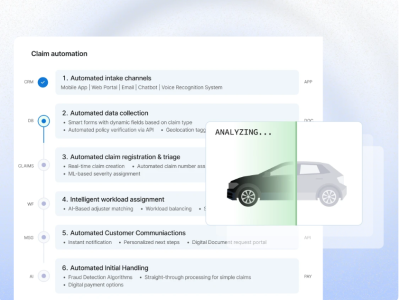

In the modern, busy business environment, Human Resource (HR) departments are wasting hours at the station performing repetitive administrative tasks approving leave requests, student attendance, payroll details, and employee records.
Such manual processes waste some precious time that could be devoted to what is really important: strategy, engagement, and talent development.
These processes are even more complicated as organizations grow. What was effective with 20 workers may easily get out of control with 200.
That is why HR automation is not only a nice-to-have but also a must-have for companies that want to remain efficient, compliant, and competitive.
Automation eases workflows, removes human mistakes, and provides timely data feedback that assists HR executives in making well-informed and quicker decisions.
It can help you save hours per week, whether onboarding a new employee, managing payroll, or performance tracking.
Automation will give your HR department time to create a more robust and productive team of workers.
Automating the appropriate HR processes today, the business will open new possibilities in terms of efficiency, employee experience, and be ready for the artificial intelligence-led future of work.
Table of contents
The Hidden Cost of Manual HR Processes
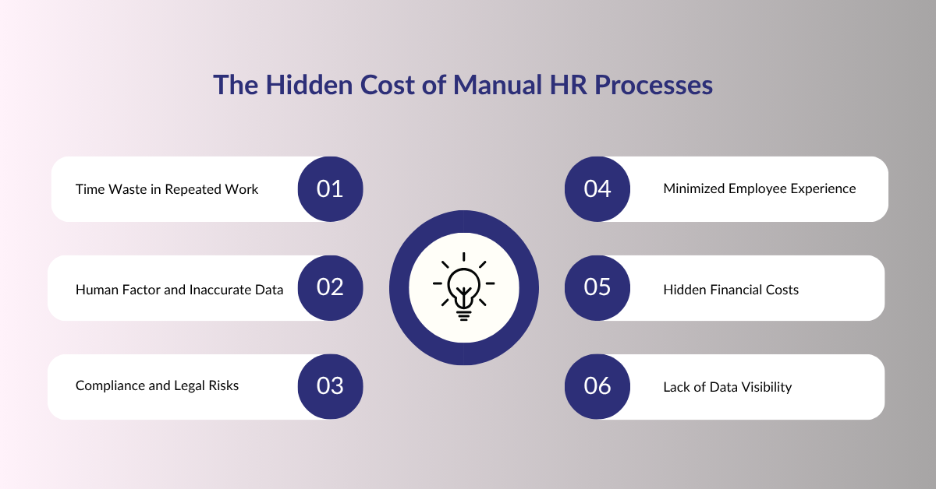
Although it may be hard to believe that manual HR processes can appear manageable, they silently take valuable time, resources, and productivity in your organization.
Here’s how:
1. Time Wasted in Repeat Work
The HR professionals are wasting hours weekly to input data, process the paperwork, or send their reminders, something that could be done through automation in a few seconds.
This restricts time in strategic projects such as employee engagement or talent development.
2. Human Factor and Inaccurate Data
Paper-based data entry raises the chances of error in payroll, attendance, or compliance reporting.
Minor errors can cause wrongful compensation, job dissatisfaction, or even compliance with fines.
3. Compliance and Legal Risks
Manually monitoring the changing labor laws, document renewals, and reporting requirements is subject to errors.
Automation makes sure that there are timely reminders, proper documentation, and audit trails that can be easily accessed.
4. Minimized Employee Experience
The longer the waiting period for employees in the case of the need to approve or update, the lower the level of involvement.
Faster responses are achieved within automated workflows, which results in happier and more productive teams.
5. Hidden Financial Costs
Working manually translates to increased man-hours, slowness, and lost chances.
It would be more expensive in the long run than investing in an automated HR system.
6. Lack of Data Visibility
In the absence of automation, HR leaders cannot access real-time information.
On the other hand, automated dashboards enable superior decision-making and labor planning.
Simply put, one hour spent on the half-minded activity of manual work is an hour wasted on strategic development.
Most Popular HR Processes to Automate Immediately
HR automation is very timesaving and results in fewer errors.
It also makes the HR teams more people-oriented than paper-oriented.
The following are some of the major HR activities that should be automated in the current times:
1. Employee Onboarding
Hiring new employees involves a lot of minor processes, such as obtaining paperwork, arranging emails, and policy briefings.
Onboarding automation means that all preparations are made in time.
The forms are also available to be completed online, and company guides can easily be accessed by new employees.
It provides them with an easy beginning and saves hours of manual work in HR.
2. Attendance and Leave Management
Attendance and leave tracking can become disoriented when performed manually.
Through an automation system, workers can enter attendance or request leave via the Internet.
HR can identify those who are available and those who are not, without searching for paper files or spreadsheets.
3. Payroll Processing
Payroll is time-consuming every month, and even minor mistakes can create issues. Salary, taxes, and deductions are calculated with the help of automation.
It auto-sends pay slips as well. This is timesaving and develops employee trust.
4. Performance Reviews
Automated tools may be used to monitor employee targets and monthly and annual development.
Managers receive notifications of reviews and have the option of giving feedback online.
This ensures a fair, easy, and documented process.
5. Recruitment and Hiring
Hiring may also be accelerated with automation of sorting through applications, arranging interviews, and dispatching updates to the applicants.
It not only helps HR to locate the right people quickly but also enhances the experience of the candidate as well.
6. Employee Data Management
Having all employee information on a single digital platform allows HR to always retrieve information.
There are fewer errors and updated records with automation.
7. Training and Development
Through an automated learning system, workers will be able to subscribe to online courses and make progress, as well as receive certificates automatically.
HR can simply identify who attended which training easily.
True Benefits Companies Are Experiencing
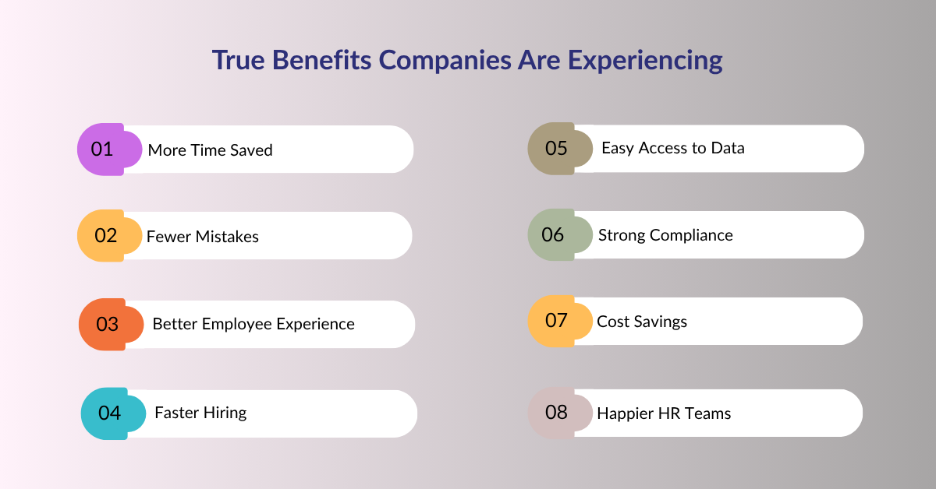
Firms that automate HR are recording significant advancements in time, accuracy, and satisfaction amongst employees.
Their key advantages include the following:
1. More Time Saved
The repetitive tasks, such as data entry, tracking documents, or emails with reminders, can be eliminated through automation.
The HR teams would spend several hours less per week on manual work.
This will allow them time to dedicate themselves to better work, like employee development, involvement, and strategy.
2. Fewer Mistakes
There is always the fault of small errors in manual HR activities, particularly in payroll or attendance.
Calculations done on automated systems are accurate at all times. This makes it less confusing and prevents expensive payroll or compliance issues.
3. Better Employee Experience
With automation, HR processes are streamlined.
Workers are capable of checking their pay slips, requesting leave, or updating their details easily online.
They do not need to wait to get HR responses or certain long forms. This enhances satisfaction and develops trust in the HR team.
4. Faster Hiring
The act of automating recruitment has enhanced the process of posting job advertisements to the process of onboarding.
HR does not need to screen all the CVs manually or email them.
This assists the companies in hiring new employees within a short period and also prevents losing well-qualified candidates.
5. Easy Access to Data
Everything is stored under automated HR systems.
Reports, history, and performance data of employees can be accessed quickly by HR.
Managers also receive real-time insights, which are useful in decision-making.
6. Strong Compliance
Automation is necessary to prevent HR from being contrary to the company’s rules and labor laws.
Systems may also notify the HR of something missing, such as an expired contract or a lost tax form.
This prevents legal complications and puts everything in check.
7. Cost Savings
Automation tools are expensive initially, but they are cost-effective in the long term.
Regardless, reduced manual errors, speed of processing, and cost of paperwork translate into large savings annually.
8. Happier HR Teams
In cases when HR employees do not have to waste much time on useless documents, they become motivated.
They can concentrate on individuals, concepts, and plans – the actual objectives of HR.
How Ensaan Technologies Empowers Smarter HR Automation?
Ensaan Technologies helps companies save time and work smarter with HR automation in Saudi Arabia and the GCC.
Their tools make HR tasks faster, simpler, and more accurate.
With Ensaan’s AI-driven HR solutions, HR teams can automate payroll, leave management, onboarding, performance tracking, and employee learning.
This means less manual work, fewer mistakes, and more time for strategic HR tasks like employee engagement and development.
For medium and large businesses, Ensaan provides easy-to-use solutions that can grow as the company grows.
Large enterprises benefit from scalable systems that handle thousands of employees with real-time reports and analytics.
Some key features include:
- Automated Payroll & Compliance: Ensaan calculates salaries, taxes, and deductions automatically, ensuring accuracy and legal compliance.
- Smart Leave & Attendance Management: Employees can apply for leave online, and HR can track attendance in real-time.
- Performance & Training Automation: Track goals, appraisals, and training progress without manual work.
- Centralized Employee Data: All employee information is stored safely in one place, easy to access anytime.
By partnering with Ensaan Technologies, companies can achieve digital HR transformation and build a future-ready, efficient workforce.
Automation reduces stress, improves employee satisfaction, and helps HR focus on what really matters to people.
Conclusion
Automation is no longer just a choice; it’s a must for HR teams that want to save time, reduce stress, and work smarter.
By automating key tasks like payroll, leave requests, onboarding, and performance reviews, HR can focus more on people and less on paperwork.
Companies that start now will have a big advantage in faster workflows, fewer mistakes, and happier employees.
The tools are easy to use, affordable, and made to fit all business sizes.
Action Tips:
- Start small, pick one or two HR tasks to automate first.
- Choose an HR tech partner that offers local support and easy setup.
- Train your HR team to use automation tools effectively.
- Keep reviewing results to find more ways to save time.
Smart automation today means smoother HR operations tomorrow.
FAQs
HR automation uses software to do repetitive tasks automatically, like payroll, leave tracking, and onboarding.
Start with payroll, attendance, leave management, onboarding, or performance tracking.
No. It helps HR work faster and focuses on people instead of paperwork.
Yes. Automation saves time and reduces errors, even for small teams.
Costs vary, but they usually save money over time by reducing errors and saving hours of work.