

Hiring landscape in 2026 is more data-driven, more AI-supported, and, for many organizations, more complex than ever before.
The UAE, Saudi Arabia, and Qatar have the most ambitious hiring and training plans in the world.
Yet, their economies are growing so fast that they still face a massive shortage of skilled workers.
These 65 recruitment statistics debunk the hype.
These points reveal the reality across six critical areas of hiring, with every single number backed up by clear sources.
Global Hiring: Recruitment Statistics That Frame 2026 – 2036
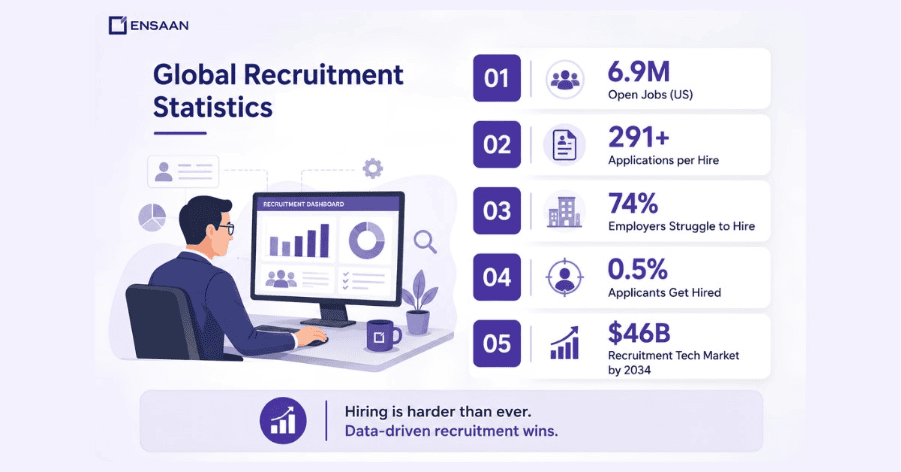
The biggest trend in hiring right now is a total contradiction: companies have plenty of job openings, but they are struggling to actually turn those candidates into final hires.
- In February 2026, the number of job openings in the U.S. was 6.9 million, and the hire rate was 3.1%, the lowest since April 2020. (Bureau of Labor Statistics, 2026)
- Applications per hire have nearly tripled since 2021, with every successful hire requiring an average of 291 to 300+ inbound applications. (Ashby via Elevatus, 2026)
- 52% of professionals globally are open to a new role in 2026, yet 74% of employers still report difficulty filling positions. (JobScore, 2026)
- Only 0.5 percent of applicants get the job. (National University, 2026)
- The global recruitment technology market is projected to grow from $17.5 billion in 2026 to $46 billion by 2034. (MSH, 2026)
- Each recruiter now manages an average of 14 open requisitions, a 56% jump in three years, while team sizes have shrunk from 31 to 24. (Gem via Pin, 2025)
- By 2036, organizations that have fully integrated AI across their hiring lifecycle are forecast to operate with time-to-fill averages 60% below today’s 44-day benchmark. (Gartner Future of Work, 2025)
- Only 30% of talent acquisition teams expect budget growth in 2026. (Pin, 2026)
The takeaway: When you have a lot of volume and a lot of difficulty, then you have a process problem, not a pipeline problem.
Talent Shortage and Skills Gap Recruitment Statistics
The problem isn’t a lack of applicants. It’s a lack of the right skills.
Even though hundreds of people might apply for a single job, only a tiny fraction actually have the specific abilities required.
This issue is more intense in the Gulf region (GCC) than anywhere else in the world.
- 45-75% of employers in the GCC report facing challenges in finding skilled talent. (HCM Global, 2026)
- 90% of GCC organizations are wrestling with significant skills gaps, driven by inadequate pay (38%), intense talent competition (31%), and unclear career paths (28%). (Taggd, 2026)
- 46% of employers globally cite finding qualified candidates as their biggest recruitment challenge. (JobScore, 2026)
- By 2030, Korn Ferry projects a global talent shortfall of 85.2 million unfilled roles, threatening $8.5 trillion in unrealized annual revenue across 20 major economies. (Korn Ferry Global Talent Crunch projection)
- 76% of recruiters report difficulty attracting quality talent, making process speed a key competitive differentiator. (Second Talent via One Hour Digital, 2026)
- By 2030, 170 million new jobs will be created, and 92 million will disappear—causing massive shifts in the global workforce.
Because of this rapid turnover, filling positions one by one as they open up is no longer a realistic strategy. (WEF Future of Jobs Report, 2025)
- Organizations with pre-built talent pipelines hire 2x faster and achieve a 3x higher offer acceptance rate. (JobScore, 2026)
The takeaway: Reactive hiring is expensive. The organizations winning maintain warm talent pipelines before gaps appear.
Time-to-Hire and Cost-Per-Hire Recruitment Statistics
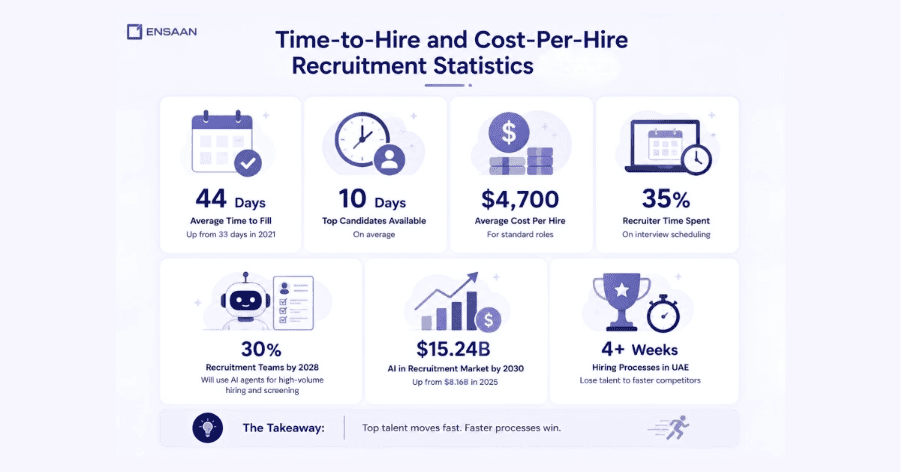
Both numbers are getting worse, revealing a surprising truth: dragging out the interview process doesn’t help you find better employees.
It just causes the best candidates to walk away.
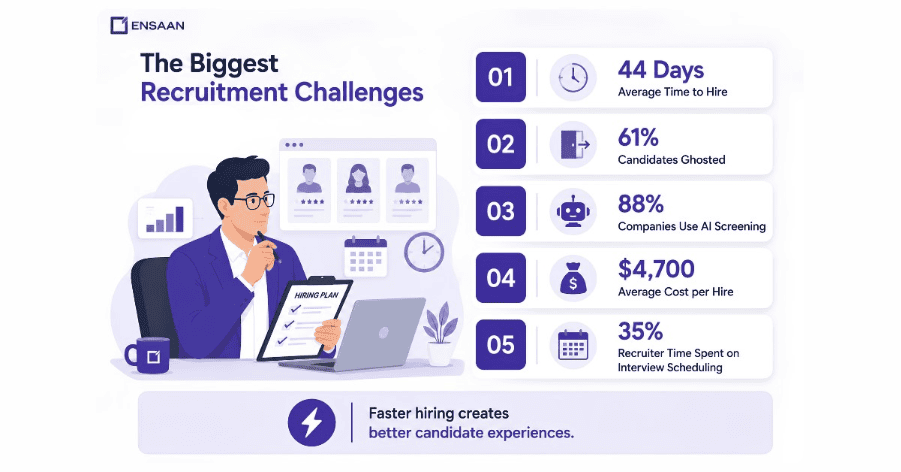
- The average time to fill an open role has risen to 44 days in 2026, up from 33 days in 2021. (SHRM via Matchr, 2025)
- Top candidates are on the market for an average of 10 days, a structural mismatch with most hiring timelines. (SelectSoftwareReviews via One Hour Digital, 2026)
- The average cost per hire is $4,700 for standard roles, with executive hires costing three to four times the first-year salary. (SHRM, 2025)
- 35% of recruiter time is spent on interview scheduling alone. (GoodTime, 2025)
- By 2028, nearly a third of recruitment teams will use AI to handle high-volume hiring and initial screening from start to finish. This will speed up hiring far beyond what human-driven processes can achieve. (Gartner, 2026)
- The AI recruitment market is expected to nearly double, reaching $15.24 billion by 2030. Companies are pouring money into these tools to fill jobs faster and cut hiring costs. (Grand View Research via Pin, 2026)
- In the UAE market, processes taking over four weeks to reach the offer stage are losing talent to faster competitors. (ReapHR, 2026)
The takeaway: The 10-day gap between availability and the 44-day hiring cycle is the most compelling of these recruitment statistics because it is most actionable.
Automated scheduling is the fastest lever to pull.
AI Recruitment Statistics
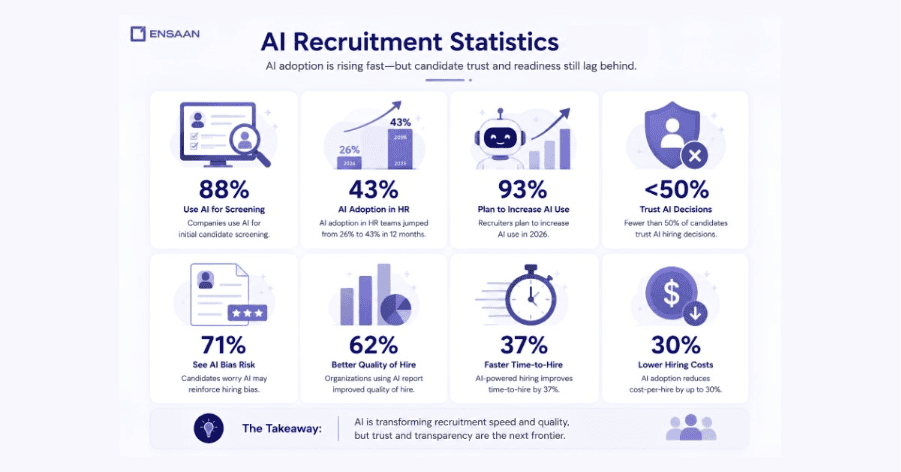
Companies are adopting AI tools to hire people faster than ever before, but the candidates applying for those jobs don’t trust the technology at all.
- 88% of businesses currently use AI for initial candidate screening. (MSH, 2026)
- AI adoption in HR teams jumped from 26% to 43% in twelve months, the fastest single-year increase recorded. (SHRM via Pin, 2025)
- 93% of recruiters plan to increase AI use in 2026, yet fewer than half have fully implemented it across all pipeline stages. (RecruitBPM, 2026)
- AI recruitment can reduce hiring costs by up to 30% per hire and is linked to a 4% average increase in revenue per employee. (DemandSage, 2026)
- AI video interview summarization reduces review time per candidate by approximately 60%. (HireVue / Spark Hire via One Hour Digital, 2025)
- AI-assisted recruiter messaging makes organizations 9% more likely to make a quality hire. (RecruitBPM, 2026)
- By 2028, 25% of job applicants worldwide will use fake AI-generated profiles, including realistic audio and video designed to trick automated screening. As a result, verifying candidate identities will become an absolute must for modern hiring. (Gartner, 2026)
- Starting in 2028, AI will create more jobs than it replaces. However, with 32 million roles changing every year, retraining existing employees will become the primary focus of hiring strategies through at least 2036. (Gartner HR Research, 2026)
- 83% of companies used AI to screen resumes by late 2025, with 75% of resumes rejected before a human reviews them. (HiringThing, 2025)
- 25% of candidates trust employers less when AI is involved in hiring decisions. (Gartner via MSH, 2026)
The takeaway: AI is best suited to eliminate friction in logistics.
The organizations seeing real gains use it for scheduling and screening, not to replace human judgment.
Candidate Experience Recruitment Statistics
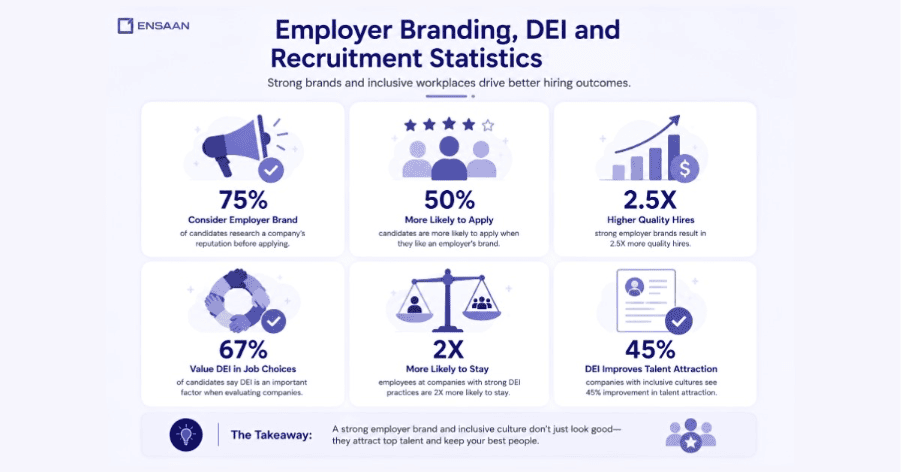
These recruitment statistics on candidate experience reveal a serious gap between what job seekers expect and what most hiring processes deliver.
Here are some top candidate-experience recruitment statistics to identify leaks and where they cost the most.
- Only 26% of North American job seekers say they had a great candidate experience. (JobScore, 2026)
- 61% of job seekers have been ghosted after a job interview, a nine-point increase since early 2024. (Greenhouse via HiringThing, 2025)
- 60% of candidates abandon applications that are too long; those over 15 minutes hit a 73% abandonment rate. (CareerBuilder / Greenhouse, 2025)
- 52% of job seekers have declined an offer due to a poor hiring experience. (HiringThing, 2026)
- 78% of candidates say the hiring experience signals how much a company values its people. (RecruitBPM, 2026)
- 72% of candidates with a bad experience tell their network, and 48% post about it on social media. (RecruitBPM, 2026)
- By 2030, Gen Z will make up nearly a third of the global workforce. Because they demand fast, digital, and mobile-friendly communication, companies must update their hiring process now to keep up. (Deloitte Gen Z Survey, 2025)
- By 2032, interactive, AI-customized hiring methods, such as adaptive video interviews and real-time simulations, will replace traditional application forms in competitive job markets. (Gartner Future of Hiring, 2025)
The takeaway: The biggest lever in candidate experience is communication frequency, not budget.
The 61% ghosting rate is one of the most avoidable mistakes in modern recruiting.
Employer Branding, DEI and Recruitment Statistics
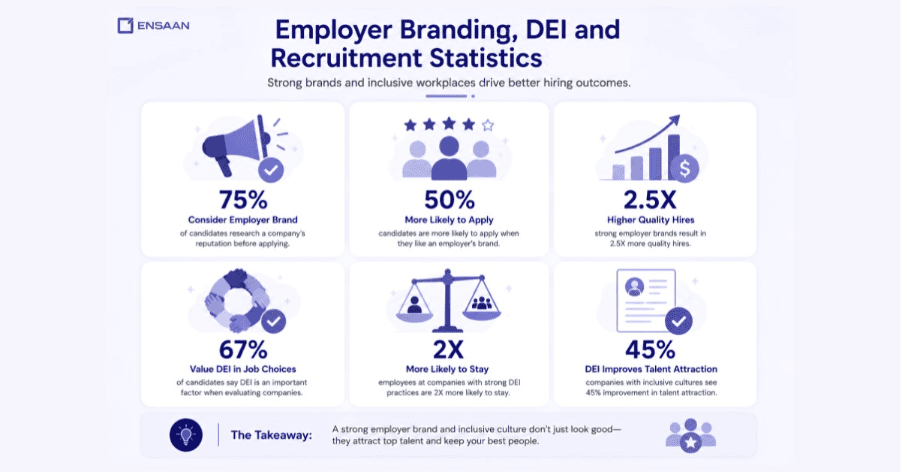
How your company looks to the outside world directly impacts how much you spend on hiring and how long employees stay.
In the Gulf region (GCC), where professional circles are tight and word spreads fast, a good or bad reputation is a direct financial variable.
- Companies with strong employer brands see a 50% reduction in cost-per-hire and attract 50% more qualified applicants. (HiringThing, 2026)
- By 2034, sustainability and social impact will be top priorities for workers under 35. To attract this talent, companies will need to put their green credentials front and center in their hiring campaigns. (Mercer Global Talent Trends, 2025 projection)
- 83% of job seekers research a company’s reviews before deciding where to apply. (Glassdoor / Harris Poll via Matchr, 2025)
- Companies with a Glassdoor rating below 3.3 stars lose more than half of potential applicants before they click apply. (Elevatus, 2026)
- Strong employer brands reduce employee turnover by 28%. (Elevatus, 2026)
- Diversity hiring is a top priority for 85% of talent acquisition leaders globally. (MSH, 2026)
- By 2036, companies with strong diversity programs will far outperform those without them, as diverse teams drive more innovation and adapt faster to tech shifts. (McKinsey Diversity Wins projection, 2025)
- Women now represent 42% of new hires across the GCC, with direct implications for inclusive sourcing strategy. (HCM Global, 2026)
The takeaway: Every ghosting incident negatively impacts the employer brand.
When 61% of candidates are ghosted and 72% share their experience with their network, a single bad hiring experience affects hundreds of future applicants who were never in the room.
Employee Referral Statistics
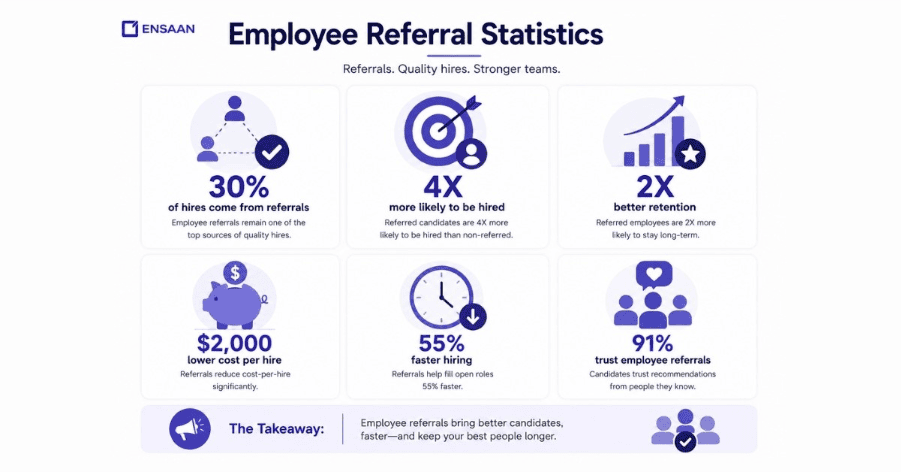
The single best way to hire people is through employee referrals. Yet most companies completely ignore it.
If you built a perfect hiring system from scratch, it would look exactly like a great referral program because it delivers candidates who are already screened, get hired quickly, accept offers easily, and stay at the company longer.
Most organizations underinvest in it.
- Employee referrals generate just 7% of applications but account for 30–50% of all hires, the highest conversion rate of any channel. (National University, 2026)
- Referral hires are hired 55% faster than candidates from traditional sourcing. (MSH, 2026)
- Referred candidates pass initial screens at 52% versus 35% for all other candidates. (Ashby, 2026)
- By 2030, AI built into employee referral platforms will automatically match open jobs to people in employees’ networks based on their skills. This turns employee referrals from a passive, occasional source into a fast, data-driven hiring machine. (LinkedIn Talent Intelligence forecast, 2025)
- A sourced outbound candidate is 5x more likely to be hired than a cold online applicant; referrals are 6x more effective than all other channels. (HiringThing, 2026)
The takeaway: Most referral programs fail because they are passive, but companies get great results when they actively promote the program and ask employees for help with specific open roles.
Skills-Based Hiring Recruitment Statistics
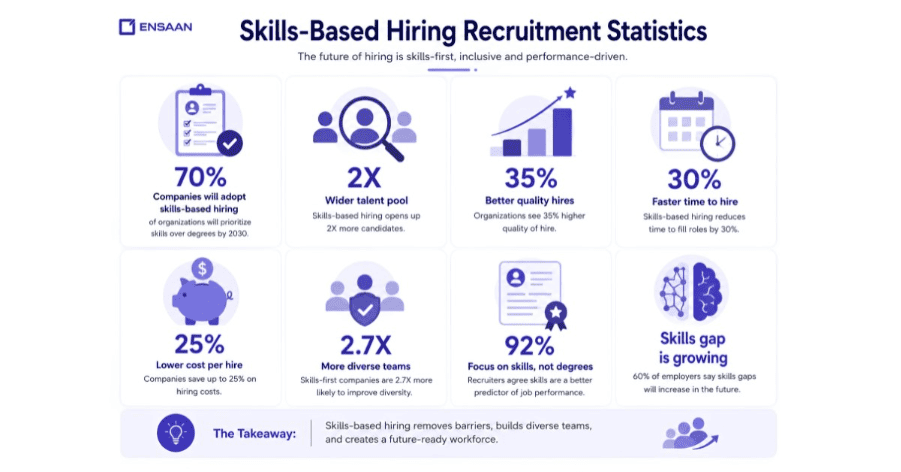
Companies are now hiring for actual skills rather than university degrees.
This is especially true in the Gulf region (GCC), where strict local hiring laws mean companies must find citizens who can do the job, rather than just hiring people to tick a box.
- Nearly 70% of organizations now prioritize skills over traditional degree requirements, up from 65% in 2024. (NACE, 2026)
- Skills-based hiring expands the talent pool by 15.9x in the U.S. and 6.1x globally. (LinkedIn Economic Graph via National University, 2025)
- By 2030, nearly 40% of workers’ core skills will be outdated. Because skills change so fast, checking degrees or static resumes isn’t enough anymore. (WEF Future of Jobs Report, 2025)
- Firms using the most skills-based hiring practices are 12% more likely to make a quality hire. (LinkedIn via Pin, 2025)
- By 2032, companies that hire for skills rather than degrees will be far better at finding and keeping top talent, as AI tools that track and match skills become standard across big businesses. (Deloitte Skills Economy Forecast, 2025)
- Soft skills are rated 4x more important than technical skills by hiring managers across most industries. (MSH, 2026)
The takeaway: Testing candidates on their actual skills predicts job success much better than looking at their college degrees.
Plus, it gives everyone a fair shot, even if they didn’t go to a prestigious university.
GCC-Specific Recruitment Statistics
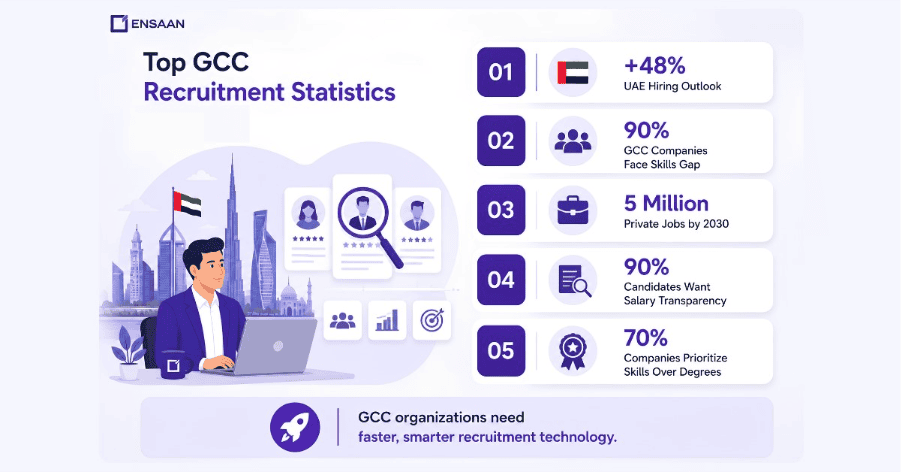
The Gulf region (GCC) is facing a completely unique hiring market.
Companies are racing to meet strict local hiring quotas, business optimism is at an all-time high, bidding wars are driving up salaries, and the workforce is made up of people from dozens of different countries.
- According to the Q1 2026 ManpowerGroup Employment Outlook Survey, the UAE recorded a Net Employment Outlook of +46%, ranking third globally behind Brazil (+54%) and India (+52%). (ManpowerGroup, 2026)
- Saudi Arabia posts a +35% Net Employment Outlook for 2026, driven by Vision 2030 investment in AI, renewables, and tourism. (ReapHR, 2026)
- The GCC is projected to create over 5 million private-sector jobs by 2030. (HCM Global, 2026)
- 66% of GCC employers are actively expanding headcounts even as 60% of employees report a pay-to-responsibility disconnect. (Elevatus, 2026)
- 90% of GCC job seekers prioritize salary transparency, with 74% seeking pay information before submitting an application. (Elevatus, 2026)
- By 2036, salaries for AI, data, and green energy jobs in the Gulf will beat global averages by 15 to 20% due to massive national development plans and a local talent shortage. To compete, regional HR leaders must combine high pay with strong employer branding. (Mercer Total Remuneration Survey, 2025 projection)
The takeaway: Because hiring in the UAE is booming, top candidates are receiving multiple job offers at once.
Companies that move fast and talk about money early are winning the talent war, which makes perfect sense given the hiring challenges GCC companies face today.
What do These Recruitment Statistics Mean for Your Hiring Process?
The trend of the 65 data points is the same. Hiring cycles are longer, candidate expectations are rising, and the cost of a slow or poorly communicated process is more measurable than it has ever been.
GCC companies, in particular, have workforce nationalization goals, significant talent demand, and high salaries, making reactive, manual hiring a liability rather than a strategy.
Two things can help move all of the above metrics in a positive direction: better recruitment technology and a better candidate communication experience.
Ensaan Technologies tackles these problems through its two fundamental recruitment platforms.
1) Cornerstone Recruiting
Cornerstone Recruitment, implemented by Ensaan across the GCC, brings AI-powered candidate matching, skills-based screening, and intelligent sourcing into one connected system.
Rather than filtering by keyword match, Cornerstone scores candidates against the actual competencies each role needs, directly addressing the fact that 70% of employers now prioritize skills.
Automated interview scheduling, mobile-optimized career sites, and embedded candidate communication workflows reduce recruiter time spent on logistics and candidate application abandonment due to poor application experiences.
2) Kore.ai
Kore.ai, deployed by Ensaan, builds the communication layer that most recruiting teams cannot maintain manually at scale.
Its intelligent chatbots automatically screen questions on the spot, push updates to applicants, schedule interviews in real time, and respond to applicants’ questions in Arabic and English at any time of day.
For companies in the Gulf (GCC) handling thousands of job applications, this means no candidate is left waiting for a late email, recruiters don’t waste hours on repetitive screening calls.
And the company builds a great reputation instead of being known for ignoring applicants.
A deeper look at the Kore.ai platform explains how the technology operates in existing HR and ATS workflows.
Request a free consultation to see how Cornerstone and Kore.ai are filling gaps for GCC organizations today.
Or get in touch directly to start a conversation about where your hiring process needs the most attention in 2026.
FAQs on Recruitment Statistics
Q1. What are recruitment statistics and why do they matter for hiring in 2026?
Recruitment statistics are actionable data on recruitment trends, candidate behavior, and process efficiency. They assist employers in choosing candidates based on solid evidence.
Q2. What are the most important recruitment statistics HR teams should track in 2026?
Key metrics include time-to-hire, cost-per-hire, candidate drop-off rates, and source-of-hire effectiveness.
Q3. How do recruitment statistics improve hiring outcomes?
They show you where the problems lie within your hiring process, giving you the chance to improve your job postings, interview procedures, and candidate experience.
Q4. What recruitment trends are shaping hiring in 2026?
AI-driven screening, skills-based hiring, and remote/hybrid roles continue to dominate recruitment trends this year.
Q5. How can small businesses use recruitment statistics effectively?
Even basic metrics like application-to-interview ratio and offer acceptance rate can help small teams hire smarter with limited resources.
Q6. What are the top recruitment platforms in the GCC that help organizations hire better?
Cornerstone Recruitment Onboarding system and Kore AI are examples of top recruitment software solutions in the GCC.