

The Gulf Cooperation Council is in the middle of one of the most ambitious economic restructuring programs in modern history, and payroll sits at the centre of it.
It’s no longer just behind-the-scenes admin work, but a compliance tool and a workforce governance tool, and increasingly an AI-driven layer that surfaces workforce intelligence that annual reports used to miss entirely.
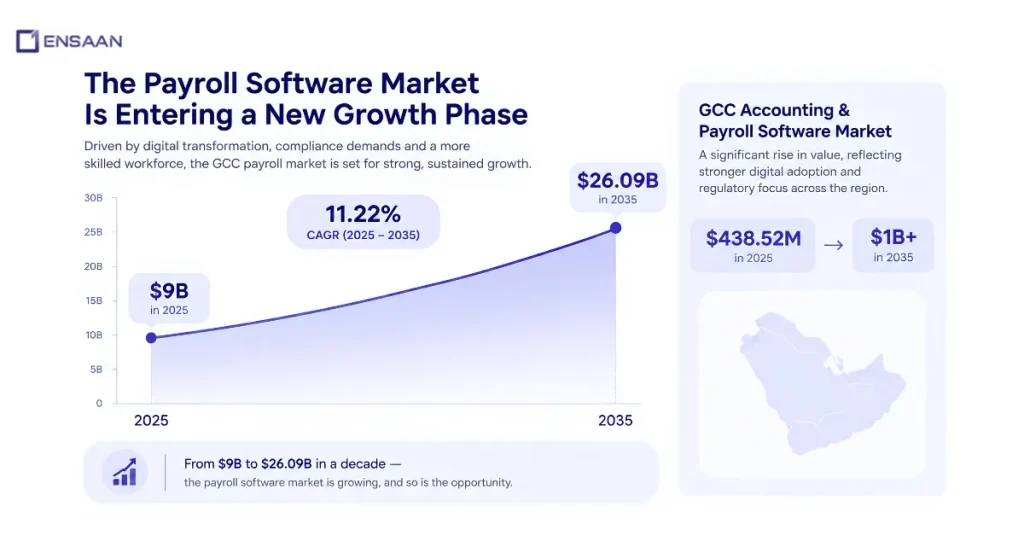
The statistics of this change are huge. According to Market Research Future, the global HR payroll software market is projected to grow from $9 billion in 2025 to $26.09 billion by 2035 at an 11.22% CAGR.
According to the same research body, the overall accounting and payroll software market size in the GCC is expected to increase from $438.52 million in 2025 to more than $1 billion in 2035.
These are not incremental numbers. They represent a new framework for how organisations across the United Arab Emirates, Saudi Arabia, Qatar, Kuwait, Oman, and Bahrain manage their largest operational spend.
This post shows you where payroll software in the GCC is heading, the top 6 trends transforming payroll between now and 2035, and what leading organizations are doing about it today.
Table of contents
- How Is GCC Payroll Software Evolving?
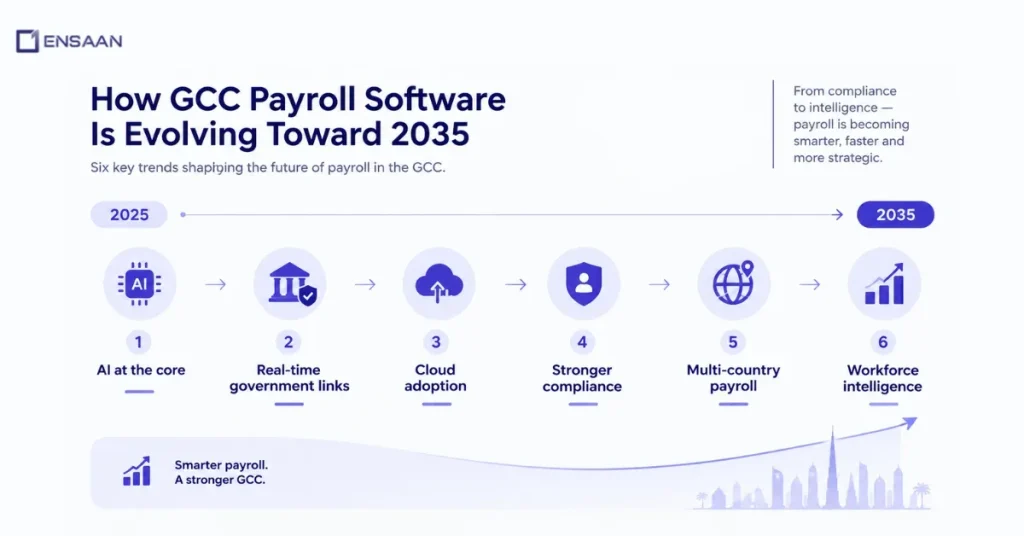
- The Six Trends in the GCC That Will Define Payroll Software by 2035
- 1. AI Integrated to Operational Core
- 2. Real-Time Government Integration Becomes Non-Negotiable
- 3. Cloud-Native Payroll Overtakes On-Premises Across the Board
- 4. Nationalization Compliance Transforms Payroll into a Strategic Instrument
- 5. Multi-Country GCC Payroll Consolidation Becomes a Priority
- 6. Payroll Analytics Evolves into Workforce Intelligence
- What Does This Mean for GCC Organizations Planning Ahead?
- How is Ensaan Technologies Positioned for the GCC Payroll Decade Ahead?
- Frequently Asked Questions
- 1) What is driving the growth of payroll software in the GCC between now and 2035?
- 2) Will AI replace payroll teams in GCC organizations by 2035?
- 3) How does nationalization policy affect the future of payroll software across the GCC?
- 4) Is cloud payroll secure enough for GCC data residency requirements?
- 5) How should organizations choose between a local and global payroll platform for 2035 readiness?
How Is GCC Payroll Software Evolving?
The role of payroll in the GCC has changed more profoundly in the last five years than in the previous 20 years.
Wage Protection Systems, national workforce programs, and government-mandated digital compliance frameworks have all combined to make payroll software in the GCC a strategic requirement rather than an operational convenience.
The best indication of where things stand now is the new WPS 2.0 framework, which eliminated the 15-day grace period and introduced real-time monitoring via Al Etihad Payments.
Payroll is now a regulated, monitored, publicly accountable process. A late or incorrect SIF file triggers enforcement automatically.
Emiratisation fines have hit AED 9,000/month per unfilled skilled job, reported Links International, and the scope of Saudisation has been extended to 269 professions under a phased 2025 implementation.
The GCC labour market, valued at $105.2 billion in 2030, is forecast to reach $174.65 billion by 2034. A payroll system must process every dirham of that value without error and in compliance.
The Six Trends in the GCC That Will Define Payroll Software by 2035
1. AI Integrated to Operational Core
AI is no longer just a marketing claim for payroll software but a measurable operational benefit.
A 2025 PwC survey, cited by Paylite, found that 75% of employees in the Middle East already use AI in their daily work, ahead of the 69% global average.
At the leadership level, greythr’s 2026 UAE HR trend analysis noted that 92% of CEOs in the UAE report confidence in how they are using AI, a figure well above comparable global benchmarks.
Real-world AI applications in payroll aren’t replacing payroll departments.
It eliminates the tasks that make them slow: EOSB calculations auto-populated from contract dates, gratuity reconciled against service history automatically.
It also eliminates overtime anomalies flagged before submission and generates payroll variance reports in seconds rather than assembling them manually from spreadsheets.
By 2030, payroll software in the GCC that cannot do this natively will be treated the way systems without WPS compliance are treated today: as platforms that should have been replaced.
The platforms already building AI meaningfully into GCC payroll rather than labelling existing features with the term include PeoplesHR, through its Lexi AI assistant, and Adrenalin, through its Sara conversational AI embedded in Microsoft Teams.
Both eliminate the hassle of enquiries and calculations for payroll personnel, allowing them to focus on decisions that require human oversight.
2. Real-Time Government Integration Becomes Non-Negotiable
The WPS 2.0 shift in the UAE is part of a wider regional move toward live compliance verification rather than periodic reporting.
Saudi Arabia’s Mudad platform enables real-time links between payroll data, GOSI contributions, and Saudization monitoring.
Qatar’s Ministry of Labour has made contract applications and WPS monitoring digital.
Across the GCC, payroll data is being drawn into government compliance infrastructure as it is generated, not weeks after the pay cycle ends.
By 2035, not connecting payroll software directly to these national data systems will become a compliance risk.
According to ZenHR’s 2026 GCC HR trends report, integrated payroll systems syncing with Mudad for real-time compliance tracking are already a baseline for Saudi employers at any meaningful scale.
It will therefore be the minimum standard across all GCC markets by the end of this decade.
3. Cloud-Native Payroll Overtakes On-Premises Across the Board
The shift from on-premises payroll infrastructure to cloud-native approaches is happening faster in the Middle East than previous adoption rates suggested.
Precedence Research projects that the global cloud-based payroll software market will grow at an 8.8% CAGR to reach $61.71 billion by the end of 2035, with the MEA region showing rapid growth.
In 2024, cloud deployment already held a higher valuation than on-premise in the GCC accounting software market, at $251 million versus $150 million, according to Market Research Future.
The reason the GCC is moving faster than many markets expected is practical rather than ideological.
Managing multi-country operations across six GCC countries is easier with a cloud instance than with six separate on-premises operations.
The cloud is the only way to provide mobile access for non-desk workers. And government compliance updates, which happen on policy timelines rather than IT project schedules, can be pushed to cloud platforms without waiting for an organisation’s internal deployment cycle.
By 2035, on-premises payroll software in the GCC will be a niche choice for specific data sovereignty use cases, not the default.
4. Nationalization Compliance Transforms Payroll into a Strategic Instrument
Emiratization, Saudization, Omanisation, Bahrainisation. Each GCC state has a nationalization program for its workforce, and each is becoming more sophisticated, more enforced, and more connected to payroll systems compared with five years ago.
The GCC will create more than 5 million new private-sector jobs by 2030, People Connect Global reported.
Nationalisation policy determines the types of jobs for national citizens and imposes financial penalties on organisations that do not meet their quotas.
For a payroll software system, this means monitoring national headcount ratios, flagging compliance issues before they result in fines, and providing real-time links between workforce data and payroll reporting.
By 2035, the most competitive payroll software won’t simply process salaries. It will be the system of record for proving workforce nationalisation compliance to regulators, connected live to government monitoring infrastructure.
Platforms that treat nationalisation tracking as a separate reporting module rather than a core payroll function will struggle to meet the compliance requirements that GCC regulators are building toward.
The broader HR challenges facing GCC companies show how nationalization is already reshaping workforce planning.
Payroll software that connects these dots matters today, not just by 2035.
5. Multi-Country GCC Payroll Consolidation Becomes a Priority
The next wave of payroll software evolution in the GCC will be driven not by individual country compliance but by the need to manage payroll across all six states from a single integrated system.
Currently, large enterprises operating across the UAE, Saudi Arabia, Qatar, Kuwait, Bahrain, and Oman face governance and administrative gaps amid heavy reliance on a combination of platforms, spreadsheets, and manual reconciliation processes.
Global payroll outsourcing services are projected to grow from $41.27 billion in 2025 to $73.83 billion by 2035, according to Spherical Insights, partly because the multi-country payroll problem remains unsolved for many organizations.
By 2035, top HR platforms will be those that have solved it natively, covering all six GCC states under a single payroll engine with country-level compliance configurations.
Adrenalin, deployed in the GCC by Ensaan Technologies, covers 24 GCC and wider MENA countries with government portal uploads and is one of the few platforms that take a technical approach to this multi-country consolidation need.
6. Payroll Analytics Evolves into Workforce Intelligence
The final frontier of payroll software in the GCC between now and 2035 is the analytical layer. Right now, most payroll systems answer historical questions: what was paid, to whom, and when.
The platforms pulling ahead focus on forward-looking questions rather than past data. They track where overtime costs are trending, monitor EOSB liability thresholds, and project how headcount compares to nationalisation targets.
According to HCM Global’s 2026 GCC labour market analysis, workforce nationalization has evolved beyond simple quota compliance into Human Capability Development.
This shift requires payroll systems to link compensation, role, and skills data in ways traditional payroll software was never designed to handle.
The platforms that bridge payroll, HR, and workforce planning will be the ones that GCC organisations renew contracts with in 2035.
HR platforms such as PeoplesHR and Adrenalin create real-time dashboards and workforce reporting directly in the payroll and HR layer.
It covers cost centre analytics, overtime trends, and live Emiratisation progress, tying operational payroll data to strategic decision-making.
What Does This Mean for GCC Organizations Planning Ahead?
These capabilities are not widely deployed: Live government data integration, AI-based calculation and anomaly detection, cloud-native multi-country deployment and predictive workforce cost analytics.
But by 2035, it will be integral to payroll software in the GCC region.
The organisations implementing payroll platforms with these capabilities now are building a compliance and competitive advantage for 2027, not just preparing for 2035.
The integrated HR and payroll guide covers the current platform landscape for organizations still evaluating their HR software options in the UAE.
How is Ensaan Technologies Positioned for the GCC Payroll Decade Ahead?
For nearly ten years, Ensaan Technologies has been implementing core HR and payroll solutions across the UAE, Saudi Arabia, Qatar, Kuwait, Oman, and Bahrain.
It covers the six trends above in two ways through the two payroll platforms it implements and supports.
Built for the realities of the GCC workforce, PeoplesHR offers 15-language mobile access, native WPS and GOSI compliance, automated EOSB, Lexi AI for employee-facing payroll queries, and Middle East cloud hosting for data residency requirements.
Adrenalin handles the governance and scale needs of large, multi-entity GCC operations with 24-country payroll coverage and direct government portal uploads.
It also features Sara AI in Microsoft Teams and over 300 real-time reports tracking labour costs, nationalisation progress, and compensation analytics.
The implementation services team configures both platforms against real GCC compliance requirements before deployment, and bilingual support services run around the clock after go-live.
Frequently Asked Questions
1) What is driving the growth of payroll software in the GCC between now and 2035?
Three converging factors: stricter government compliance (WPS 2.0, Mudad, nationalisation fines), workforce expansion from Saudi Vision 2030 and UAE Vision 2031, and practical AI automation.
2) Will AI replace payroll teams in GCC organizations by 2035?
No. AI automates routine calculations, variance checks, and query handling. Humans will pivot to exception management, compliance strategy, and workforce planning.
3) How does nationalization policy affect the future of payroll software across the GCC?
Directly. Systems must track national workforce ratios in real time, link compensation to compliance reporting, and provide auditable records for regulators, making it as fundamental as WPS SIF generation.
4) Is cloud payroll secure enough for GCC data residency requirements?
Yes, when hosted in a regional cloud. Cloud-native solutions such as PeoplesHR can be locally hosted in accordance with strict data residency regulations in the GCC region and deliver security that’s more robust than most on-premises solutions.
5) How should organizations choose between a local and global payroll platform for 2035 readiness?
Prioritise native GCC configuration over brand origin. A global platform requiring extensive customisation for local requirements (WPS, EOSB, Mudad, GOSI) carries far higher implementation risk than a purpose-built GCC platform.
Schedule a free consultation to see how PeoplesHR or Adrenalin can best complement your GCC payroll strategy.