

If you are onboarding new hires anywhere in Dubai, Abu Dhabi, or another emirate, the UAE probation period is one of the first compliance details your HR team needs to get right, and one of the easiest to get wrong.
A notice given a day late, a probation condition that wasn’t mentioned, or a termination letter sent a day too late can turn what should be routine into a labour complaint.
This guide covers UAE rules governing the probation period, key considerations for HR teams before terminating a probationary period, how the rules differ from the notice period, and how payroll and HR systems can help keep the process documented.
Table of contents
- UAE Probation Period Rules at a Glance
- What Is the Maximum Probation Period in the UAE?
- Is the UAE Probation Period Applicable to All Free Zones?
- Can an Employer Terminate an Employee During Probation?
- Does the Normal UAE Notice Period Apply During Probation?
- What Should HR Document Before Ending Probation?
- Can HR Extend Probation Beyond Six Months?
- What Leave Rights Apply During Probation?
- Can an Employer Terminate Without Notice During Probation?
- What Should HR Check Before Terminating a Probationary Employee?
- How Can Payroll Software Support the UAE Probation Period?
- Why is GCC Experience Important to UAE Probation Processes?
- A Practical Approach for UAE Employers
- Frequently Asked Questions
- 1. What is the maximum UAE probation period?
- 2. How much notice must an employer give during probation?
- 3. Can probation be extended beyond six months?
- 4. Is a change of job allowed during the probation process?
- 5. Is paid sick leave available during probation?
- 6. Does probation count toward the employee’s service period?
UAE Probation Period Rules at a Glance
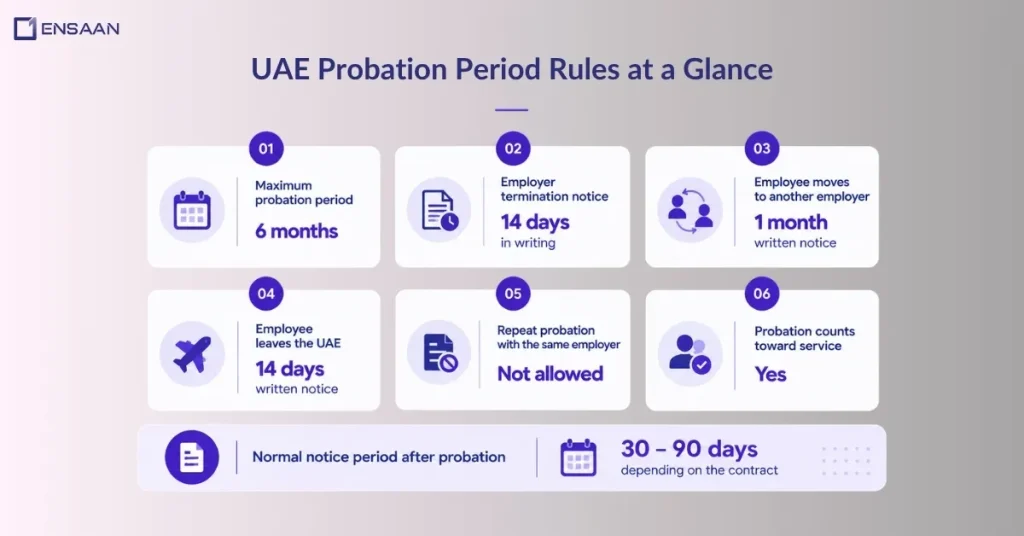
| Rule | What employers need to know |
| Maximum period | Six months from the start of work |
| Employer termination notice | At least 14 days in writing |
| Employee moves to another UAE employer | At least one-month written notice |
| Employee leaves the UAE | At least 14 days written notice |
| Repeat probation with the same employer | Not allowed |
| Probation counts toward service | Yes |
| Normal notice after probation | 30 to 90 days, depending on the contract |
These rules come from Article 9 of the UAE Labour Law.
The UAE Labour Law, Federal Decree Law No. 33 of 2021, states that probation cannot exceed six months and that an employer terminating employment during probation must provide at least 14 days written notice.
What Is the Maximum Probation Period in the UAE?
An employer can place a worker on probation for up to six months from the start date under Article 9. The same employer may not place the same person on probation more than once.
The six-month period is significant for HR because probation should not be viewed as a fixed assessment period.
Once the employee completes probation and continues working, the employment contract continues under the agreed terms, and the probation period counts as part of the employee’s service.
The law also does not require all employees to have a six-month probation period. It establishes the maximum term of employment that an employer can use if probation is specified in the employment arrangement.
For HR teams, the practical step is simple: record the exact joining date and the contractual probation end date in the HR system from day one.
Is the UAE Probation Period Applicable to All Free Zones?
Not always. The UAE Government says employees in most free zones are usually governed by the relevant free zone’s rules, alongside federal employment laws.
And the financial free zones, like the Dubai International Financial Centre and Abu Dhabi Global Market, have their own employment laws.
This distinction matters for HR teams managing employees in Dubai because a mainland entity and a DIFC entity may not follow exactly the same employment rules.
Before applying a probation template, HR should ensure the legal entity, free zone, employment contract, and governing framework are correct.
That one check can prevent a process designed for a mainland employee from being incorrectly applied to a special financial free zone.
Can an Employer Terminate an Employee During Probation?
Yes. During the UAE probation period, an employer may terminate employment; however, the employer must provide the employee with written notice of termination at least 14 days before the specified termination date.
Remember, an employer cannot waive the formal procedures when a worker is on probation. HR must provide the notice in writing and keep a record of the service date, the final working day, and the same information held in payroll.
This is where connected HR processes can step in.
The core HR and Payroll solution provided by Ensaan Technologies brings employee records, payroll, workflows, and reporting into a connected environment, which can reduce the risk of HR and payroll teams working from different data.
Does the Normal UAE Notice Period Apply During Probation?
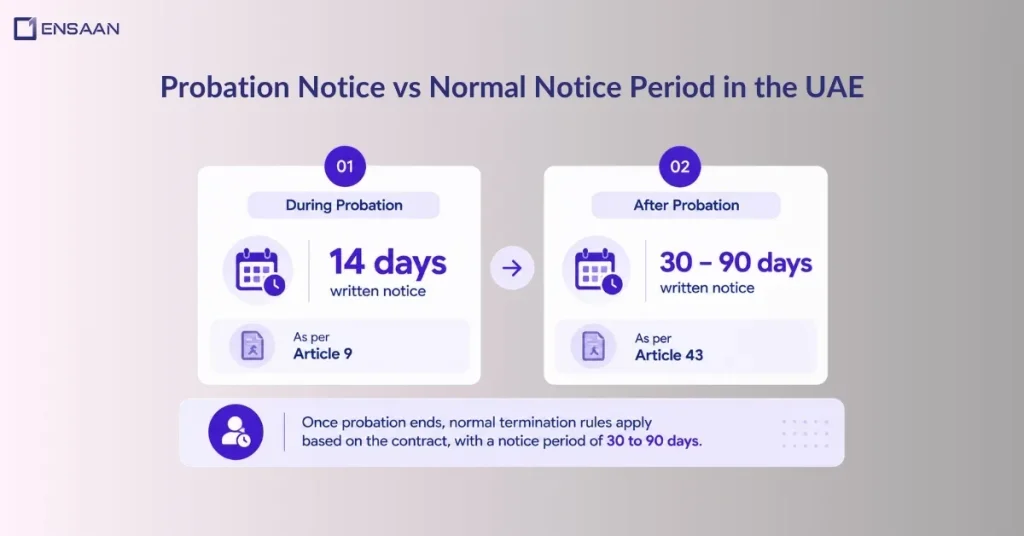
No. The special rules under Article 9 apply while the employee is on probation.
Once probation ends, normal termination rules apply.
Under Article 43, either party can terminate the employment contract with written notice, according to the terms agreed in the contract, of at least 30 days and no more than 90 days.
An employee is still eligible to receive the applicable wage for the notice period.
This distinction matters when HR calculates an employee’s final working date. A 14-day probation notice should not be confused with the longer notice period that may apply after confirmation.
This guide on the notice period in the UAE explains notice-period timelines, notice termination, notice pay, and related HR considerations.
What Should HR Document Before Ending Probation?
A good process benefits both the company and the employee. HR should have a clear record of the following before issuing a probation termination notice:
- Employee joining date and probation end date.
- Employment contract and agreed probation terms.
- Performance or role evaluation records.
- Attendance, leave, and conduct records where relevant.
- Written termination notice and the date it was provided.
- Final salary, deductions, leave balance, and other payable amounts.
- Work permit, visa, company asset, and access closure steps.
The UAE probation period should therefore be tracked as a defined HR milestone rather than left to a manager’s calendar or a spreadsheet reminder.
This is especially crucial for businesses operating in Dubai, Abu Dhabi, and other GCC locations with staff spread across different locations, where employee records may involve several HR administrators or legal entities.
Can HR Extend Probation Beyond Six Months?
No. The federal UAE Labour Law sets six months as the maximum probation period and does not allow the same employer to put the same employee on probation more than once.
With this in mind, an employer may continue the evaluation after the probation period, but it will be part of the standard employment contract, not an extended probation.
Employers should develop a formal review process within the six-month time frame. Set goals and performance criteria, provide feedback, and decide on outcomes before probation.
What Leave Rights Apply During Probation?
While probation doesn’t eliminate all employee leave rights, some entitlements have specific rules.
Under Article 31, an employee is not entitled to paid sick leave during probation.
An employer may grant unpaid sick leave when a recognised medical authority confirms the need for it. The UAE Government guidance on sick leave confirms this position.
A different provision applies to annual leave. Article 29 allows an employer to approve annual leave during the employee’s probation period from the employee’s remaining annual leave.
If employment ends before the employee passes probation, the employee retains the applicable entitlement to payment for unused annual leave.
These details are easy to miss when probation data, attendance, and payroll sit in separate systems. They also show why HR should avoid treating probation as a standalone recruitment stage.
Can an Employer Terminate Without Notice During Probation?
There is an important distinction here.
Ordinary termination during probation follows the Article 9 rule requiring at least 14 days written notice.
Separately, Article 44 sets out specific circumstances under which an employer may terminate an employee without notice.
These cases include forged documents, serious damage, major safety violations, and repeated failure to perform basic contractual duties.
Termination without notice is also permitted for disclosing confidential information, workplace assault, or serious unauthorised absences.
In these situations, you must follow the proper protocol. In the UAE Government, it is stated that, in the cases mentioned, an employer shall conduct a written investigation and reach a written, justifiable decision on dismissal.
Being on probation is therefore not the same as giving the employer unlimited rights to dismiss someone instantly.
What Should HR Check Before Terminating a Probationary Employee?
A practical employer workflow can be kept to six steps:
- Confirm the employee is still within the contractual and legal probation period.
- Check the employment contract and the employee’s exact joining date.
- Review documented performance, attendance, conduct, and role expectations.
- Determine whether the matter is an ordinary probation termination or a case covered by the Labour Law’s serious misconduct provisions.
- Issue the correct written notice and record delivery.
- Coordinate final payroll, leave, visa, access, and company asset processes.
Ensaan’s Payroll Process in the UAE guide also highlights the importance of bringing employee data, attendance, leave, salary information, and final payroll records together for accurate processing.
How Can Payroll Software Support the UAE Probation Period?
The UAE probation period itself is an HR process, but many of its consequences reach payroll.
When an employee leaves, you may need to pay off salary through the last working day, unused leave, deductions, advances, and other contractual amounts. HR should also have a reliable log of the notice date and termination date.
PeoplesHR, the offering from Ensaan Technologies, provides automated payroll calculations, HR integration, real-time alerts, discrepancy controls, employee self-service, and reporting.
If you’re looking to minimise manual HR and payroll management, explore PeoplesHR Payroll to see how the platform handles connected payroll and employee processes.
For companies handling frequent hiring and exits, the benefit is not that software decides whether an employee should pass probation.
That remains an HR and management decision.
The upside is connected records and workflows that help the team apply this decision accurately.
Why is GCC Experience Important to UAE Probation Processes?
A company headquartered in Dubai may hire in Abu Dhabi today and expand into Riyadh or Doha tomorrow. While the HR process may look the same, the legal aspects differ across the GCC.
Regional implementation experience is crucial when businesses select HR technology, and that’s one reason.
Ensaan Technologies has served the UAE, Saudi Arabia, Qatar, Kuwait, Oman, and Bahrain for 10+ years, is bilingual in English & Arabic, and has regional knowledge of regulatory requirements.
The company has also earned the trust of over 500 organisations with its HR applications.
For a business with several legal entities, HR software is only part of the decision. Configuration, implementation, support, employee data migration, workflow design, and ongoing regulatory updates can matter just as much.
That regional implementation approach is particularly relevant for GCC businesses where one organisation may have several employment frameworks and payroll processes running at the same time.
A Practical Approach for UAE Employers
The best approach to the UAE probation period is to think of it as a defined process, not a waiting period.
Start when the employee joins. Record the probation start date. Set review checkpoints before the deadline. Keep performance and attendance records in one place.
Make termination or confirmation decisions early enough to follow the correct notice rule. Then hand the final decision into payroll and offboarding workflows.
If you’re still tracking these dates with email and spreadsheets, it’s easy to miss simple issues like incomplete probation dates, poor documentation, or payroll records that don’t align with the employment file.
Handovers are easier when HR and payroll work seamlessly and are connected. Reliable HR technology should also be flexible and adaptable to the company’s expansion and local requirements throughout the GCC region.
Ensaan Technologies combines HR technology with implementation and regional support, which can be useful for businesses that need more than software alone.
Its stated focus on GCC markets, local regulatory requirements, bilingual support, and HR implementation gives employers a way to review both the technology and the process around it.
If your company still does manual reviews of outcomes, notices, and payroll changes tied to the probation date, now is a good time to identify areas to improve the process by automating tasks to minimize missed deadlines and duplicated work.
Frequently Asked Questions
1. What is the maximum UAE probation period?
UAE federal private sector law stipulates a maximum probation period of six months from the employee’s start date.
2. How much notice must an employer give during probation?
During probation, the employer must give at least 14 days’ notice when terminating an employee in the UAE.
3. Can probation be extended beyond six months?
No. The same employee cannot remain on probation beyond six months or be placed on probation more than once by the same employer.
4. Is a change of job allowed during the probation process?
Yes. Generally, an employee who wants to change jobs with another employer in the UAE must give at least one month’s written notice, subject to the provisions of Article 9.
5. Is paid sick leave available during probation?
No. UAE private sector employees are not entitled to paid sick leave during probation, although an employer may grant unpaid sick leave supported by a recognised medical report.
6. Does probation count toward the employee’s service period?
Yes. If the probation period ends and the employee remains on the job, the probation period is considered part of the employee’s service.