

At a commercial bank in Dubai, the HR director is handling a compliance task that most industries would find overwhelming.
The Emiratisation target for private-sector banking in the UAE is among the highest set by any regulator in the UAE.
Every AML and regulatory training session must be logged, auditable, and up to date.
Employee clearance procedures for when someone exits must follow a documented chain.
And somewhere between the DIFC branches, the Abu Dhabi Global Market, and the mainland, the HR team is handling dozens of nationalities on different types of contracts, with varying visa scenarios and end-of-service benefits.
When it comes to HR Software for a bank in the UAE, it’s not about which one has the most features.
It’s about identifying one that has been developed to meet the unique compliance, audit, and workforce management requirements of the financial services industry.
This guide will explore 7 hr platforms that stand out for the banking industry in the UAE & Dubai.
The 7 Best HR Software for the Banking Industry in UAE and Dubai
1. PeoplesHR
For banks operating in multiple GCC markets, the payroll and compliance environment is tricky to manage with most single-country platforms.
With compliance provisions that address the particular requirements that banking HR teams in the UAE face in practice, PeoplesHR is built across 40 countries and 20 industries, with more than 500 active deployments across the GCC.
WPS payroll with SIF file generation, EOSB calculations, and integration with GOSI for Saudi payroll operations and multi-currency payroll processing are natively available on the platform.
For banks with employees on both local and international contract terms, PeoplesHR handles both in the same system, without requiring data reconciliation between separate payroll tools.
Employee lifecycle management is particularly relevant for banking’s specific exit requirements.
The clearance process for an employee from a UAE bank requires multiple departments, documentation, and EOSB settlement, which should relate directly to the payroll record.
PeoplesHR handles this end-to-end, and a document audit trail is created that can withstand regulatory review.
Lexi, PeoplesHR’s AI-powered HR assistant, handles the employee-facing HR queries that pile up in any large branch network: payslip access, leave balances, contract queries, training deadlines.
This multilingual mobile application allows branch employees who speak various languages to access HR-related information and sign necessary compliance documents without relying on bilingual HR assistance for every action.
PeoplesHR is the most practical solution for mid-sized banking institutions seeking top HR software for the banking sector in Dubai, with full compliance with GCC payroll laws and regulations and a robust audit trail documentation mechanism.
2. Adrenalin
Banking is one of the sectors where Adrenalin’s depth genuinely sets it apart.
Adrenalin offers the complete solution to manage compliance with CBUAE and/or DFSA and everyday HR tasks across multiple locations, without a separate compliance platform running in parallel.
The platform’s payroll engine supports full compliance with local requirements in each of the 24 countries in the GCC.
This allows direct uploads to government portals for the WPS SIF, EOSB calculations, and multi-currency payroll for banks with both mainland and free zone staff on varying contract types.
This is especially important for institutions that have entities in both DIFC and on the mainland, as there are significant differences in regulatory regimes and conditions of employment.
Over 300 built-in reports give HR directors, compliance teams, and auditors a real-time view of workforce data, training completion rates, Emiratisation progress, and compensation analytics without anyone building a custom extract.
Emiratisation dashboards are live rather than retrospective, which matters when the Central Bank’s compliance window is measured in quarters, not years.
Sara, Adrenalin’s AI chatbot integrated with Microsoft Teams, handles routine employee requests, including policy queries, payslip access, leave applications, and compliance acknowledgment workflows.
So the HR team’s attention stays on governance decisions rather than high-volume repetitive interactions.
This layer makes this HR operation truly scalable for a bank with 300 HR staff across five branches, without having to add 300 more HR staff.
Adrenalin is the most comprehensive HR software solution for the banking sector in the UAE, serving large and mid-sized banks in Dubai, Abu Dhabi, and Sharjah, where the depth of compliance reporting is crucial and cannot be compromised.
3. Kore.ai
Banking HR teams deal with a specific communication volume problem.
A bank with 8 branches and 400 staff has a multitude of HR-related questions that always crop up.
In most banks, this is handled manually by the HR team, consuming hours that should be directed toward compliance and strategic work.
To resolve this, Kore.ai‘s conversational AI Platform creates intelligent HR assistants that can automatically do so in Arabic and English on the tools that bank staff already know. Instantly answers policy questions.
Proactive Training Deadline Reminders. Requests made and monitored in a conversational interface. Compliance acknowledgment without employees even having to use a separate HR portal.
For detailed context, you can read this guide on why organizations use Kore.ai.
The platform works alongside PeoplesHR and Adrenalin rather than replacing them, adding the automation and communication layer on top of core HR and payroll.
For banking HR teams managing high query volumes from distributed branch networks, Kore.ai addresses the specific bottleneck that turns three-person HR teams into reactive operations rather than strategic ones.
4. SAP SuccessFactors
SAP SuccessFactors is the standard system for financial groups and larger banks in the UAE with complex multi-entity structures and an existing SAP ecosystem.
Its Joule AI copilot introduces conversational analytics across all HCM modules, and its compliance documentation features are robust, especially for businesses grappling with multiple compliance frameworks at once.
Ideal for: Large dedicated HR technology teams, existing SAP enterprise infrastructure, major banks and financial groups with multi-jurisdiction operations.
Limitation: It requires 12 months or more to implement, and because many UAE mid-sized banks cannot afford major licensing fees, it is not available to most banks without enterprise IT support.
5. Workday
Workday has an established footprint in large UAE multinationals and regional banks, as well as a proven history in financial services worldwide.
It is directly linked to HR and financial planning, so headcount costs are automatically reconciled with the finance department’s budget model in real time, which is particularly important in banks where cost per employee is an important metric.
Ideal for: Large regional and international banks where HR and finance planning must be based on a single data model, including banks that consider headcount to be one of their main cost lines.
Limitation: High licensing and implementation costs, plus the need to maintain configurations by a dedicated Workday team, make it impossible for most banks that are not large enterprises.
6. Oracle HCM Cloud
Oracle HCM Cloud provides powerful workforce planning, scenario modeling, and compliance analytics capabilities, with strong support.
Its integration with finance and HR makes it more seamless for banking groups with multiple entities, allowing staffing decisions to be directly linked to cost modeling, something that standalone HR systems can’t replicate.
Ideal for: Regional banking groups with Oracle ERP or Fusion Finance that consider a common data model for HR and financial planning a key strategic imperative.
Limitation: Oracle HCM’s value is highest within its own ecosystem, but it requires significant setup investment to ensure the UAE-specific compliance layer that regional banks require.
7. GulfHR
GulfHR is built specifically for businesses in the Middle East, with the compliance level set at a regional, rather than a Western, default.
GCC-specific leave and attendance rules, together with WPS payroll and an Arabic interface, are natively available.
It’s a practical initial step for mid-sized banks requiring robust GCC compliance and simple HR management without enterprise complexity.
Ideal for: Mid-sized UAE banks and financial institutions looking for payroll compliance in the GCC and a simple, bilingual interface without a lengthy and complicated implementation process.
Limitation: Less advanced analytics, less multi-entity reporting depth, and a shorter regulatory documentation trail than with enterprise platforms or Adrenalin.
Why Banking HR in the UAE Carries Its Own Set of Demands
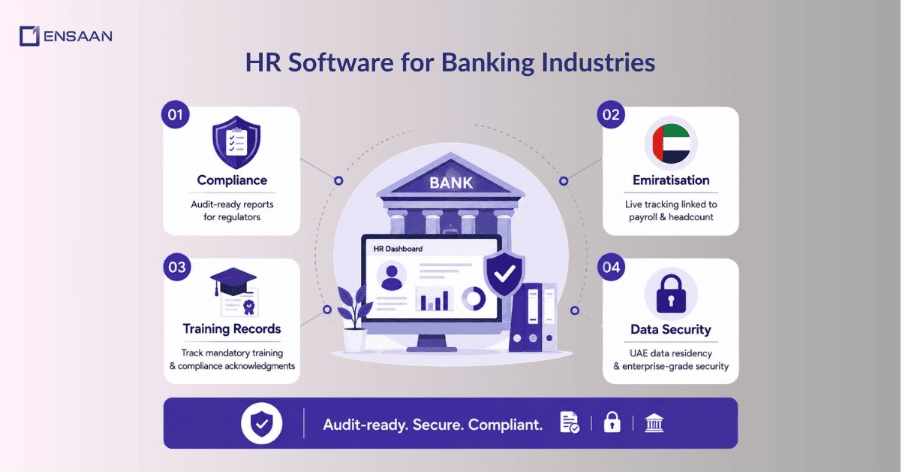
The UAE banking sector is regulated by a framework that is more stringent than that of most other private sectors.
The Central Bank of the UAE, the Dubai Financial Services Authority in DIFC, and the Financial Services Regulatory Authority in ADGM set expectations for governance, training documentation, workforce records, and related areas that directly affect HR software requirements.
The Emiratisation targets are also higher than the banking average, with a daily fine for non-compliant organizations.
This means that HR systems in UAE banks must register the number of national employees, provide compliance reports on request, and link to the real-time number of employees hired to ensure compliance is not based on a quarterly manual count.
To give some context on how regional organizations are dealing with these pressures, the top HR challenges facing GCC companies include compliance and talent acquisition, which are most relevant to highly regulated industries such as finance.
What the Best HR Software for the Banking Industry in the UAE Needs to Cover
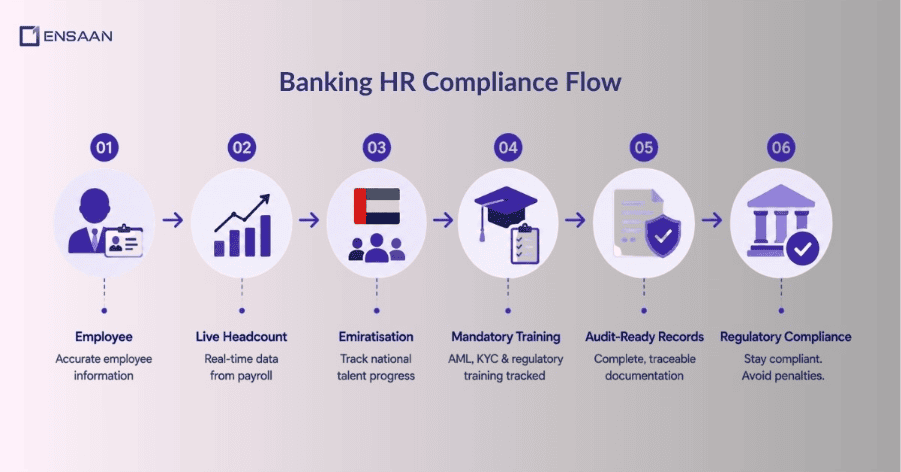
Before comparing platforms, banking HR buyers in Dubai should check these things.
First, audit-ready compliance reporting: the platform must generate clean, exportable records of training completion, policy acknowledgment, and employee status for regulatory review without manual collation
Secondly, Emiratisation tracking is linked to live payroll and headcount data, rather than being retrieved from a spreadsheet.
Third, comprehensive data security and data residency facilities: DFSA or CBUAE banks must process sensitive personal and financial data, and it must not be stored on foreign servers unless carefully managed.
The fourth aspect regarding banking is integrated learning/compliance training management.
Banks that are obligated to have compulsory AML/KYC/financial regulations training cycles should have a direct link between the HR system and how training is monitored and demonstrated, rather than viewing training as a separate activity.
Why is Ensaan Technologies the Right Implementation Partner for Banking HR in the UAE?
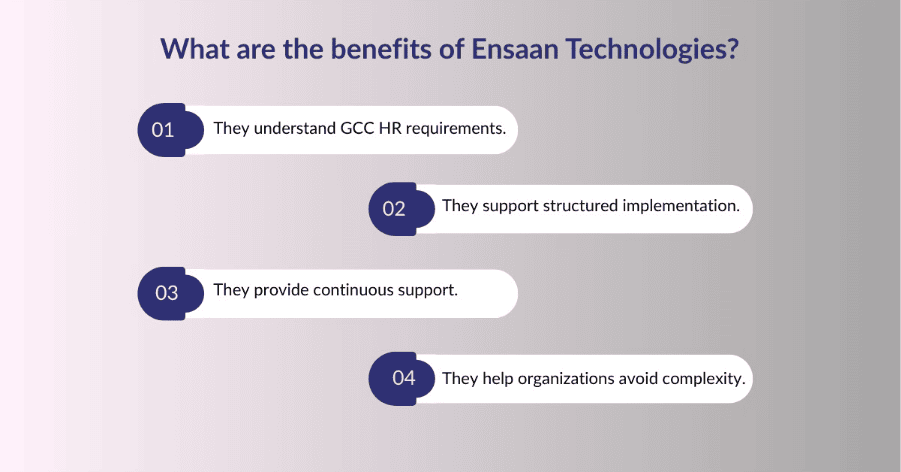
The most effective banking HR software in the UAE comes down to its configuration.
A platform that works seamlessly for CBUAE Emiratisation reporting at one bank can turn into a compliance nightmare for the same bank if the entity structures, employment terms, and payroll rules are not mapped correctly on day 1.
Ensaan Technologies has spent nearly a decade implementing core HR and payroll solutions exclusively for organizations across the UAE, Saudi Arabia, Qatar, Kuwait, Oman, and Bahrain, including financial institutions.
The implementation services team maps every compliance requirement, entity structure, and payroll configuration before anything is deployed.
Ongoing bilingual support services in English and Arabic cover post-go-live issues around the clock.
For a broader view of the best integrated HR and payroll options in the UAE, this blog covers the landscape in detail.
For banks wanting a deeper training compliance layer, pairing HR software with a dedicated learning management system gives L&D and compliance full visibility in one connected system.
Schedule a complimentary consultation to learn which platform best suits your bank’s specific needs and workforce requirements, or contact Ensaan directly.
Frequently Asked Questions
1) How is HR software for banking different from regular HR software in the UAE?
Banks in the UAE face compliance obligations from CBUAE, DFSA, or FSRA that require audit-ready training records, documented employee clearance processes, and live Emiratisation tracking.
2) How does Emiratisation tracking work in HR software for UAE banks?
Emiratisation tracking is linked to real-time payroll and headcount reporting in platforms such as Adrenalin and PeoplesHR.
3) What training compliance features should a bank’s HR software include?
At minimum, the platform should track mandatory training completion, generate certificates, send automated reminders before deadlines, and produce an auditable record for regulators.
4) What is the significance of data residency for the banking HR software in Dubai?
Very important for institutions under CBUAE or DFSA oversight. Employee data, payroll records, and training documentation should be hosted within the UAE, not on foreign servers.
5) How long does HR software implementation take for a bank in the UAE?
For a mid-sized bank with multiple branches and multi-entity payroll, a structured implementation with proper compliance mapping and data migration typically takes two to four months.