
If asked today, what skills does your organization have, and how confident would you be in your answer?
Most HR leaders could tell you the roles they have filled. They’ll know which departments are present, how many people are in each, and a general idea of each department’s function.
However, when it comes to skills, there’s less clarity. Not that the information is unavailable somewhere, but rather because most organizations have never developed a system to surface it, connect it, and act on it.
This is what skills intelligence is designed to do. This guide explains what it is, why it is now a strategic priority rather than an HR project, and what it looks like in practice.
And how organizations throughout the Gulf Cooperation Council (GCC) region are beginning to leverage it to build workforces capable of adapting to the next.
What is Skills Intelligence?
Skills intelligence is the capacity of an organization to anticipate, identify, and respond to the skills the business and its people have, those they are acquiring, and those the business will need tomorrow. It’s not just one tool or a one-time audit.
It’s an always-evolving, data-informed perspective on capability relevance that links each person to the organization’s path.
The crucial word that distinguishes it from the traditional skills database is action.
If a competencies spreadsheet exists, it tells you that something exists.
A good system lets you know whether it aligns with the business’s direction, who in the business has the greatest potential to fill a gap, and which learning investment will provide the quickest return.
That shift transforms skills data from a record into a decision-making resource.
Why Has Skills Intelligence Become Urgent in 2026?
The shift toward this approach is not a trend. It is a response to a structural change in how work actually functions.
The 2026 Skills Economy Report from Cornerstone documents this in detail: AI, automation, the green transition, and demographic change are collectively reshaping role demand faster than annual workforce plans can keep pace with.
The old approach, building a job architecture once, hiring to it, and reviewing it every few years, cannot keep pace.
Three specific pressures are driving this shift right now.
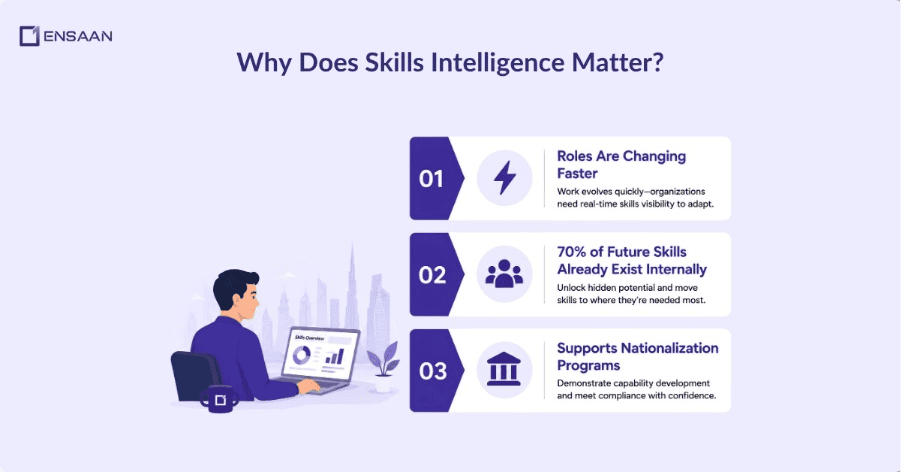
1) Roles Are Changing Faster Than Job Descriptions
A software engineer hired two years ago may now spend a third of their time doing work that did not exist when they joined.
If an organization doesn’t have this type of visibility, there is no way to detect this or react to it on any systematic basis.
2) Hiring Alone Cannot Close the Gap
70% of the skills a business will need in the next 3 years are already in the business’s workforce, but not where they are needed right now.
Those capabilities are hidden and, with the proper tools, become visible and movable.
3) Nationalization Programs in the GCC Require Skills Proof
Emiratisation, Saudization, and Qatarisation are increasingly moving from quota compliance to capability development.
Regulators and leadership both want evidence that national employees are genuinely building the skills tied to meaningful roles, which is exactly what skills intelligence is built to answer.
What Does Skills Intelligence Actually Involve?
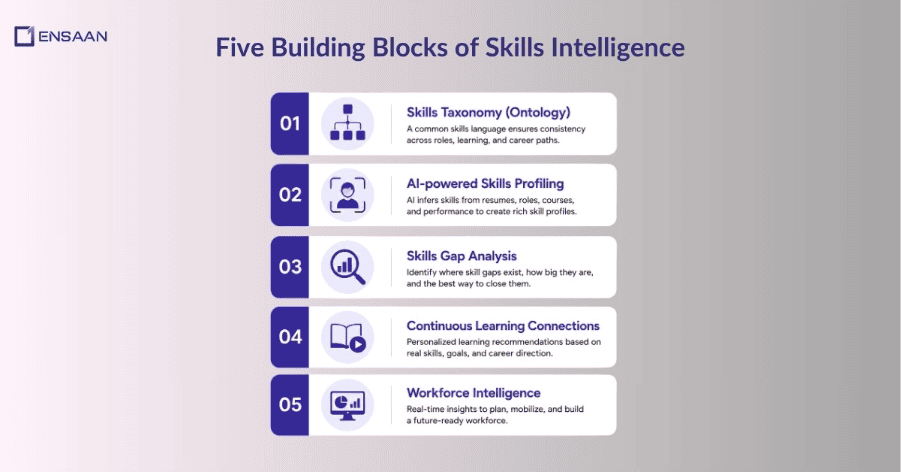
Involving a capability-building effort is not a single project. It’s a collection of layers that collectively present an organization with real-time insights. The main elements are:
1) A Skills Taxonomy or Ontology
Before you can measure skills, every role, learning program, and employee profile needs to speak the same language.
A skills ontology creates a common framework, ensuring that “data analysis” in one department means the same thing in another, and that it connects to the right content and career paths.
2) AI-powered Skills Profiling
It would be impractical to evaluate the competencies of all employees manually at this scale.
These systems employ AI algorithms to infer skills from resumes, job titles, completed courses, and performance data, creating comprehensive profiles for each individual without a survey.
Cornerstone Skills Graph can generate a substantive skill profile from a job title and a resume alone, thereby changing the starting point for every development conversation.
3) Skills Gap Analysis
When one knows what abilities and capacities lie within and what the business needs, a good system plots the gap between them.
This is where the value of planning comes in: not only recognizing there is a gap, but also knowing how big it is, where it is focused, and whether it can be addressed through hiring, reskilling, or internal mobility.
4) Continuous Learning and Skilling Connections
The entire system is most useful when it connects directly to learning.
An individual’s needs for meaningful recommendations are based on their actual skills profile and career direction, and are more relevant than a static role-based course catalog.
SkillsDNA is a common language for skills that the EdCast learning experience platform uses to unify, normalize, and leverage skill data to power personalized learning, career development, and internal mobility at scale.
5) Forward-looking Workforce Intelligence
The most sophisticated layer of this approach looks outward as well as inward. HRForecast adds external GCC and global labor market data to the picture, allowing organizations to benchmark internal skills against the talent market.
Model which skills will be critical in three to five years, and translate business strategy into concrete workforce actions through its smartPlan and smartLibrary tools.
How Skills Intelligence Changes the Way HR Works?
When this functionality is present and effective, it’s not just a matter of improving existing HR processes. It changes the nature of what HR is required to do, and what it can credibly answer.
1) Hiring Shifts from Role-matching To Skills-matching
This means candidates are not narrowed down by their previous job titles and experience but by their competencies, thus broadening the pool of talent and enhancing the quality of hire.
2) Learning Stops Being Generic
Based on each employee’s skills profile and development direction, the LMS can recommend relevant content at the right time, rather than offering the same courses to everyone in the same department.
3) Internal Mobility Becomes a Real Strategy
Many organizations fail to retain high-performing staff because those staff members don’t see a path forward within the organization.
Skills, intelligence, and capabilities, such as Cornerstone’s Talent Marketplace, help internal opportunities become discoverable and better align people to projects, mentors, and opportunities based on true capability fit.
4) Succession Planning Has Something to Work With
It is quite simple to name successors. Assessing whether those successors actually have the skills the role will require in three years is where most succession planning falls short.
The right skills data gives that process a factual foundation.
What Skills Intelligence Looks Like in Practice: The DHL Story
DHL, working within the Cornerstone ecosystem, built a workforce skills approach that connected back-office and frontline roles through a common skills ontology, something that had always been treated as too complex to bridge.
AI detected previously unaddressed skill gaps that later became workforce issues, and workers had access to structured career trajectories linked directly to the skills they were acquiring.
The end product was a workforce development system that the business could not only run but also count on and trust.
The full DHL skills intelligence case study covers how the approach was built and what changed.
Skills Intelligence in the GCC: Why the Stakes Are Higher Here?
The GCC is not a typical market for the adoption of workforce skills.
The combination of ambitious national vision programs, high workforce diversity, rapid digital transformation, and specific regulatory expectations around national talent development creates a higher-stakes environment than most global markets face.
With UAE, Saudi, and Qatari organizations, it’s not only about maximizing the ROI of the L&D investment.
It is the mechanism that will make the nationalization strategy work, enable digital transformation, and make talent retention viable in a region where high-performing individuals have more choices than elsewhere in the world.
Understanding the full context of HR challenges in the GCC lies behind the demand for better skills visibility. So does the broader AI transformation in GCC talent management, which is worth reading alongside this guide.
How Does Ensaan Technologies Build Skills Intelligence for GCC Organizations?
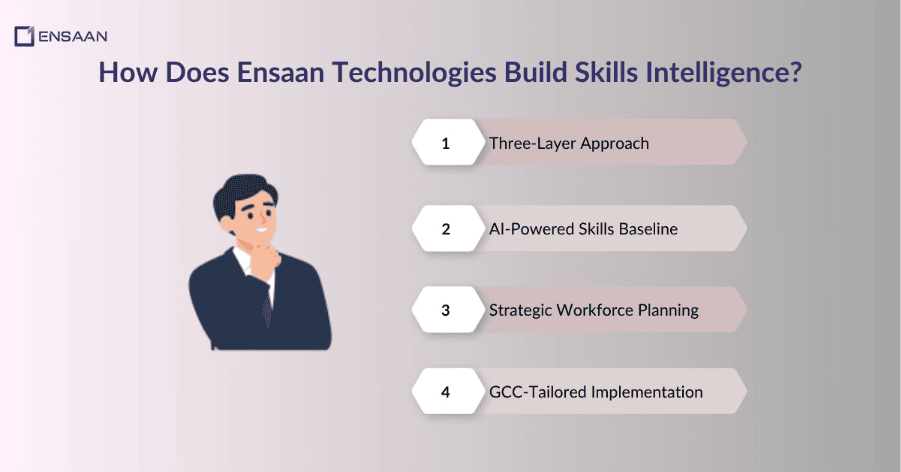
Ensaan Technologies is developing this capability in three overlapping layers, each tackling a distinct portion of the picture.
The foundational skills layer is Cornerstone Skills Graph and Skills and AI.
This AI-powered system provides the building blocks for individual skill profiles, organizational visibility of skills, skills-based learning, and career development and succession planning, all based on real skills data.
The Skills and AI platform establishes a common skills language across the organization, which is the prerequisite for everything else.
The HRForecast skills capability helps in modeling future skills requirements, identifying upskilling priorities, and connecting workforce strategy to business direction using GCC-specific labor market data.
These tools collectively encompass the entire journey: from identifying current skills to outlining a course of action to reach the business destination to developing skills through linked learning to continuously monitoring skill development.
Based on the GCC’s organizational structure, employees’ nationalities, and the regulatory landscape, each layer is configured by the implementation services team at Ensaan Technologies rather than using a global default and asking the client to adapt.
See the platform in action with a personalized demo, or talk to Ensaan’s team about where to start for your organization.
Frequently Asked Questions
1) What is skills intelligence, and how is it different from skills management?
Skills Management is used to record and manage employees’ skills. It automates skills analysis, identifies skill gaps, forecasts demand, and aligns skills to decisions.
The key difference between a record and a real-time strategic tool is that a record is static, while a real-time strategic tool is dynamic.
2) Does skills intelligence require replacing an existing HR system?
No. This approach serves as a layer that interfaces with and augments existing HR, learning, and performance systems. These tools, such as Cornerstone’s Skills Graph and HRForecast, aim to complement an existing system, not replace it.
3) How does AI contribute to skills intelligence?
The entire system is scalable thanks to AI. Otherwise, it would be impossible to profile each employee’s skills manually.
4) Can skills intelligence support Emiratisation and nationalization program requirements?
Yes, directly. These tools now enable organizations to identify who in the national ranks is developing which competencies, what competencies are lacking in the nationalized roles, and what targeted development is needed to address these gaps.
5) How quickly can an organization expect to see results from a skills intelligence investment?
Profiles are usually created in the initial phase, and organ maps can be generated within a few weeks of deployment.
6) What is the difference between a skills taxonomy and a skills ontology?
A skills taxonomy is a structured list of skills organized into categories. It goes further, mapping the relationships between skills, how they connect to roles, how they relate to each other, and how they evolve.
Most effective platforms are built on an ontology rather than a flat taxonomy, which is what enables AI to make genuinely useful recommendations rather than simple keyword matches.