
Enterprise payroll in the UAE is not difficult because the technology has not caught up.
It’s a challenge because most payroll software was designed for simpler organizational arrangements than those run by larger UAE enterprises.
A commercial bank that has a mainland entity, a DIFC entity, and a subsidiary in Abu Dhabi Global Market does not have one payroll.
It has three operating entities, each under a different employment system, each with varying WPS requirements, compensation arrangements, and end-of-service benefits.
An industrial conglomerate with production facilities in Dubai, Sharjah, and Saudi Arabia requires consolidated payroll reporting at the group level, with accurate cost center allocation at the facility level.
For a technology firm that employs international staff on a shadow payroll, with multi-currency compensation and LTIP packages, the platform must support the intricacies of expatriate compensation and regular salary processing in the UAE.
The payroll software that works for an SME in Business Bay will not work for these organizations.
This platform guide outlines the nine platforms that truly fit the enterprise size and compliant environment of the UAE and defines which ones satisfy the requirements of the sheer complexity.
Best Payroll Software for Enterprises in UAE and Dubai
1. PeoplesHR
In the UAE, enterprise-grade payroll software can vary based on the organization’s or individual’s interpretation.
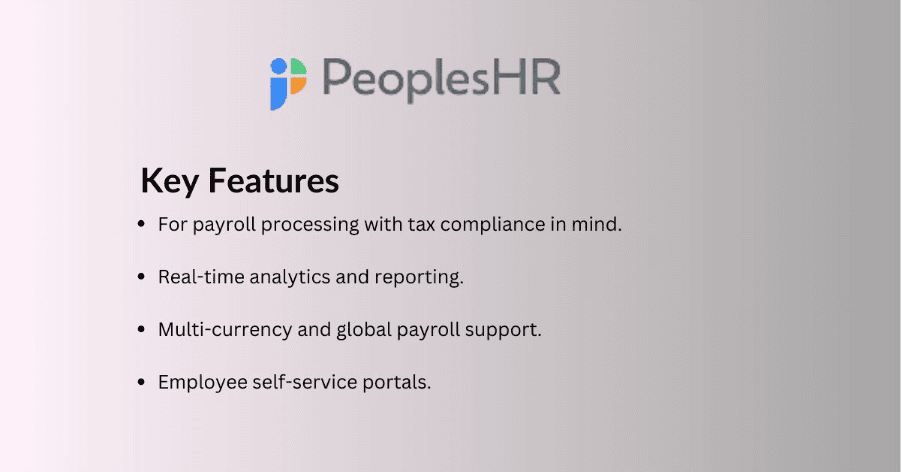
PeoplesHR offers the most comprehensive solution for most companies in the UAE.
PeoplesHR offers deep GCC compliance, multi-entity configuration, AI-powered automation, and a track record of successful implementations in the UAE, including financial services, hotel, and industrial groups.
What sets PeoplesHR apart for UAE enterprise payroll:
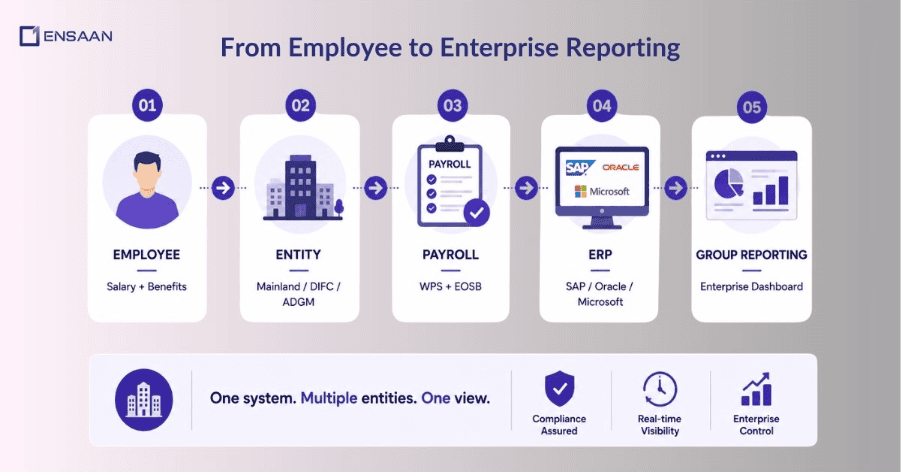
Multi-entity payroll is a core configuration capability.
Separate employment terms, payroll structures, and compliance settings can be maintained per legal entity, whether mainland, free zone, or a GCC subsidiary.
The group-level HR director sees consolidated reporting across all entities in a single dashboard.
The generation of WPS SIF and the calculation of EOSB are native and accurate, including correct allowance calculations in the base used for gratuity calculation, whereas many enterprise platforms require manual corrections.
With payroll self-service available across 15 languages, the mobile app makes it possible to engage with HR technology accessible to every employee in the enterprise, regardless of seniority or nationality.
PeopleHR’s AI Assistant, Lexi, can automatically respond to payroll-related questions from the workforce, significantly reducing the time spent on repetitive queries for large enterprise payroll teams.
Flexible deployment across SaaS, on-premises, and private cloud, with Middle East regional hosting, addresses the data residency requirements that financial services and government-linked enterprises in the UAE typically carry.
Pricing: Per-employee, per-month subscription. Enterprise agreements available through Ensaan Technologies.
2. Adrenalin
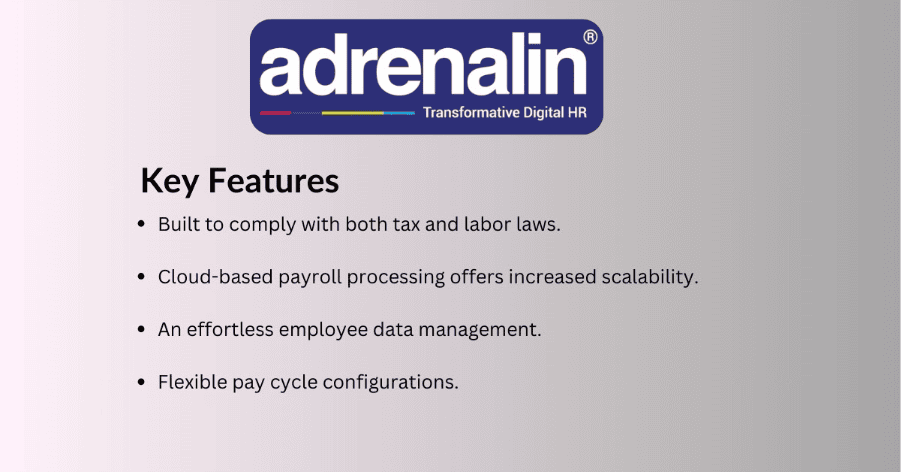
Where ‘multi-entity’ in enterprise reflects countries as well as UAE legal entities, the scale and depth provided by Adrenalin make it a complete payroll software for governing UAE enterprises with operations across the GCC.
What sets Adrenalin apart for UAE enterprise payroll:
The payroll engine covers 24 GCC countries with direct government portal uploads, making it practically unique among platforms on this list in its ability to handle payroll compliance obligations across the entire Gulf from a single system.
For a UAE group with entities in Saudi Arabia and Qatar alongside its Dubai and Abu Dhabi operations, this eliminates the parallel-systems problem that most enterprise clients manage through expensive middleware or manual reconciliation.
More than 300 built-in reports support enterprise governance needs: Emiratisation progress by entity, payroll cost by department and cost center, overtime variance by site, and compensation equity analysis across the enterprise.
Finance directors and board-level HR leadership receive the information they need, without requiring a BI team to create custom extracts.
Sara, Adrenalin’s AI chatbot integrated natively with Microsoft Teams, handles payroll queries, leave approvals, and compliance acknowledgments through the interface enterprise employees already use daily.
This means that for a payroll team of 1,000-plus employees, the volume of individuals requesting queries decreases, and the capacity equation for the entire function changes.
Pricing: Quote-based, structured by deployment scope and total headcount. Enterprise agreements through Ensaan Technologies.
3. Oracle HCM Cloud Payroll
Oracle HCM is an easy enterprise selection for organizations in the UAE using Oracle ERP or Fusion Finance, where enterprise selection is directly linked to HR/finance, and headcount costs are visible in operating budgets in real time.
Oracle HCM handles complex compensation architecture, multi-entity reporting, and global payroll consolidation well within its own ecosystem.
Enterprise fit: Very high within the Oracle ecosystem. To get the UAE-specific compliance and regional allowance structures right, it’s essential to have the expertise of implementation partners.
Practical consideration: Like SAP, value compounds primarily within the Oracle infrastructure and requires significant investment to maintain GCC-specific configurations.
Pricing: Enterprise pricing on request.
4. SAP SuccessFactors Payroll
This is the benchmark for companies already on SAP ERP, particularly manufacturing companies, government bodies, and large retail and logistics firms where payroll is tightly coupled with finance, procurement, and project management.
The 2026 Joule AI update adds a conversational analytics layer across HCM modules.
Enterprise fit: Very high, within an SAP ecosystem. Payroll data flows directly into SAP Finance and Project Accounting in real time. UAE-specific compliance requires expert configuration.
Practical consideration: Twelve months or more for implementation time and a need for specific SAP skills to support the configuration.
Pricing: Enterprise Licensing, through SAP’s UAE partner network.
5. Workday Payroll
Workday has been adopted by large multinationals and professional and technology services companies in the UAE.
Its ability to link HR, financial, and payroll planning directly makes it an ideal solution for organizations that require headcount decisions to be on the same data model as financial forecasts and payroll expenses.
The Workday Skills Cloud also introduces a talent intelligence component that enterprise CHROs are looking for in addition to payroll.
Enterprise fit: High for multinationals and professional services firms managing complex compensation and global workforce planning.
Practical consideration: Cost and implementation complexity position it squarely in the large enterprise bracket.
Pricing: Enterprise pricing, available through Workday’s UAE implementation partners.
6. ADP GlobalView Payroll
ADP GlobalView is the default for multinational enterprises that need payroll managed across 40 or more countries from a single platform and want a managed service model rather than a software implementation.
GlobalView offers smooth regional integration for a global corporation already implementing ADP globally in the UAE. UAE-specific compliance is handled through ADP’s regional configuration rather than native product design.
Enterprise fit: High, for global enterprises operating on ADP around the world. Very good for multi-country payroll consolidation and managed payroll service models.
Practical consideration: Not suitable for U.A.E. based businesses that do not already have a global ADP relationship.
Pricing: Managed service pricing on request.
7. Dayforce Payroll
Dayforce Payroll is an integrated HCM platform used by large enterprises globally for payroll, workforce management, and talent in one system.
Its continuous payroll calculation model distinguishes it for large organizations that calculate payroll in real time based on shifts rather than at the end of the month and/or include executive compensation.
Enterprise fit: Very good for UAE enterprises that operate complex shift-based payrolls in addition to their workforce payroll. It takes regional partner expertise for UAE compliance configuration.
Practical consideration: UAE market presence is less established than the global enterprise platforms above it, which affects local implementation and support depth.
Pricing: Enterprise licensing is available through Dayforce regional partners.
8. Darwinbox
With its growing presence in the UAE and GCC, Darwinbox is an AI-driven HCM platform that fills the gap between enterprise platforms and mid-market tools in the region.
It provides strong talent management, modern UX, and competitive pricing compared to SAP and Oracle, making it a viable solution for UAE companies to leverage modern HCM features without the complexities of a global enterprise solution.
Enterprise fit: Moderate to strong for UAE enterprises with 500- 3,000 employees for whom modern talent management is as critical as payroll compliance. GCC payroll compliance depth is developing.
Practical consideration: UAE-specific payroll compliance and multi-entity governance are still maturing relative to more established regional implementations.
Pricing: Quote-based through Darwinbox’s regional team.
9. Microsoft Dynamics 365 HR
For a large business in the UAE that uses Microsoft Dynamics 365 Finance and Operations, the HR module offers a native integration layer to tie HR, payroll, and financial reporting under the Microsoft umbrella.
Copilot AI integration adds conversational analytics across the HR function in 2026.
Enterprise fit: Very good for enterprises with a strong dependence on Microsoft Dynamics as an ERP.
Microsoft’s UAE implementation partner network enables compliance with UAE WPS and regional payroll setup.
Practical consideration: Like Oracle and SAP, the value is highest within the Microsoft ecosystem and requires partner expertise for regional compliance accuracy.
Pricing: Dynamics 365 HR pricing is part of Microsoft enterprise licensing agreements.
What Makes Enterprise Payroll in the UAE Structurally Different?
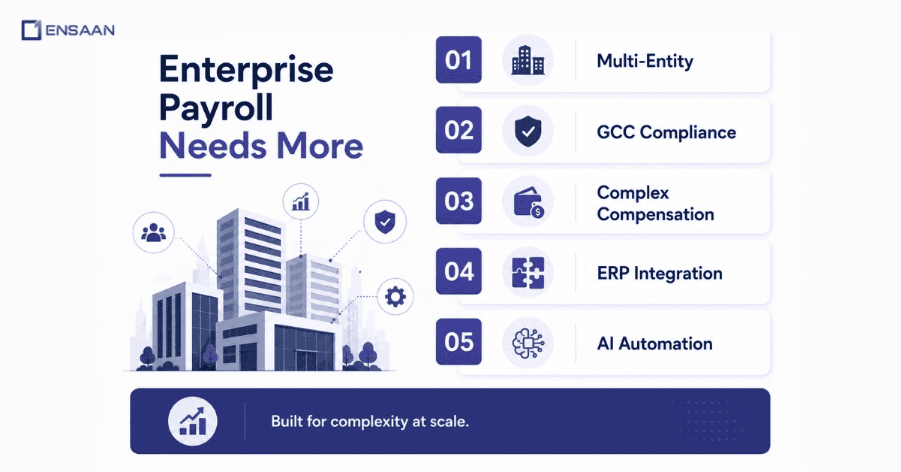
Enterprise payroll in the UAE has three layers, and most regional platforms handle only two at best.
1) Multi-entity legal structure
Generally, large companies in the UAE have multiple legal entities on parallel regulatory structures.
Different employment legislation, leave entitlements, and payroll responsibilities apply to companies in the mainland, DIFC, ADGM, and free zones.
A platform that cannot maintain separate payroll configurations per entity while consolidating reporting at the group level creates a governance gap that shows up in every audit.
2) Compensation architecture
Executive base salaries, housing & transport allowances, performance bonuses, sales commissions, LTIPs, and multi-currency aspects for internationally mobile employees are common components of enterprise compensation in the UAE.
They have varying EOSB implications and treatment under WPS, as well as varying tax reporting requirements for employees from specific home countries.
Generic payroll tools built for salary-and-allowance structures break down at this level of complexity.
3) Regulatory reporting at scale
Not a quarterly manual count, but live data segmented by entity, seniority band, and national employee category is what an enterprise HR director handling Emiratisation compliance for a workforce of 2,000 employees needs.
Each one has its own reporting format that the Central Bank, MOHRE, and free zone authorities require to be accurate, automatic, and on demand.
How Was This Comparison Built?
Each platform below was assessed against five criteria specifically relevant to enterprise payroll in the UAE:
1) Multi-entity configuration
Can the platform maintain separate payroll rules, compliance settings, and employee terms per legal entity while producing consolidated group reporting?
2) GCC compliance depth
Does the platform offer native WPS SIF generation and EOSB calculation and/or regional regulatory compliance as an add-on?
3) Enterprise integrations
How deeply does the platform integrate with SAP, Oracle, Microsoft Dynamics, and other ERP systems that large UAE organizations already run?
4) Compensation complexity
Does it support executive compensation, multi-currency compensation, shadow payroll, LTIP, and variable pay in the same payroll cycle?
5) Automation and AI capability
Will AI significantly reduce the manual workload of large payroll teams, or is it just a marketing ploy?
How Does Ensaan Technologies Help Your Organization Choose the Right Payroll Software?
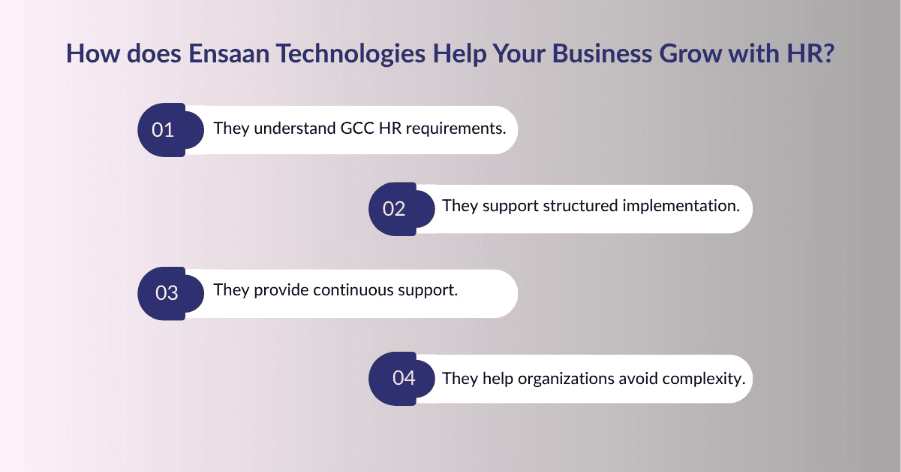
Configuring the right platform for a UAE enterprise’s specific entity structure, compensation architecture, and compliance requirements is where most enterprise payroll implementations either succeed or fall short.
For nearly a decade, Ensaan Technologies has implemented core HR and payroll solutions specifically for companies in the UAE, Saudi Arabia, Qatar, Kuwait, Oman, and Bahrain.
Ensaan Technologies helps organizations by consulting, designing, and implementing digital Human Capital Management (HCM) and workforce solutions.
They act as a regional partner for software vendors to automate and optimize HR, payroll, and corporate learning.
The implementation services team models all legal entity structures, compensation components, and compliance requirements before implementation for enterprises in the UAE and Dubai, considering payroll software.
Bilingual support services in English and Arabic cover post-go-live issues across all time zones in which UAE enterprise payroll typically runs.
Schedule a meeting to explore the best platform for your enterprise business, or reach out to Ensaan directly.
Frequently Asked Questions
1) What is the key compliance requirement for enterprise payroll in UAE that most global platforms miss?
WPS SIF file generation formatted specifically for UAE banks. Global platforms commonly handle payroll calculation correctly but require custom configuration for SIF formatting.
2) Can one payroll system handle both mainland and DIFC entity payroll simultaneously?
Yes, if it is a multi-entity configuration, not a multi-company workaround. PeoplesHR handles this natively.
3) How should enterprises manage payroll for DIFC and ADGM entities specifically?
DIFC and ADGM entities operate under their own employment laws, separate from the UAE Labor Law that covers mainland entities.
4) Is enterprise payroll software in the UAE priced per employee or per module?
Both models exist across this list. PeoplesHR is per employee per month. SAP, Oracle, and Workday typically combine per-employee subscription with module licensing. Adrenalin and several others are scoped and quoted per enterprise.
5) What integration depth should enterprises require between payroll and ERP systems?
With real-time or near-real-time bidirectional integration, payroll costs should appear in financial reporting as payroll runs, not days later.