
Each year, businesses around Dubai, Abu Dhabi, Riyadh, and Doha invest in learning technology to create a workforce that can keep pace with the rapid pace of change in the region.
But still, a surprising number of those implementations fail to get employees to use the platform, stay within budget, or make it practical.
It’s not always the software. It’s usually the process that’s the problem.
This guide will take you through what a successful LMS implementation in the GCC region entails, the benefits of an LMS, and how to prevent costly mistakes that can eat up time, money, and credibility for organizations.
7 Important Steps for a Successful LMS Implementation in the GCC Region
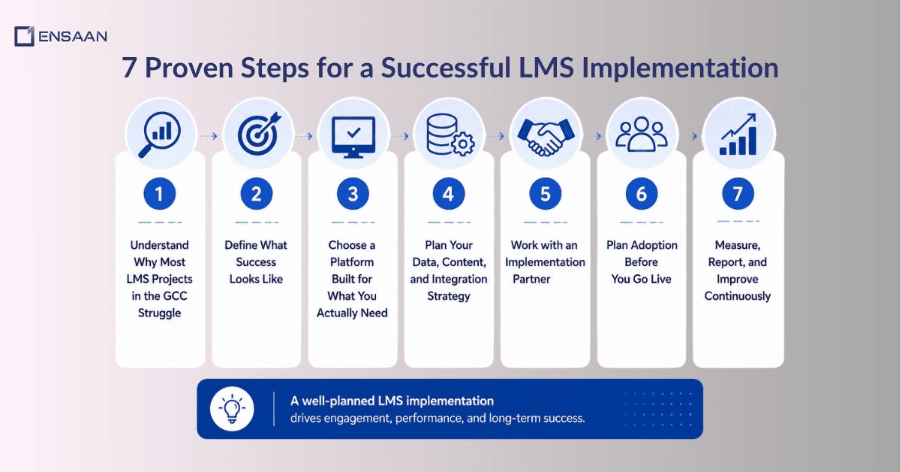
1) Understand Why Most LMS Projects in the GCC Struggle Before They Start
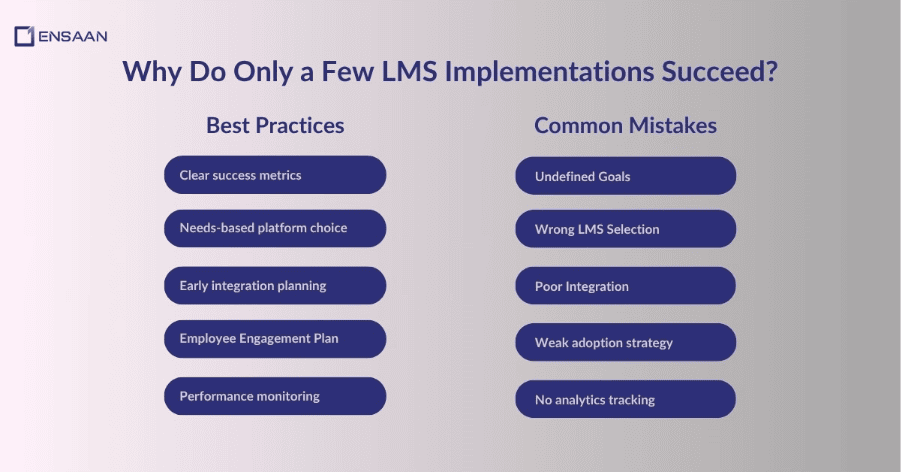
You should first understand the common issues in the area before you shortlist a vendor.
The two biggest reasons for LMS failures in Dubai and the UAE are that it is implemented as an IT project and not a business transformation.
The learning system is technically deployed but never really used due to insufficient consideration of change management, multilingual support, and the system’s fit within the organization.
You also have a unique workforce in the GCC. Many workers, such as those in hospitality, construction, retail, and logistics, work at the front line and are not behind a desk.
If you set up a system based on logins or English-only, you will exclude most of your people from the start.
If you are still figuring out the basics, it helps to first understand how a learning management system works and the different types of LMS before diving into implementation planning.
Understanding these facts helps in implementing an LMS in Dubai successfully.
2) Define What Success Looks Like Before Choosing a Platform
This seems like a no-brainer, but it’s done less frequently than you might think.
Before assessing any system, meet with your stakeholders and answer this question:
- What training issues are you addressing? Is it for compliance tracking with MOHRE/DOH regulations?
- Is it a quick way to get employees up to speed in a fast-moving retail business?
- Does it address any gaps for Vision 2030 or UAE Vision goals your organization is working towards?
Your answers will shape every decision that follows, from which features matter to how you measure ROI.
But if you’re considering the Ultimate LMS Checklist method, which is to compare different platforms feature by feature without considering the business results, you might end up choosing the most impressive demo, not the most effective system.
You need to understand the basics to know when choosing an LMS, including everything from deployment types to the LMS vs LXP distinction.
Document your requirements. Communicate with HR, IT, legal, and line managers. The organizations that get this right move much more quickly in implementation because everyone is aligned before the project starts.
3) Choose a Platform Built for What You Actually Need
The platform choice is not as complicated once you’ve understood your needs.
Ensaan Technologies provides top-tier Learning Management Systems (LMSs) that have been rolled out in Dubai and across the GCC region.
Cornerstone is the world’s leading LMS, trusted by over 7,000 organizations and 100 million users across more than 180 countries.
Its ability to support Arabic, along with 50+ other languages, makes it especially relevant for the GCC, and its AI-powered learning recommendations and compliance management features align seamlessly with the region’s regulatory requirements.
It easily tracks learning and skills in one place and demonstrates compliance across HR and operations teams with Cornerstone.
It’s also VR-ready, includes gamified learning paths and an offline mobile learning app, a feature that is critical for frontline workers in industries such as manufacturing, healthcare, and hospitality.
The Cornerstone Learning Suite consists of five integrated modules to provide GCC organizations with an ecosystem of learning management, learning experience, extended enterprise, immersive training, and content.
Saba LMS is an enterprise learning system for rapid deployment with excellent configurability, especially tailored for Public Sector and Government organizations in the GCC region.
It integrates learning and performance/succession capabilities and is a perfect fit for organizations with integrated talent programs.
If you’re considering which of the two enterprise LMS platforms, Cornerstone or Saba, is the right choice for you, you’ll find a side-by-side comparison of the two in Ensaan’s guide to the best enterprise LMS platforms for 2026.
Related topic: Best Enterprise LMS Platforms
These can both be implemented through Ensaan Technologies, where you will have a single implementation partner who is very familiar with each product.
4) Plan Your Data, Content, and Integration Strategy Early
It is here that most LMS implementations in the region stall midway through the project.
These things must be planned before:
Data migration: Moving from a legacy system or spreadsheets requires clarity in transferring your employee data, historical training records, and completion certificates.
In organizations with employees from different countries in the GCC region, employee information is likely dispersed across various HR systems and even paper records. Cleaning this up takes longer than expected.
Content readiness: The platform is only as valuable as its content. Many organizations that start their LMS in Dubai and Qatar discover that they have little Arabic material, courses that are no longer relevant, or none that align with job roles.
Ensaan’s Learning Content solutions address this directly, giving you access to world-class content providers through Cornerstone’s Content Anytime offering, so you are not starting from scratch.
Integration: Your LMS needs to talk to your HRIS, payroll, and possibly your performance management system.
Cornerstone integrates natively with tools like Salesforce, Microsoft Teams, Workday, and others.
Ensaan Technologies also supports API-based integrations for locally used HR platforms common in the GCC region.
If you are also looking to go beyond structured learning, the Learning Experience Platform built on EdCast opens up social, collaborative, and AI-driven content discovery that complements a traditional LMS extremely well.
5) Work with an Implementation Partner Who Knows the GCC
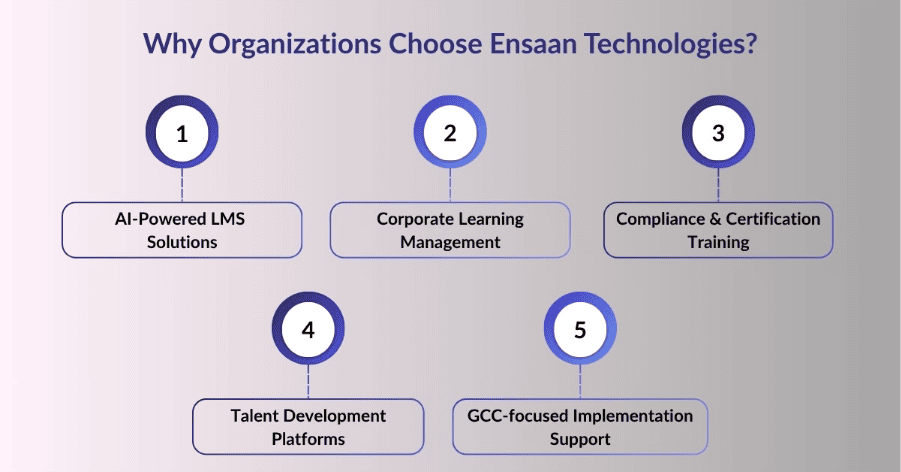
The most important thing to consider when deciding if your LMS implementation is successful is not the software itself. It’s the people who help you install it.
Ensaan Technologies is designed for this.
They operate in the UAE, Saudi Arabia, Qatar, Kuwait, Oman, and Bahrain and have almost 10 years of experience in the UAE.
This allows them to appreciate the compliance environment, the characteristics of multinational staff, and the business culture in the region that are very hard to replicate.
Their Implementation Services team follows a structured approach: assessing the existing technology environment, confirming business and technical needs, and creating a deployment blueprint aligned with your timeline.
It is built around how GCC organizations actually operate, not a generic methodology repackaged for the region.
This also extends beyond go-live. Ensaan’s Support Services keep your system healthy after launch, ensuring your team always has someone who knows your configuration when questions or issues arise.
Ensaan’s Digital Transformation consulting service can integrate your LMS with your organization’s broader technology vision, rather than treating it as an individual tool.
6) Plan Adoption Before You Go Live
The adoption of technology in the GCC is unique. You may have frontline workers accessing training on a mobile phone in shared accommodation alongside office-based professionals, and everything in between.
The adoption planning process should begin while implementing, not after go-live. Here are a couple of strategies that work well:
Communicate early in multiple languages: If a large portion of your employees are native speakers of Arabic, Urdu, Hindi, or Tagalog, the information you share internally about the new system must be communicated in their native tongue.
Assign learning champions in each department: In GCC organizations, where personal credibility drives adoption, having respected colleagues champion the system is worth more than any corporate email.
Make early wins visible: Gamification features inside platforms like Cornerstone, including leaderboards, badges, and completion milestones, create the kind of social proof that gets people engaged.
Ensaan’s Gamified LMS options take this further for organizations that want to build learning into a genuinely compelling daily habit.
Connect learning to performance. When employees see that what they complete in the LMS directly connects to their performance reviews and career development, participation follows naturally.
This is where connecting your LMS with a Performance Management System creates a much stronger story for employees.
7) Measure, Report, and Improve Continuously
Implementing is not the end of the road. It’s the beginning.
Organizations that utilize their LMS the most in Dubai and the GCC region are those that view learning data as a business asset.
A real-time reporting and analytics dashboard will provide Cornerstone with real-time visibility into completion rates, skill development trends, compliance status, and learning ROI across your entire workforce.
For L&D leaders building an internal business case, real LMS examples from enterprise organizations are worth a look.
Your learning strategy must evolve as your workforce and business evolve.
Skills and AI features in Cornerstone can predict skill gaps before they manifest as performance issues and automatically suggest appropriate learning for each employee based on their role and growth.
This is what separates organizations that get a reasonable return from their LMS from those that genuinely transform how their people grow.
The LMS Products Offered by Ensaan Technologies
Here’s a brief overview of what Ensaan Technologies has to offer for those organizations that are ready to take the next step in learning solutions:
Cornerstone LMS is the flagship platform for organizations wanting AI-powered, compliance-ready, globally scalable learning in English, Arabic, and 50+ languages. It is the global number one for a reason.
Saba LMS is an enterprise cloud-based solution designed for rapid deployment and highly configurable for public sector and government organizations in the GCC region.
When combined with Cornerstone, EdCast LXP Platform empowers a robust ecosystem of AI-powered content discovery, social learning, and skills-based experiences.
Gamified Authoring and Microlearning tools let your content team build engaging, bite-sized learning experiences without needing a full production setup.
Learning Content via Cornerstone Content Anytime gives you access to thousands of courses across business skills, compliance, technical training, and leadership from world-leading providers.
Ready to Get Started with LMS Implementation for Your Organization?
The first step to an LMS implementation in Dubai, UAE, or anywhere in the GCC is a conversation with somebody who has done it numerous times before in your exact area. Talk to an Ensaan LMS Expert Today
Visit the Ensaan blog for further practical tips on learning, performance management, and HR transformation in the GCC region.
If you specifically want to look into the options available in Qatar, the article on top LMS platforms for corporate training would be a great read.
Frequently Asked Questions About LMS Implementation in Dubai and the GCC
1) What is the typical timeframe for organizations to implement an LMS in Dubai?
The go-live process typically takes 8-16 weeks from the contract signing, contingent on data complexity and integration needs for most mid-sized organizations in the UAE.
2) Does the LMS support Arabic and comply with UAE labor regulations?
Yes. Cornerstone LMS is available in Arabic, offers 50+ languages, and supports compliance tracking in accordance with regional regulatory requirements.
3) How is an LMS different from an LXP for GCC organizations?
An LMS handles and monitors formal training and compliance, whereas an LXP, such as EdCast, focuses on personalized, self-directed learning with AI-powered and social content discovery.
4) Can the LMS work on mobile for frontline workers in sectors like construction or hospitality?
Absolutely. Cornerstone’s mobile app works offline, making it fully accessible for field-based or frontline workers who may not always have reliable internet access.
5) Is there a way to load historical training records from our old system into the new LMS?
Yes. The Ensaan implementation team performs data migration during deployment, cleaning up old training records and mapping them to your new system architecture.