
If you work with a team in Dubai, Abu Dhabi, or anywhere else in the UAE, you know end-of-service benefits aren’t optional paperwork.
They are legally mandated, and getting the calculation wrong, even by a small margin, can turn into a labour complaint, a delayed settlement, or an unhappy employee walking out the door with a bad final impression of your company.
This shows that workplace savings are becoming an important part of HR and payroll.
This guide explains how UAE end-of-service benefits work today, how the UAE’s DEWS (Dubai End of Service) evolved, and how GCC employers maintain consistency in end-of-service benefits without wasting hours on spreadsheets.
Table of contents
- What Are UAE End-of-Service Benefits?
- Who is Eligible for End-of-service Benefits in the UAE?
- How is Gratuity Calculated Under UAE Labour Law?
- DEWS: How Dubai’s Funded Savings Plan Changes the Rules
- Gratuity or DEWS: What Applies to Your Business?
- Where Employers Get End of Service Benefits Wrong
- Managing End of Service Benefits with the Right Payroll Software
- Ensaan Technologies: A Payroll Partner Designed for the GCC
- Frequently Asked Questions
- 1) Is every employee in the UAE entitled to end-of-service benefits?
- 2) How is the UAE end-of-service gratuity calculated?
- 3) What is DEWS, and who does it apply to?
- 4) Does resigning reduce my gratuity in the UAE?
- 5) How long does an employer have to pay end of service benefits?
- 6) Are allowances included when calculating UAE end-of-service benefits?
- Ensuring that End-of-Service Benefits Are Right, Every Time in the UAE
What Are UAE End-of-Service Benefits?
In the UAE, end-of-service benefits, also known as UAE gratuity, are the benefits that an employer must provide an employee once their contract ends, whether through resignation, termination, or contract completion.
The current rules are under Federal Decree Law No. 33 of 2021, which replaced the older labour law and removed the earlier distinction between limited and unlimited contracts.
This payout applies to every full-time private-sector staff member who has worked for at least one year, and it is based solely on base salary, not the total monthly package.
That’s where many employers make mistakes. Housing allowance, transport allowance, and other allowances are not included.
If your payroll setup is mixing gross salary with basic salary for gratuity purposes, you are either overpaying or exposing the company to a future dispute.
Who is Eligible for End-of-service Benefits in the UAE?
Eligibility for end-of-service benefits in the UAE is fairly general, but with a few conditions that you should be aware of before you set your expectations with your team:
- The employee must have completed at least one full year of continuous service.
- The entitlement applies regardless of nationality, as long as the person is a private sector employee under a UAE contract.
- Government employees and UAE or GCC nationals covered under pension schemes such as GPSSA generally follow a different framework.
- Employees dismissed for gross misconduct under Article 44 may forfeit their gratuity entirely.
Since resignation no longer reduces the payout under the current law, employers can no longer rely on the old one-third or two-thirds deduction that used to apply to unlimited contracts.
This alone has changed how many finance teams budget for end of service liability.
How is Gratuity Calculated Under UAE Labour Law?
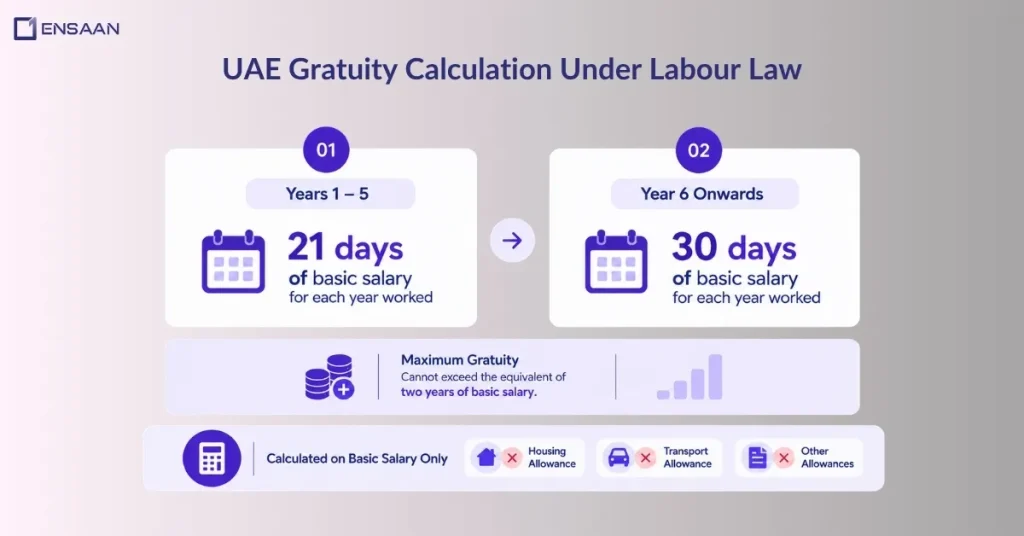
The formula isn’t complicated when broken into two layers. An employee earns 21 days of basic salary for each year of service for the first five years.
This increases to 30 days of basic salary for each year from year six onwards.
According to The National News, a worker earning a basic salary of AED 10,000 would earn a daily wage of about AED 333, meaning each year in that first bracket is worth roughly AED 7,000 in gratuity.
Here is a simple worked example. An employee with a basic salary of AED 6,000 who has worked seven years would receive 21 days pay for each of the first five years, then 30 days pay for each of the remaining two years, adding up to AED 33,000 in total.
You can also read this guide for detailed information on gratuity calculation in the UAE.
There is also a ceiling to remember: total gratuity cannot exceed the equivalent of two years of basic salary, no matter how long someone has been with the company.
Missing that window gives the employee grounds to file a complaint, which is a headache no HR team wants during an already busy exit process.
One more detail that trips up employers: settlement timing. MOHRE guidance, as reported by Gulf News, states that final dues, including gratuity, should be paid within 14 days of an employee’s last working day.
DEWS: How Dubai’s Funded Savings Plan Changes the Rules
The standard gratuity formula doesn’t apply to them if any part of your workforce sits inside the Dubai International Financial Center.
Rather, they’re part of DEWS, or DIFC Employee Workplace Savings.
DEWS was introduced in February 2020 and replaced the previous unfunded gratuity program with a funded, professionally managed savings plan.
DIFC-registered employers make monthly contributions, currently 5.83 percent of basic salary for employees with under five years of service and 8.33 percent after that, into a regulated trust.
According to Mercer, the shift was designed to bring end-of-service benefits in line with global retirement savings practices and to protect employees in case an employer runs into financial trouble.
DIFC’s own announcement confirmed that DEWS crossed USD 1 billion in assets under administration in October 2025, a sign that the model has real traction rather than being a niche compliance exercise.
Employers who prefer an alternative can apply through the DIFC Qualifying Schemes process, though DEWS remains the default option for most companies operating in the center.
Gratuity or DEWS: What Applies to Your Business?
It’s not about company size or industry, but about jurisdiction.
Mainland UAE companies, along with most free zones outside the DIFC, such as DMCC or JAFZA, follow the standard Federal Decree Law No. 33 of 2021 gratuity model unless they have separately adopted a qualifying scheme.
For eligible expatriate employees, however, DIFC-registered entities must use DEWS or an approved system. Many UAE and GCC nationals also generally do not sit in DEWS, since they already receive benefits from pension schemes.
This creates a genuine operational difficulty for companies active in Dubai, Qatar, and Saudi Arabia.
Each jurisdiction and free zone can carry its own end-of-service rules, and treating them as one uniform policy is a costly assumption.
This is exactly the kind of multi-entity complexity that pushes HR teams in the GCC toward a proper HR and payroll software setup rather than manual tracking in separate files.
Where Employers Get End of Service Benefits Wrong
Some common themes emerge from the UAE and GCC-wide payroll audits:
- Calculating gratuity on gross salary instead of basic salary.
- Missing the 14-day settlement deadline after an employee exits.
- Applying mainland gratuity rules to DIFC based staff who should be under DEWS.
- Forgetting to apply the two-year salary cap on long tenured employees.
- Restructuring salary packages to shrink the basic component and reduce liability, which MOHRE explicitly does not permit.
The majority of these are not intentional errors.
They occur because payroll teams are juggling multiple free zones, multiple contract types, and manual calculations at the same time, especially in fast-growing companies expanding across Dubai and neighboring markets like Qatar.
Managing End of Service Benefits with the Right Payroll Software
Here’s where the correct payroll software takes away the guesswork.
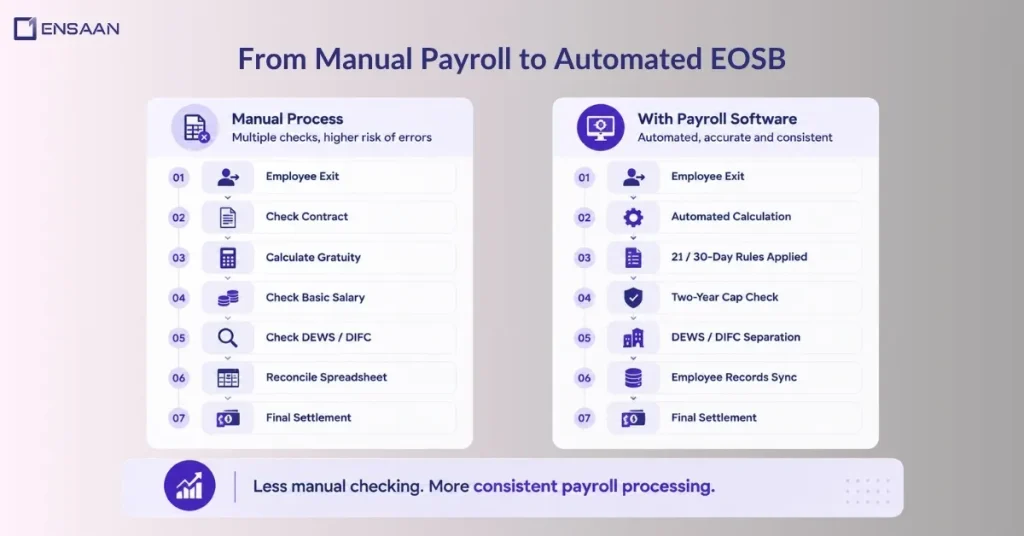
A payroll system that already understands the rules of end-of-service benefits in the UAE can automatically apply the 21- and 30-day formula and alert employees approaching the five-year milestone.
It also automatically applies the two-year cap and separates DIFC staff under DEWS from mainland employees under standard gratuity.
PeoplesHR Payroll was designed with this in mind, with compliance with GCC-specific needs.
It automates payroll calculations, real-time error detection, and provides self-service options for employees to check their accumulated benefits, which cuts down on the back-and-forth HR usually deals with near contract renewals or exits.
Because it sits within a wider Human Capital Management suite, gratuity and DEWS contribution data stay connected to attendance, compensation, and core HR records rather than living in a separate spreadsheet that someone has to manually reconcile.
If companies prefer to outsource the entire function, payroll outsourcing is also an option to consider, especially for smaller HR teams managing employees across more than one emirate or GCC country.
If you’re also looking at a wider compensation structure, it’s worth thinking about how compensation and benefits fit into the bigger picture, since end-of-service liability is really just one part of total reward planning.
Ensaan Technologies: A Payroll Partner Designed for the GCC
Ensaan Technologies is an implementation partner for HR and payroll technologies across the Middle East, which means the compliance layer built into its systems reflects region-specific rules rather than a generic global template.
That’s where regional expertise matters: UAE end-of-service benefits regulations can differ from those in Saudi Arabia or Qatar, and a platform not designed with GCC labour law in mind will require constant manual workarounds.
Companies already using PeoplesHR for core HR functions get gratuity and DEWS tracking as part of the same system, backed by implementation and support teams based in the region.
If you want a closer look at how other GCC businesses are approaching payroll technology, the blog on top payroll software for UAE enterprises and the separate guide to HR software choices in Qatar are both useful next reads.
Frequently Asked Questions
1) Is every employee in the UAE entitled to end-of-service benefits?
Most private sector employees who complete at least one year of continuous service qualify, though government staff and some nationals under pension schemes follow different rules.
2) How is the UAE end-of-service gratuity calculated?
For the first five years, it is 21 days of basic salary per year. After that, it is 30 days of basic salary per year, capped at two years’ total basic salary.
3) What is DEWS, and who does it apply to?
DEWS is a funded savings plan for DIFC-registered employers, replacing standard gratuity with monthly contributions into a regulated trust.
4) Does resigning reduce my gratuity in the UAE?
No, under the current labour law, resignation no longer triggers the old reduction that applied to unlimited contracts.
5) How long does an employer have to pay end of service benefits?
According to MOHRE guidance, the employer has 14 days from the employee’s last working day to settle all final dues.
6) Are allowances included when calculating UAE end-of-service benefits?
No, the calculation is based only on basic salary, excluding housing, transport, and other allowances.
Ensuring that End-of-Service Benefits Are Right, Every Time in the UAE
Once you know the rules, UAE end-of-service benefits aren’t that complicated, but they do demand consistency across every contract, every free zone, and every exit.
Whether your team falls under standard gratuity or DEWS, the safest approach is to build the calculation into your payroll system rather than recalculating it manually each time someone leaves.
If you would like to see how top payroll software in the UAE looks in practice, schedule an appointment, and the Ensaan team can walk you through it.