

Public holidays affect much more than just office calendars, especially for managers in Riyadh, Jeddah, Dammam, or elsewhere in Saudi Arabia.
They can affect payroll schedules, leave balances, work schedules, overtime calculations, customer support coverage, and monthly workforce schedules.
For HR teams, knowing the Saudi Arabia public holidays in 2027 in advance gives finance and operations more time to prepare.
The key is knowing which dates are statutory holidays, how many days employees are entitled to, and what happens when a holiday overlaps with weekly rest or annual leave.
This guide is aimed primarily at private-sector employers and refers to Saudi labour law and official government sources.
Table of contents
- What are the Saudi Arabia Public Holidays in 2027?
- When is Founding Day in Saudi Arabia in 2027?
- What are the Eid al-Fitr holiday dates in Saudi Arabia in 2027?
- When is Eid al-Adha in Saudi Arabia in 2027?
- When is Saudi National Day in 2027?
- What Happens When a Saudi Public Holiday Falls on a Weekly Rest Day?
- Do Employees Receive Overtime When They Work on a Public Holiday?
- Is Saudi Flag Day a Public Holiday in 2027?
- Are Ramadan and Other Islamic Occasions Public Holidays for Private-sector Employees?
- What Should Employers Do with the 2027 Holiday Calendar?
- How can Payroll Software Help Employers Manage Saudi Public Holidays?
- What About Banks and Financial Institutions in Saudi Arabia?
- How Can Ensaan Technologies Help GCC Employers Prepare for 2027?
- Frequently Asked Questions
- 1. How many public holidays are there in Saudi Arabia in 2027?
- 2. When is Saudi Founding Day in 2027?
- 3. When is Saudi National Day in 2027?
- 4. Are Eid holidays four days in Saudi Arabia?
- 5. What happens when a Saudi public holiday overlaps with a weekly rest day?
- 6. Is Saudi Flag Day a paid public holiday?
What are the Saudi Arabia Public Holidays in 2027?
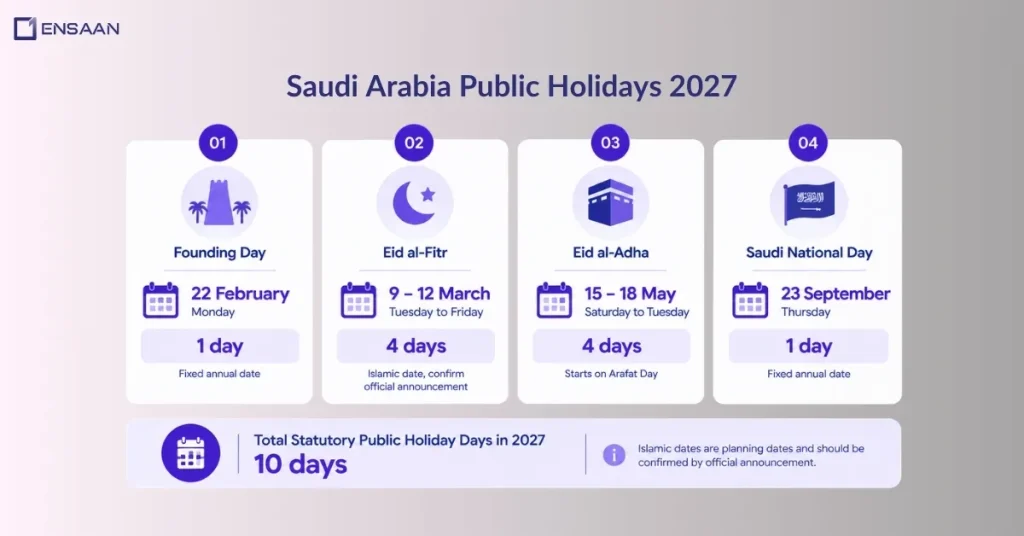
Under Saudi labour law, private sector employees are entitled to fully paid leave for Eid al Fitr, Eid al Adha, Saudi National Day, and Founding Day.
HRSD’s current guidance for employers states four days for Eid al-Fitr, four days for Eid al-Adha, one day for National Day and one day for Founding Day.
That means employers should plan for 10 statutory holiday days in 2027 before considering any additional compensation that may arise when holidays overlap with weekly rest days.
Disclaimer: Islamic holidays (Eid al-Fitr and Eid al-Adha) are based on lunar sightings and are subject to change.
| Holiday | 2027 planning date | Duration | Employer planning note |
| Founding Day | February 22, Monday | 1 day | Fixed annual date |
| Eid al Fitr | March 9 to March 12, Tuesday to Friday | 4 days | Islamic date, confirm official announcement |
| Eid al Adha | May 15 to May 18, Saturday to Tuesday | 4 days | Starts on Arafat Day |
| Saudi National Day | September 23, Thursday | 1 day | Fixed annual date |
The Islamic holiday dates above are planning dates and are based on calculations from the current Umm Al Qura calendar and current 2027 holiday references.
Employers should refer to the relevant Saudi authority announcement as they approach each holiday to confirm payroll calendars.
Current calendar references place Eid al Fitr around March 9 or March 10 and Eid al Adha around May 16, which is why HR should avoid treating projected Islamic dates as an irreversible payroll date too far in advance.
When is Founding Day in Saudi Arabia in 2027?
The Saudi Founding Day will be celebrated on Monday, 22 February 2027.
The date is fixed. A Royal Decree declared February 22 as Founding Day and made it an official holiday.
HRSD has also announced in its employer information that Founding Day is a one-day paid holiday for employees.
For employers, this is one of the easiest holidays to plan because the Gregorian date does not move.
Companies can add February 22 to their annual leave and payroll calendars well in advance.
What are the Eid al-Fitr holiday dates in Saudi Arabia in 2027?
Under Saudi labour law, all workers are entitled to 4 days of paid leave during Eid al-Fitr, which begins the day after the 29th day of Ramadan according to the Umm Al Qura calendar.
So, those four-day holidays, based on the current 2027 calendar, fall between March 9 and March 12.
HR teams should verify the exact dates before closing payroll for Ramadan and Eid, as these dates are tied to the Islamic calendar and are officially announced.
For employers, Eid al Fitr also falls during the Ramadan period, so workforce planning should account for both the holiday and Ramadan working arrangements. HR should not treat the start of Ramadan itself as an additional public holiday.
When is Eid al-Adha in Saudi Arabia in 2027?
Saudi labour regulations provide four paid days for Eid al-Adha, starting with the Day of Arafat.
Arafat Day falls on Saturday, 15th May, followed by Eid al Adha on May 16th in 2027, according to the current calendar.
The statutory 4-day holiday period is thus around May 15 to May 18. The independent calendar also has May 15 as Arafat Day and May 16 as Eid al-Adha.
This is an important date for HR because the first day falls on a Saturday in the projected calendar.
Where the holiday overlaps with an employee’s weekly rest day, the labour rules provide for compensatory time off before or after the holiday.
When is Saudi National Day in 2027?
Saudi National Day is celebrated on Thursday, September 23, 2027.
September 23 is Saudi National Day, commemorating the unification of the Kingdom, and HRSD guidance confirms it as a one-day paid holiday for private-sector employees.
Under the normal calendar, there is no weekend substitution issue in 2027 since September 23rd is a Thursday.
What Happens When a Saudi Public Holiday Falls on a Weekly Rest Day?
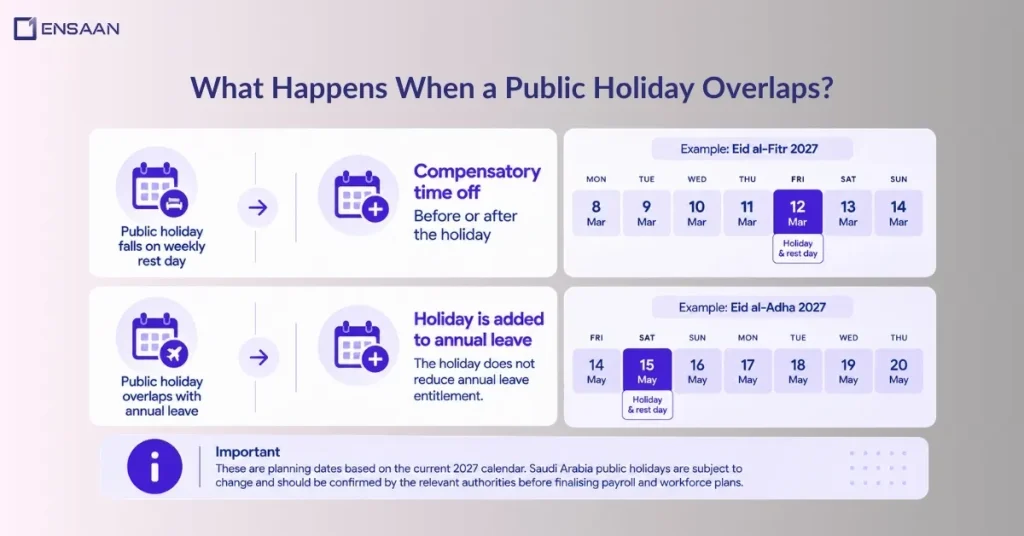
Friday is the standard weekly rest day for private-sector employees in Saudi Arabia, and many employers also observe Saturday, so holidays falling on either day can trigger compensatory time.
This is one of the details HR teams cannot afford to miss.
Saudi labour regulations state that if Eid or any official holiday falls on a weekly rest day, the worker must be given the same compensatory time before or after the holiday. In addition, official holidays that coincide with leave will also be added to annual leave.
This is important in 2027, as the Eid al Fitr holiday ends on a Friday (if Ramadan lasts 30 days), which is the standard weekly rest day, and the Eid al Adha holiday starts on a Saturday, which many employers also observe as a rest day.
The specific pay date may vary due to the company’s work schedule and weekly rest policies. HR should therefore avoid simply marking the statutory holiday dates as days off and closing the payroll calendar.
Do Employees Receive Overtime When They Work on a Public Holiday?
Yes. Under Saudi labour guidance, hours worked on official holidays are considered overtime. The Labour Law also provides overtime compensation based on the hourly wage plus 50 per cent of the basic wage, subject to the applicable rules.
For companies that operate continuously, such as healthcare, hospitality, logistics, security, retail, and some industrial businesses, this makes holiday scheduling especially important.
The HR team needs the right payroll software that integrates a holiday calendar with attendance and payroll, rather than simply keeping it in a separate calendar.
Is Saudi Flag Day a Public Holiday in 2027?
Saudi Flag Day on March 11 is an official national observance and not a paid public holiday for the private sector under Saudi labour regulations.
Saudi Arabia’s National Platform identifies March 11 as Flag Day, while the HRSD holiday guidance identifies Eid al Fitr, Eid al Adha, National Day, and Founding Day as the relevant official holidays for workers.
This distinction helps because employers may see the national days on public calendars and assume every occasion requires a company-wide paid day off.
Are Ramadan and Other Islamic Occasions Public Holidays for Private-sector Employees?
Not all religious and cultural days are additional paid public holidays.
This is because Ramadan is not an additional official holiday for private sector workers. Eid al Fitr marks the relevant statutory holiday period.
Similarly, religious events like the Islamic New Year and Saudi Flag Day should not automatically be added to the employer’s paid holiday calendar.
For payroll and scheduling, employers should work from the labour regulations rather than from general holiday calendars that may combine public holidays, observances, school breaks, and cultural occasions.
What Should Employers Do with the 2027 Holiday Calendar?
A useful HR process is to incorporate the calendar into the systems you utilise for attendance, leave, payroll, and workforce planning.
Confirm the legal entity and employee category.
- Add the fixed holidays, including February 22 and September 23.
- Add the projected Eid dates and mark them for confirmation.
- Check whether any holiday overlaps the company’s weekly rest pattern.
- Configure compensatory leave where the regulations require it.
- Update leave calendars and employee self-service systems.
- Check payroll rules for employees working during public holidays.
- Review staffing requirements before each extended holiday period.
- Communicate confirmed dates to employees before the holiday.
- Keep the final government announcement or supporting record with the payroll calendar.
For companies already managing multiple locations or large workforces, these steps become difficult when attendance, leave, employee data, and payroll are maintained in separate spreadsheets.
Ensaan’s blog on Digital HR transformation resources for Saudi businesses discusses how automation can connect payroll, compliance, employee data, and workforce processes in the Saudi market.
How can Payroll Software Help Employers Manage Saudi Public Holidays?
A holiday calendar has little value when payroll cannot use it.
Holiday calendars can integrate with an employee’s attendance, leave applications, payroll, overtime, and employee records in a modern HR and payroll system.
That means HR does not have to update several separate files whenever a holiday date changes.
Ensaan Technologies implements PeoplesHR and Adrenalin, which connect payroll, attendance and leave, employee records, and statutory settings in one system.
That means the approved holiday calendar, leave balances, and payroll impact can be managed together instead of across separate files.
The platform also supports statutory requirements across multiple countries, which is relevant for GCC businesses managing employees in more than one market.
Ensaan’s guide to payroll software for Saudi businesses explains the importance of local requirements such as WPS, GOSI, salary calculations, deductions, and connected HR data.
The practical benefit is not simply automation. It is having one place where HR can see the holiday calendar, employee leave, attendance information, and payroll impact.
What About Banks and Financial Institutions in Saudi Arabia?
Banks and other financial institutions should not rely solely on the general private-sector holiday calendar.
The Saudi Central Bank publishes its own official holidays for financial institutions.
For 2027, SAMA currently lists a financial institution Eid al Fitr holiday from March 7 to March 11 and an Eid al Adha holiday from May 16 to May 20.
These dates differ from the private-sector calendar, so banks and other regulated financial firms should follow the SAMA schedule instead of assuming everyone closes on the same days
HR and finance teams working in banking should therefore maintain the SAMA calendar alongside the broader labour holiday rules.
How Can Ensaan Technologies Help GCC Employers Prepare for 2027?
If the company operates in Saudi Arabia and the UAE, as well as Qatar, Bahrain, Oman, and Kuwait, holiday planning becomes more complicated.
These dates may differ, as may labour rules, and payroll teams may require a different calendar for each legal entity.
Ensaan Technologies operates in the GCC and supports organisations with HR technology, implementation, and digital transformation.
For organisations looking beyond basic payroll processing, digital transformation services include HR process assessment, technology planning, process standardisation, automation, and implementation support.
This can help a business if it wants its holiday calendar, leave process, payroll, and employee records to work together rather than in isolation.
The best place to start for a company planning its workforce calendar for 2027 is obvious: confirm the rules on legal holidays, pinpoint which ones are yet to be finalised, and ensure the approved calendar flows directly into leave and payroll.
Talk to Ensaan Technologies about an HR and payroll setup that suits your company’s needs and requirements.
Frequently Asked Questions
1. How many public holidays are there in Saudi Arabia in 2027?
Private sector employees are entitled to four days for Eid al Fitr, four days for Eid al Adha, one day for Founding Day, and one day for National Day, giving 10 statutory holiday days before compensatory rest is considered.
2. When is Saudi Founding Day in 2027?
Saudi Founding Day is on Monday, 22nd Feb. 2027, and is a 1-day official paid holiday for workers.
3. When is Saudi National Day in 2027?
Saudi National Day in 2027 falls on Thursday, September 23, and private-sector employees are granted a paid day off for this national holiday.
4. Are Eid holidays four days in Saudi Arabia?
Yes. Saudi labour laws provide four paid days for Eid al-Fitr and four paid days for Eid al-Adha.
5. What happens when a Saudi public holiday overlaps with a weekly rest day?
Employees receive equivalent compensatory time before or after the official holiday when the statutory holiday overlaps with a weekly rest day.
6. Is Saudi Flag Day a paid public holiday?
No. March 11 is Saudi Flag Day, but it is an observance rather than one of the statutory paid private-sector holidays listed by HRSD.