
Imagine a new employee’s first month at a rapidly expanding business. In 3 days, they complete the required onboarding modules, check off all the items on their compliance checklist, and that’s it.
They are not assigned to learn anything else, so they do not learn it.
Six months later, they still don’t know what skills they may have learned that could get them promoted, and their manager has little idea of what they have learned.
That’s where a Learning Experience Platform (LXP) comes in, filling these gaps.
Where a traditional LMS handles structured, mandatory training well, an LXP picks up right after that first checklist is done and keeps people learning, growing, and genuinely engaged for as long as they stay with you.
If your organization already has training in place but engagement keeps flattening out once the required courses are over, the use cases and benefits of LXP below will likely sound familiar, and so will the benefits that follow once you fix it.
What Exactly Does a Learning Experience Platform Do?
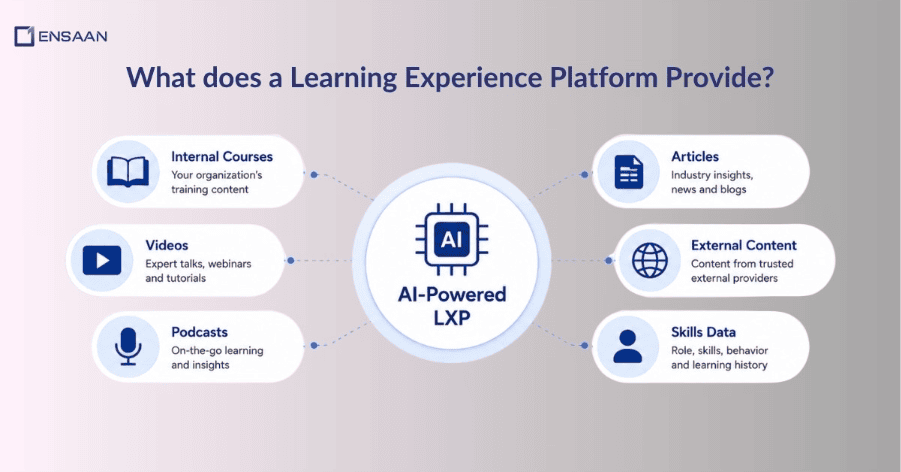
An LXP is placed on top of or alongside your current learning systems and aggregates all the content in your training, whether that’s internal courses, videos, articles, podcasts, or even content from external providers.
It then uses AI to suggest the next item the user should view, based on the user’s role, goals, and what similar users have found helpful.
An LMS is designed to assign and track the required courses.
An LXP is designed to inspire people to continue learning on their own. If you want to read the nitty-gritty details of what the two are and how they differ, check out the LXP vs. LMS comparison.
This blog focuses on what an LXP actually does once it’s integrated into an organization.
Why Are Organizations Adding LXP on Top of Their LMS?
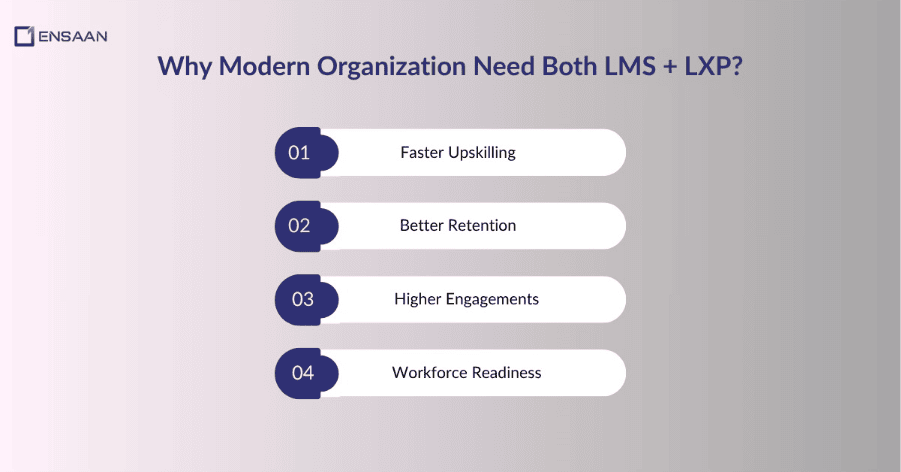
Three things are pushing this shift. Employees now expect the same personalized, on-demand experience at work that they get from any consumer app, and a static course catalog feels outdated by comparison.
Skills are also changing faster than job descriptions, so companies need a way to spot and close gaps continuously rather than once a year during appraisal season.
Hiring itself is shifting too, with more companies looking to build missing skills internally before searching outside, which only works if employees have somewhere to actually build them.
Retention has become a board-level concern. Internal mobility and visible career growth now rank among the top reasons people choose to stay rather than leave.
An LXP addresses all of this at once, which is exactly why the use cases below keep showing up across industries, from technology and finance to manufacturing and hospitality.
Understand Use Cases and Benefits of a Learning Experience Platform
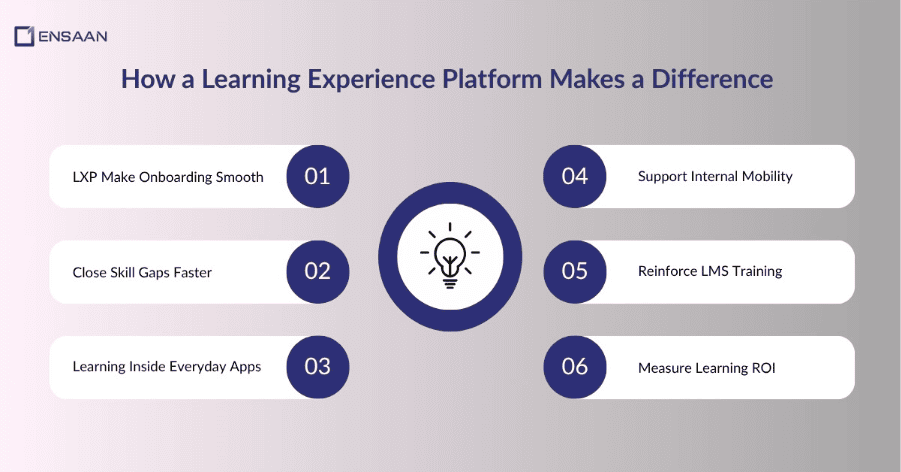
The seven scenarios below are encountered most frequently. Each relates to a business outcome, not just a feature.
1) LXP Make Onboarding Smooth
While the learning curve for a new hire continues, most onboarding concludes when required courses are checked off as completed.
Even after day one, EdCast continues to serve up relevant content in a single feed per individual, based on the individual’s role, through a combination of internal courses, videos, and articles.
Rather than a hard stop after orientation week, new employees are provided with a path that continues gradually through their first few months and often becomes more apparent later on, in the form of a quicker ramp-up time and fewer repeat questions being returned to overloaded managers.
2) LXP Help Close Skill Gaps Before They Become a Problem
Most HR teams can’t keep up with the changing requirements of the job.
EdCast’s SkillsDNA matrix matches existing skills to existing business skills to fill the resulting skills gap with content, all the while remaining in the background.
Instead of L&D guessing which courses to push out next, the system flags what is missing and routes people toward exactly that, which is the kind of proactive skill-building a static catalog alone was never built to deliver.
3) Employees Can Learn Without Leaving the Apps They Already Use
Asking them to log in to one more place is one of the quickest ways to kill employee engagement before it even begins.
By displaying learning recommendations in the communication and productivity apps teams use daily, EdCast can reduce the need for teams to seek out learning, rather than competing for their attention.
Once learning stops feeling like an added chore and becomes part of the workday, completion rates move in the right direction, as does genuine engagement.
4) LXP Support Internal Mobility and Reduce Attrition
Employees leave in increasing numbers because there is no clear path to success within the organization.
EdCast’s career mobility tools help people develop expertise and learn about internal opportunities, so that a nebulous career discussion becomes a tangible career trajectory.
Companies that use it regularly say they have better retention of their top talent because employees who know what they are doing in their company have a much lower chance of seeking jobs elsewhere.
5) LXP Reinforce the Training You Already Run Through Your LMS
An LXP is not a substitute for structured, formal training. It is in addition to it.
After an onboarding course is completed in your learning management system, EdCast keeps the topic fresh with short follow-up content and related information a month after the training ends, so the training doesn’t just fade from your mind.
These two systems complement each other better than either one running alone, especially in industries where retention of compliance knowledge genuinely matters.
6) Leaders Get Real Visibility into Learning ROI
Numbers of course completions only provide little insight to leadership about the impact on learning.
EdCast’s analytics combine learning, skilling, and career development activity in a single dashboard, providing HR, L&D, and frontline managers with a single view of what’s working and what employees are ignoring.
That shift, from tracking attendance to tracking actual impact, is usually what finally gets learning taken seriously in the boardroom rather than treated as a line item to justify every year.
7) LXP Help Diverse, Multi-Brand Organizations Unify Learning
It is common for large organizations with multiple business lines to end up with a number of disjointed learning tools, one for each business unit.
Mahindra Group, a federation of companies across diverse industries such as manufacturing, hospitality, and more, faced the same issue and turned to a unified LXP to bring its diverse, global workforce onto a single experience-centric interface.
This made for a unified learning space, rather than a patchwork that no one could fully rely on.
The Real Benefits of Investing in a Learning Experience Platform
The list of benefits comes down to a handful of outcomes worth paying for.
- Higher engagement, because people will watch content that they choose rather than content that is forced on them.
- Faster skill building, as gaps are identified and addressed on an ongoing basis.
- Stronger retention: A visible career path gives high performers a clear reason to stay.
- Less administrative load on L&D, as AI does the content curation for them instead of them doing it manually.
- Better visibility for leadership, as reporting now provides skilling data rather than just completion count.
- A genuinely better day-to-day experience for employees, which in itself tends to improve the morale of the employees towards you.
Interested in how this will play out in your own company? Booking a short EdCast demo with Ensaan Technologies team is the fastest way to find out.
Why Do Organizations Choose EdCast with the Help of Ensaan Technologies?
All the features above are exactly what EdCast, the Learning Experience Platform Ensaan Technologies implements and supports, is designed to provide.
EdCast already provides learning for well-known global organizations like teams at Salesforce, Dell, Accenture, and Novartis, and has been named a World Economic Forum Technology Pioneer, which is not a small claim for a learning platform.
Implementation and support specific to the region are what Ensaan Technologies brings to the platform.
The team delivers a structured, data-driven rollout through implementation services, and ongoing support services include bilingual support (English, Arabic), which can be important when rolling out a learning experience across a workforce that doesn’t necessarily share a first language.
When organizations already have Cornerstone LMS or wish to take it one step further with AI-enabled skill mapping, EdCast becomes the experience layer on top, creating a unified learning, skilling, and career growth solution.
If you are still comparing options, you can take a closer look at what an LXP actually is and how to choose the right one before committing to a platform.
Does Your Organization Need a Learning Experience Platform?
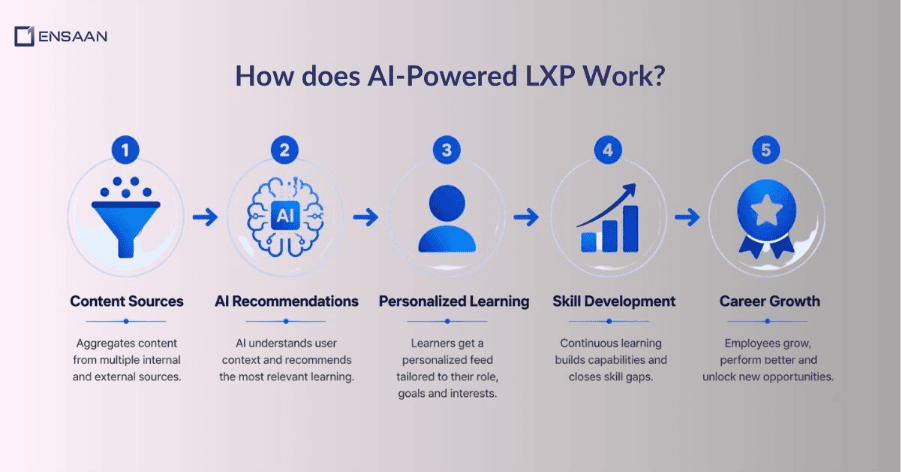
An LXP won’t fix a learning program that lacks structure, but for organizations with the fundamentals in place and that want employees to continue learning, it tends to be the single highest-leverage addition you can make.
All the above use cases and benefits of LXP are not theoretical.
They happen once EdCast goes live within an actual organization, from quicker onboarding to leaders finally being able to see what the training investment is achieving.
Book a free EdCast demo with Ensaan’s learning technology team, or get in touch to talk through whether an LXP, an LMS, or both together makes sense for where your organization is right now.
Frequently Asked Questions About Learning Experience Platforms
1) What is the difference between an LXP and an LMS?
An LMS will handle required, mandatory employee training and compliance, and an LXP will be used for personalized, self-directed learning, ensuring employees remain engaged beyond the completion of this required training.
2) Does a Learning Experience Platform replace the need for an LMS?
No, and it’s not intended to. The LMS will continue to manage compliance tracking, certifications, and required training. It works together with an LXP.
3) How long does it take to see results after rolling out an LXP?
Engagement signals occur early in the game, typically within the first two months, such as content consumption and active usage.
Changes in skill acquisition and retention are usually more gradual and will take closer to two or three quarters.
4) Can a Learning Experience Platform work for a small or mid-sized company?
Yes. At virtually any scale, the core value- personalized content and ongoing skill development is significant.
5) Does EdCast integrate with Cornerstone LMS and other HR systems?
Yes. EdCast is built by Cornerstone and connects directly to Cornerstone LMS and a wider range of HR and productivity tools, so learning, skilling, and career data stay in sync rather than living in separate systems.