

Nowadays, every platform claims to be AI-powered, but only a few can integrate AI to meet the organization’s real needs in the GCC.
The Gulf region has the most LMS vendors knocking on HRs’ doors compared to other regional markets today, and most pitches sound the same.
But the actual question for an HR director in Dubai, a training manager in Doha, or an L&D lead managing several branches in the UAE and Saudi Arabia is simple.
Which of these are the things that really make a difference to the Gulf workforce, and which are the ones that only look good on the presentation?
Whether you are an insurance company with strict regulators, a tech company hiring across three countries, or a chain of hotel properties.
This blog includes the ultimate LMS checklist for every organization in the GCC. It’s a 20-point list that’s shaped by the real needs of organizations across the UAE, Qatar, Saudi Arabia, Kuwait, Oman, and Bahrain.
When you search for the best LMS in Dubai today, you’ll find that many of the search results are loaded with jargon such as scalable, intuitive, and AI-powered, and have little to no detail about what these terms mean in practice.
None of that says anything about a platform’s ability to support a workforce that includes staff whose first language is Hindi, Tagalog, or Arabic, or whether a platform could generate three years of training records when a regulator requests them.
This guide attempts to address questions that are generally left out of a sales deck.
Why Doesn’t a Generic LMS Checklist Work for GCC Organizations?
What works seamlessly in an office in London or Austin may not be as effective in the unique business environment of the Gulf.
Most of the organizations here are composed of nationals and a substantial number of the workforce whose first languages differ.
Many of them have several offices across different emirates or even in several countries in the GCC, with each office under the control of a different branch manager and sometimes even a different local regulator.
This is why regulators in banking, insurance, and health care require training records to be maintained in a manner that will withstand an audit, rather than in a spreadsheet updated every three months.
A large portion of the workforce includes those in the hotel industry, retail, or as field engineers.
In addition, there’s the talent development drive underway region wide.
In the UAE, Saudi Arabia, and Qatar, national workforce development initiatives are driving greater company commitment to invest in formal upskilling rather than compliance box-ticking.
It is this change that is driving many HR teams to look for an LMS solution for the GCC, rather than simply any e-learning solution included in their payroll solution.
None of that is unusual. It is simply the everyday operating context of a learning management system built for the GCC, and it is exactly why the ultimate LMS checklist leans as heavily on compliance, mobility, and language as it does on flashy AI.
Related topic: How Enterprise LMS platforms Elevate Employee Learning?
What Does AI-Powered Actually Mean in a Learning Management System?
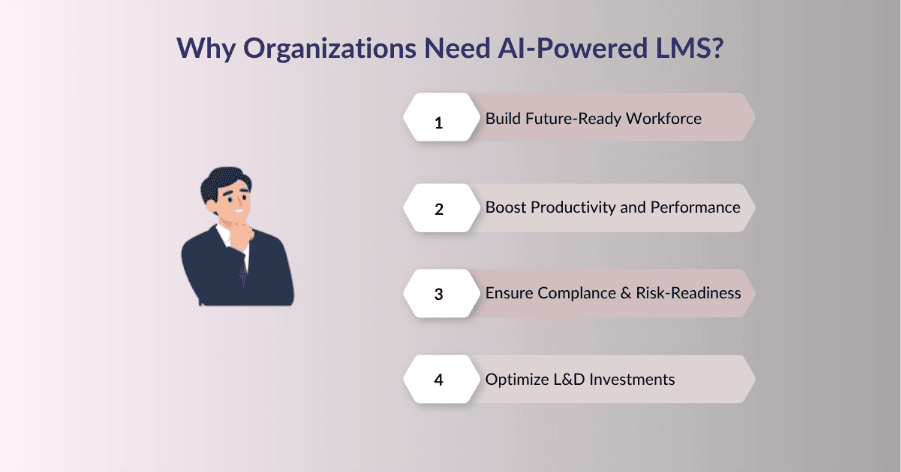
It’s important to distinguish between actual AI capabilities and marketing jargon before creating a checklist.
A truly AI-based LMS performs four things well:
- It recommends next steps in learning based on actual behavior and role
- It tags and organizes content for the administrator
- It adapts the path based on changing skills
- It can respond to simple questions with a chatbot rather than sending them to a human
What Are the 20 AI-Powered LMS Checklist Items Every GCC Organization Should Check?
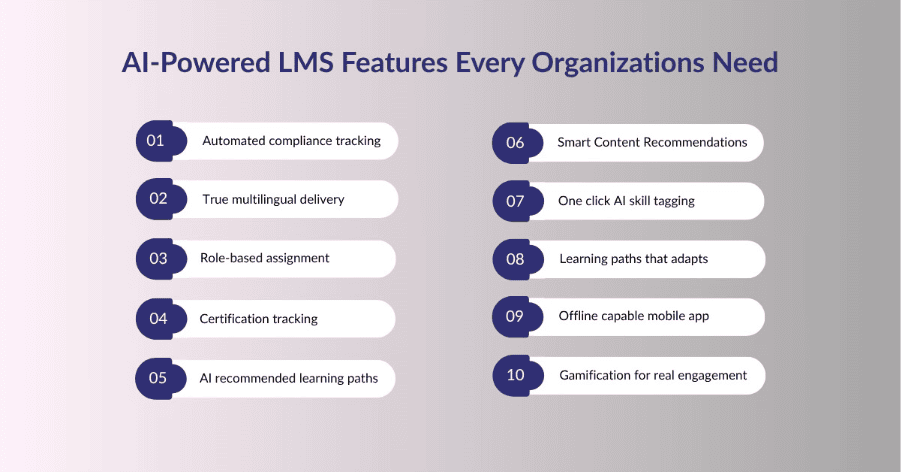
1. Automated compliance tracking with audit ready reporting
Your LMS should provide a neat, exportable history of who completed what training, when, and under which version policy, without anyone having to manually check spreadsheets before an audit.
2. True multilingual delivery
There is a requirement for course catalogs, certificates, notifications, and the mobile interface to function correctly in Arabic and English at a minimum.
Content delivery in over 50 languages is supported by Cornerstone LMS, which is important when your front desk and finance teams don’t share a first language.
3. Role, branch, and location-based assignment rules
A platform should automatically push mandatory training to an individual property, branch, or job role, rather than requiring it to be manually assigned to each employee who needs it.
4. Certification tracking with e-signatures and renewal reminders
Licenses expire, policies change, and someone must be notified 30 days before a certificate’s expiration, not 30 days after.
5. AI recommended learning paths
The system should recommend a next course to the person based on their role, skill gaps, and past learning behaviour, rather than providing a one-size-fits-all learning path.
6. Smart Content Recommendations
Just like a streaming service, related learning recommendations help employees continue to find relevant content without having to search through a catalogue.
7. One click AI skill tagging
Good platforms can automatically tag existing content with the relevant skills they build, saving learning teams from manually categorizing thousands of courses.
8. Learning paths that adapt to the learner
As a person completes courses and acquires new skills, the system should adapt its recommendations accordingly.
9. Offline capable mobile app
Field staff, hotel housekeeping teams, and warehouse staff don’t sit at a laptop for 8+ hours a day.
The right LMS mobile app enables users to download content and finish it without a constant Internet connection, then sync their progress when they reconnect to the Internet.
10. Gamification that drives real engagement
When done well, points, badges, and friendly competition between branches or teams can positively impact completion rates.
Applications based on it, such as gamified microlearning apps, report engagement that is close to nine times higher than standard course libraries.
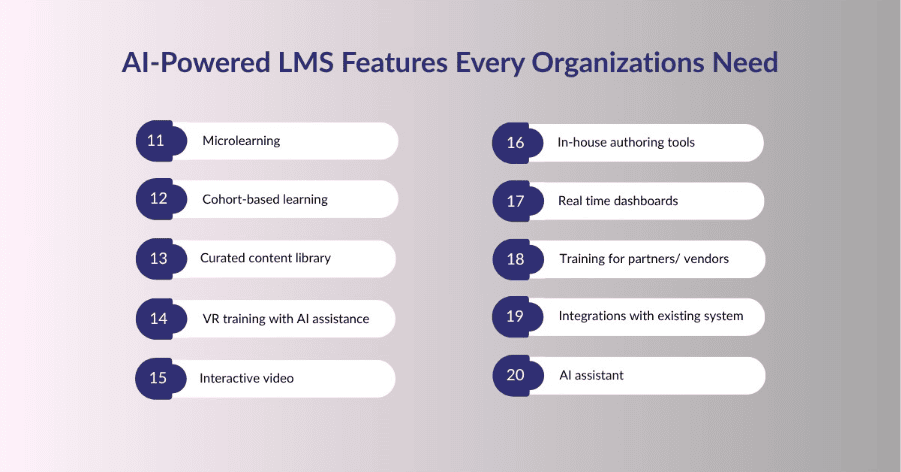
11. Microlearning and knowledge battles
Five-minute lessons and peer-to-peer quiz challenges are a perfect fit for a busy shift, rather than a ninety-minute compliance video.
12. Social and cohort-based learning
Discussion groups, shared playlists, and instructor-led virtual classrooms keep remote or shift-based teams connected to a learning community rather than isolated learning.
13. Curated global content library
Instead of creating all your courses from the ground up, the best LMS works with trusted content providers to ensure that your team always has new and verified content available to hand out.
14. VR training with AI assistance
In high-risk roles, role-play scenarios with real-time feedback via a VR headset or desktop simulation provide confidence that a slideshow can’t.
15. Interactive video with embedded questions
It is important that learners can pause, ask a question, and observe how the teacher and other learners respond, so that it feels more like a real conversation than a video.
Content should be easily created and modified by your own team, without waiting for a vendor or outside agency for every small change.
17. Real time dashboards and analytics
Leadership should be able to view completion rates, skills gaps, and compliance status at a glance, and filtered by department, branch, and country.
18. Training for partners and vendor
Full-time employees aren’t the only ones who require compliance training.
Insurance agents, hotel franchise staff, and supply chain partners may also need it. A robust LMS goes beyond your payroll training.
19. Deep integrations with your existing HR and business stack
You may have core HR and payroll software, Salesforce, Microsoft Teams, or Workday, but your LMS should not be an island of data that needs to be manually synced.
A built-in chatbot that can answer questions, such as when a certification expires or which course a person requires for a new position, can save HR teams a ton of time.
This is one feature that eliminates a lot of friction from day-to-day HR processes, by using platforms like Kore.ai .
AI-Powered Learning Management System Available in the GCC
You don’t have to create everything from scratch. Ensaan Technologies combines some of the world’s most successful learning platforms, all tailored to meet organizational needs.
1) Cornerstone LMS
Cornerstone LMS is used by more than 7,000 customers and 125 million users worldwide.
It integrates AI-based learning with VR training support through its Immerse AI Companion.
It automatically tags your library’s learning content with its Skills AI engine, keeping your library organized without manual involvement. It is also available in 50 languages, including Arabic.
2) Saba’s enterprise LMS
Saba’s business LMS is based on TIM, The Intelligent Mentor, a years-long developed AI recommendation engine.
It comes with 40 preloaded locales and is ideal for organizations that require skills management, virtual classrooms, and certifications in a single location.
3) EdCast Learning Experience Platform
The EdCast Learning Experience Platform combines learning, skilling, and career mobility into a single platform through its SkillsDNA architecture, which surfaces the relevant content to employees within their daily applications.
The Gamified Authoring Tool also allows instructional designers to develop gamified microlearning courses without coding, including SCORM- and xAPI-compliant courses, badges, leaderboards, and knowledge-gap follow-up.
For a team that learns best through microlearning between shifts, a gamified microlearning strategy can be complemented by a library of curated learning content, so teams aren’t limited to waiting for in-house content creation.
These, in combination, form part of greater learning and development solutions tailored for organizations throughout the Gulf.
Why Do GCC Organizations Prefer Ensaan Technologies for LMS Implementation?
Without someone to help you act on a checklist, it’s nothing more than a piece of paper.
Ensaan Technologies has been working closely within the UAE, Saudi Arabia, Qatar, Kuwait, Oman, and Bahrain for nearly 10 years.
The team is familiar with the compliance expectations in this region, the challenges of rollout in multiple languages, and deployments across multiple countries that only an overseas-based vendor would be.
The client portfolio spans hospitality, financial services, insurance, government, and healthcare organizations across the GCC, covering almost every regulated industry in the region.
It is their consultation that makes it different. Instead of being a reseller for a single platform.
Ensaan Technologies represents established LMS platform leaders, including Cornerstone, Saba, and Growth Engineering’s engagement-first, gamified platform.
This means the recommendation you receive is matched to your industry and team size, not to the product that pays the highest commission.
Insurers that must maintain a clear audit trail, the hospitality sector with geographically dispersed properties, and banks subject to high levels of regulatory scrutiny are each a perfect fit.
And consultative approach begins with understanding which of these is the right one for you.
This relationship isn’t just confined to the signing of the contract. Ensaan’s implementation services team manages a structured, data-driven go-live process, with support services, including bilingual assistance (English and Arabic).
If you’ve not yet made a direct comparison, you can read these detailed comparisons between Cornerstone vs TalentLMS or Cornerstone vs Workday, which are worth reading if you’re still in the research phase.
How Should You Use This LMS Checklist When Evaluating Vendors?
Using this list of points, give each vendor a score for each point, rather than relying solely on the demo.
Request a walkthrough in Arabic. Request a reference client that works in your industry in the GCC.
Ask where your data is hosted and how compliance reporting looks during a real audit.
If you want a deeper dive before that conversation, the LMS purchase checklist and LMS implementation checklist whitepapers go into greater detail on the evaluation and rollout stages.
If you are ready to see how this looks for your organization, book a personalized walkthrough with the Ensaan team or contact us directly to find out which platform best fits your compliance needs, workforce size, and budget.
Frequently Asked Questions
1) Can Small and mid-sized GCC businesses use Cornerstone LMS?
Yes. Cornerstone scales up from small teams to large organizations, depending on the organization’s budget and size.
2) Does an LMS in the GCC support Arabic?
This is not negotiable with most regulators or bilingual workforces, as they are expecting all Arabic content to be delivered.
3) How long does it take to implement an LMS?
A timeline depends on the organization’s size, but it usually takes a few weeks to a few months when the rollout is structured through a regional partner.
4) Is it possible to have compliance training for regulated industries tracked by an LMS?
Yes. Modern solutions provide automated compliance tracking, e-signatures, and audit trails tailored to regulated industries such as banking and healthcare.
5) How can AI-powered LMS platforms stand out from normal LMS platforms?
AI-powered systems create personalized learning paths, auto-tag skills, and forecast training needs, in contrast to manually configuring learning paths and static content.